We are excited to announce the creation of the inaugural Frontenac Biothon fundraising event! The Frontenac Biothon was developed to raise critical funds for our operations while simultaneously making a valuable contribution to science and conservation in the Frontenac Arch. Each year we will pick a location and a weekend in June to identify as many species of living things as possible in a 24-hour period. Each participating biologist will collect sponsorships and put their skills to the test during the biothon weekend. Our biologists will be identifying all plants, mammals, birds, amphibians, reptiles and insects encountered but will have a specific focus on rare species and designated Species at Risk. The information collected will be valuable to Frontenac Bird Studies as well as many other agencies including Ontario Parks, Canadian Wildlife Service and Ontario Ministry of Natural Resources.
This year’s biothon will take place at Frontenac Provincial Park on June 12-13. At over 5000 hectares, the park is far too large to be covered in 24 hours so we have selected a section containing mature forest, successional woodland and rock barren habitats. How many species can a group of six people identify in 24 hours: 300? 1000? This being our first year we aren’t so sure ourselves but we have embraced the challenge of finding 500 species during the biothon in 2010.
All of the biothon participants have begun researching natural history for the area, inspecting maps and reaching out to potential sponsors. It is sure to be a great event and we are looking forward to the weekend with great anticipation! Click here for more information on the Frontenac Biothon or to sponsor one of our biologists
Snow fell during the overnight in our region, which has cranked up the sparrow activity at bird feeders. Fortunately, seasonal temperatures are expected to return tomorrow – good timing for a field trip to Frontenac Park.
Yesterday I enjoyed another foray into the depths of Frontenac Provincial Park. I must have walked a good 4 kilometers or so in search of study sites for our growing MAPS network. I’ve started to learn that satellite and aerial photography is a useful tool but not a valid substitute for ground truthing. Yesterday, I was very lucky to find a good candidate study site by accident. The Compton Tortoiseshell pictured above was very shy and my persistence to ID the thing led me a ways off my intended track. I then noticed some intriguing habitat nearby and found what could be a new MAPS site for FBS!
Serviceberry blossoms
Serviceberry are blooming throughout the park. I am pretty sure this is Allegheny Serviceberry (Amelanchier laevis). They are the most eye catching plants out there right now but will soon fade into the background as their flowers drop and the other trees leaf out. Serviceberry are particularly common at the site found yesterday.
Upland hardwood forest
The site also has rich mature forest growing in steep valleys and upland slopes surrounding a small lake. Neither Rock Ridge (RRID) or Maplewood Bog (MABO) have this habitat, which makes this site particularly attractive. We know from last year’s surveys that Cerulean Warblers and Yellow-throated Vireos inhabit this forest around the lake. The problem with interior, mature forest like this is that the understorey is largely open and devoid of mistnetting opportunities. Fortunately, the mature forest surrounds a sizable area of regenerating woodland with lots of edges.
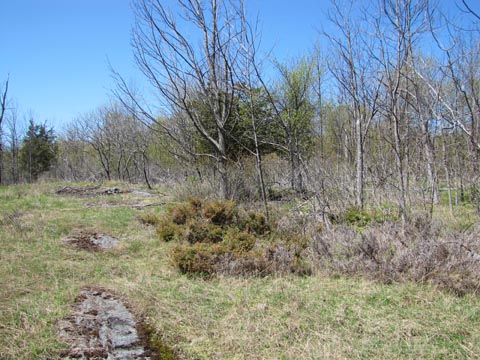
Thorn scrub
Here is a nice looking edge with thorn scrub, juniper and young trees. The combination of suitable edge habitat with mature forest is unique, which makes this a good candidate site for MAPS. One or two more visits to the area will be needed as I would like to see how it ‘greens’ out. It would also be helpful to learn a bit more about the bird community residing in the site before announcing any grand openings!
The search for new MAPS sites to join our existing Maplewood Bog and Rock Ridge stations has begun. The process is challenging, particularly here in the Frontenac Arch where ‘disturbed’ habitats with pronounced edges can be hard to find. The edges are important as this is where adults and young congregate during post-breeding dispersal, which is key to evaluating annual productivity. The heavily forested Frontenac region also tends to feature open understoreys with little shrub or sapling growth – not suitable for capturing birds using mistnets. Therefore the search feels something akin to looking for a needle in a haystack: a daunting job, to be sure, but not impossible. A needle we shall find!
Trout Lilly
Ontario Parks has been a tremendous supporter of FBS and have made a number of useful site suggestions for a second MAPS station within park boundaries. I will be checking out these various sites and will report on them as they are visited. I searched a good candidate site in a small portion of Frontenac Provincial Park today but unfortunately found nothing suitable for a MAPS site. Despite this I did have an incredible outing with some noteworthy discoveries.
Eastern White Pine
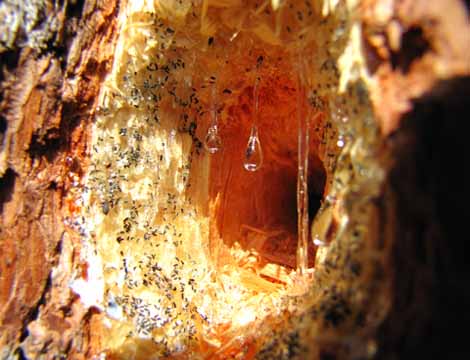
Today’s meander took me through a patch of mixed forest dominated by Eastern White Pine. Ruby-crowned Kinglets, Pine Warblers and Yellow-rumped Warblers were numerous in the canopy while newly arrived Eastern Towhees called from small rock outcrops. I came upon this excavation that was recently created by a Pileated Woodpecker, a common inhabitant of Frontenac Park. The sap was running quite thick and apparently attracted and drowned a considerable number of springtails along with a few other insects.
Woodpecker excavation
I spent an hour or two exploring the margins of many small/medium wetlands for good edge habitat but managed to find nothing of any use to a would-be bird bander. I did, however, find an impressive showing of early spring wildflowers such as Trout Lilly, trillium, hepatica, Bloodroot, Dutchman’s Breeches and Spring Beauties. After snapping a few photos, I decided to head for an area of mature forest en route back to the main road.
Red-shouldered Hawk nest
This is when things got interesting! This Red-shouldered Hawk nest was rather easily discovered in a mature Yellow Birch within a steep valley of mature hardwood forest. The adults were nearby and quite displeased with my presence! This is the first nest found by FBS in 2010, which is consistent in habitat and timing with the first nest of 2009 – a Red-shouldered Hawk nest on Canoe Lake Road. I quickly left the nest site to avoid unnecessary disturbance to the hawks, which seemed to be in the beginning stages of nest renovation.
There is a considerable amount of mature deciduous forest in Frontenac with some century old stands present. These forests are ideal for several species of conservation concern such as Cerulean Warbler and Red-shouldered Hawk. However, the ‘real’ biodiversity in these forests is exhibited by its plant and insect communities.
Woodland stream
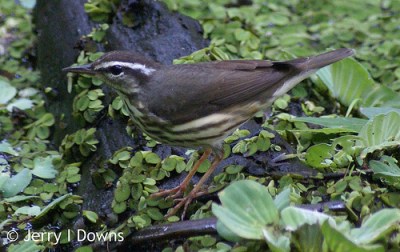
With forthcoming Louisiana Waterthrush surveys in mind, I ambled down the bank to check on the water level and flow of this stream that courses through the forest. This past winter was the driest in decades and the lack of spring rainfall has further compounded the dry conditions. The result is very low water levels and weak flow of many streams in the park. I am hoping that we will get some decent rain in the coming weeks as the current picture for breeding Louisianas is bleak. There will be more to follow on our efforts to inventory the park’s streams for Louisiana Waterthrush.
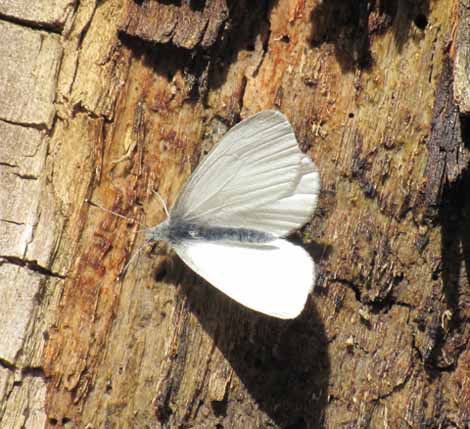
West Virginia White at rest (finally!)
The stream valley was hopping with early spring activity and the most apparent of the beasts were these ghostly-white butterflies, which I suspected might be West Virginia Whites (Pieris virginiensis), a species of Special Concern in Canada. An impressive number of these eye catching butterflies were observed fluttering about near the forest floor. This species is known to occur in Frontenac Park where suitable habitats are found. West Virginia Whites occur in mature moist deciduous forests in isolated pockets of southern and central Ontario. They are known to occur at about 50 sites in the province and were once classified as an Endangered Species (1977). The West Virginia White is one of the earliest butterflies to emerge in spring when the adults seek out emerging toothwort, which their larvae feed on exclusively. I will be watching closely for this species during all of the work in mature forest coming up in May.
West Virginia Whites
Often one finds the most interesting things when looking for something else. The search for new MAPS sites will continue……
Prairie Warbler by Tommy P (Creative Commons License)
drac
Year two of Frontenac Bird Studies is on!
drac
Our pilot field season of last year was an immensely rewarding and productive experience. Some highlights of the season included the documentation of over 100 records of Species at Risk, the installation of the first ever landbird demographic monitoring scheme for the region, the completion of over 200 point count surveys and the initiation of targeted studies for species of high conservation concern. Our experience made it clear that the Frontenac region is exceptionally diverse, rugged and deserving of attention. Migrants have begun trickling into the study area and we have already begun fieldwork for the 2010 season!
Rock barrens
drac
What’s New for 2010
After a fall season spent compiling, analyzing and disseminating our results, we began work on setting a course for the future of Frontenac Bird Studies. In 2010 we will bolster our roster of Monitoring Avian Productivity & Survivorship (MAPS) stations to provide greater geographical and species coverage, which will enhance analytical precision and scope of avian demographic patterns in the region. In May, we will conduct an inventory of Louisiana Waterthrushes in Frontenac Provincial Park. We will also be initiating a thorough exploration and study of breeding birds of the rock barrens. This fascinating disturbance dependent habitat, though difficult to access and traverse, is home to a considerable number of rare and/or heavily declining birds such as Common Nighthawk and Prairie Warbler. These projects will be our top priorities but we will also be nest monitoring, point counting and searching out habitats not explored in 2009.
Louisiana Waterthrush by Gerry Downs (Creative Commons License)
drac
Lending a hand
Frontenac Bird Studies is made possible through the support of our many volunteers, sponsors and private donors. Soon we will be announcing details of a new fundraising initiative for FBS. The fundraiser will directly support our operations and contribute to science and conservation at the same time! We hope that you will consider supporting FBS in 2010.
frontenacbirds.ca
All of our activities will be extensively detailed on our website and blog so keep checking the site for updates and feel free to leave your comments and feedback!
Funding Announcements
We are thrilled to announce that The John Hackney Foundation for the Noosphere has continued their funding support for 2010. We are honoured to have been selected as a funding recipient by Swish Maintenance Ltd., a devout corporate sponsor of Ontario Parks projects. A big thanks are due to JHF and Swish for their pledge to avian monitoring and conservation in the Frontenac Arch!
Wishing you a warm and lively spring!
Dan Derbyshire
Project Lead, Frontenac Bird Studies


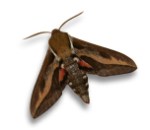 This year’s biothon will take place at Frontenac Provincial Park on June 12-13. At over 5000 hectares, the park is far too large to be covered in 24 hours so we have selected a section containing mature forest, successional woodland and rock barren habitats. How many species can a group of six people identify in 24 hours: 300? 1000? This being our first year we aren’t so sure ourselves but we have embraced the challenge of finding 500 species during the biothon in 2010.








 Frontenac Bird Studies