Frontenac Bird Studies – The 2010 Season

Prairie Warbler - Frontenac Prov. Park, June 2010.

.

Year two of our Frontenac Bird Studies program is now complete!

.
While our inaugural season in 2009 was chock-full of surveys, the 2010 season was all about Species at Risk. Weather during this year’s breeding season, like last year, was atypical, particularly in June with record high rainfall. We successfully completed another year of the Monitoring Avian Productivity and Survivorship Program (MAPS) and now have three stations sampling avian demographics for over 150 square kilometres of habitat in Frontenac County. Our results this year suggest that return rates and breeding success in the region was low, perhaps owing to the intemperate weather experienced during the last three breeding seasons. The MAPS season was not without its bright spots though as Pileated Woodpecker, Black-throated Blue Warbler, Chestnut-sided Warbler and Yellow-throated Vireo were added to the list of species being monitored by our growing MAPS network.

A primary objective for this year was to conduct inventories of two rare Ontario breeders – the Louisiana Waterthrush and Prairie Warbler. The Louisiana Waterthrush inventory began in late April and concluded in June. Sixteen streams and creeks were surveyed using an area search/playback method, which resulted in the identification of five breeding sites. Two of the sites were previously unknown, including an interior site in Frontenac Provincial Park where a nest with four eggs above a waterfall was discovered.

Once classified a Species at Risk, the Prairie Warbler was delisted in 2004 but remains one of the rarest breeding birds in Ontario and Canada. In contrast to the Louisiana Waterthrush, which occupies cool, shaded ravines in mature forest, the Prairie Warbler inhabits dry, barren habitat dominated by exposed rock, juniper and scrub. Building off our discovery of a few singing males along Slide Lake in 2009, we launched the first thorough inventory of Prairie Warblers in Frontenac Provincial Park this year. The effort was worthwhile as what is likely the largest colony outside of the Georgian Bay “core” population was found – a significant discovery. Between 20 and 30 singing males were found this summer along with four females and an exciting encounter of a pair feeding fledged young in late June.

We also conducted nest monitoring for all active nests encountered during the breeding season. Highlights of 2010 include the first documented breeding records of Ring-billed Gull and Herring Gull for Frontenac Provincial Park, the aforementioned Louisiana Waterthrush nest as well as records of Yellow-billed Cuckoo, Red-shouldered Hawk, Veery, Ovenbird, Yellow-throated Vireo and Chestnut-sided Warbler, to name a few.

In July five nature nuts got together to run our first ever Frontenac Biothon fundraiser. After gathering sponsorships our biothon team travelled to Frontenac Provincial Park with an aim to identify as many species of living things as possible in a 24-hour period. A total of 441 species were recorded. The highlight of the weekend was the discovery of a pair of Red-headed Woodpeckers occupying a flooded swamp near Devil Lake. This species, now classified as Threatened, has rapidly declined in Eastern Ontario and to my knowledge hasn’t been found in Frontenac Park in many years.

There were many other highlights of the field season, too many to list here. A detailed report will be written in the fall and all of our data will be disseminated to the appropriate agencies as soon as possible. Please feel free to contact us for further information.

The Frontenac Arch region continues to astound us with its biodiversity and its significance to Ontario’s vibrant bird populations. We hope that our work will improve the understanding of the region’s birds and bring some attention to its conservation.

Frontenac Bird Studies exists through the support of many individuals and organizations. A big thanks are due to the following for their contribution to FBS in 2010!

Funding

The John Hackney Foundation for the Noosphere
Swish Maintenance Limited

Volunteers and Sponsors

Pierre Robillard and Jan McDonald
Don Johnston
Andrew Jano
Ian Sturdee
David Mcintosh
Julia Marko Dunn
Christopher Dunn
Steve Gillis
Karina Dykstra
Seabrooke Leckie

MAPS Assistant

Seabrooke Leckie

Support

Peter Dawson
Ontario Parks

Corina Brdar
Ontario Parks

Chris Robinson
Ontario Parks

Bert Korporaal
Ontario Parks

Monique Charette
Ontario Ministry of Natural Resources

Peter Vass
Ontario Ministry of Natural Resources

-Dan Derbyshire, FBS Coordinator

Migration Research Foundation

2010 Frontenac Biothon Report

Eastern Forktail (Seabrooke Leckie)

Our first annual Frontenac Biothon was held this past weekend in Frontenac Provincial Park. The weather was excellent – clear skies and seasonal temperatures. We had originally planned the biothon to take place on June 10-11 but we had to postpone due to expected thunderstorms and heavy rain. The disadvantage of running it in mid-July was that the birds were MUCH harder to find. On the upside, plants and insects were far more diverse and abundant. Overall, the biothon went very well and all participants had an enjoyable time. Also, as this was our first biothon experience, we’ve learned a lot about what will and won’t work for future editions. We set a goal of identifying 500 species and came oh-so-close to that number, falling just short, with a total of 441! Despite missing our goal, a rather arbitrary figure, our results were fantastic and some truly wonderful species were recorded!

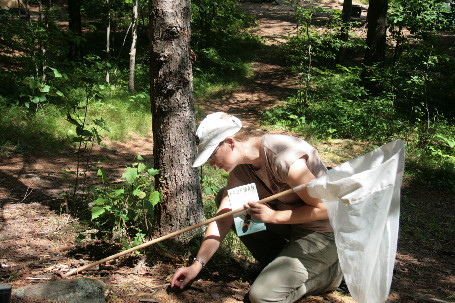
Seabrooke Leckie looking for bugs

The biothon “MVP award” has to go to both Seabrooke Leckie and Julia Marko Dunn who demonstrated superb knowledge of insects and plants respectively. Myself, Steve Gillis and Chris Dunn spent much of our time covering ground in search for elusive birds and ended the biothon with just 64 bird species – well short of what could have been found earlier in the season. However, we have experience outside of birds, as well, and managed to add bits and pieces to the throng of plants and bugs found by the girls.

Tents at Cluster 13

We camped at cluster 13 on Big Clear Lake, which was a good location for the biothon. This area of the park is known for its rugged topography – steep ridges along lakes dominated by Eastern White Pine. Of particular note at this site was the evening serenade provided by the Coyotes, two or three Whip-poor-wills and a couple of Common Nighthawks!

Red-headed Woodpecker habitat (Derbyshire)

A personal/FBS highlight was the discovery of a pair of Red-headed Woodpeckers observed in an open swamp near Hardwood Bay, Devil Lake, on Saturday afternoon! My records indicate that the last breeding record for the park dates from over ten years ago near Gibson’s Lake to the northwest. I’m not clear on the historical status of this species in the area but I do know that they have declined sharply in the Kingston region and the province as a whole. This was our first encounter with the Red-headed Woodpecker since the project began in 2009 and it was a thrill to observe these stunning birds sally for insects from the many snags in this swamp. I never would have seen these birds had it not been for Steve who found the swamp and called me over to investigate (thanks Steve!). I will have to go back to this swamp in 2011 to confirm nesting. The Red-headed Woodpecker is a provincial and federally listed Species at Risk with a designation of Threatened.

The woodpeckers were just one of many notable sightings from the weekend – too many to list here unfortunately. We visited lakes, fens, bogs, beaver ponds, deciduous and mixed forests and successional rock barrens in the 24 hour blitz. I’m sure that each participant would describe their biothons differently but it is safe to say that a lot of fun was had and that our stay was much too short!

On behalf of the Migration Research Foundation I wish to extend our grateful thanks to this year’s many sponsors and to Ontario Parks for their support of the biothon. And finally, the whole event would not have been possible without the efforts of our dedicated volunteer biothoners; Chris Dunn, Julia Marko Dunn, Karina Dykstra, Steve Gillis and Seabrooke Leckie (clap clap clap!)

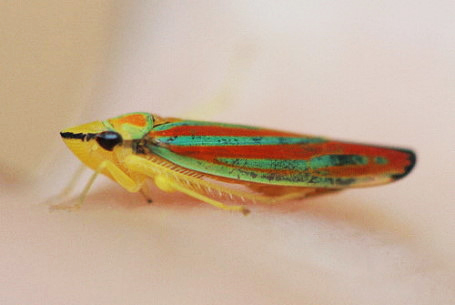
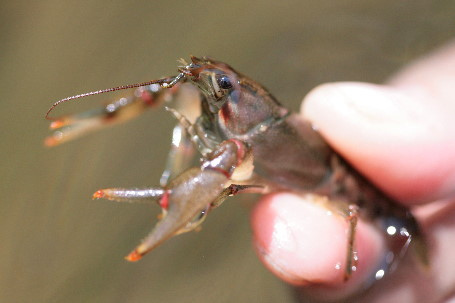
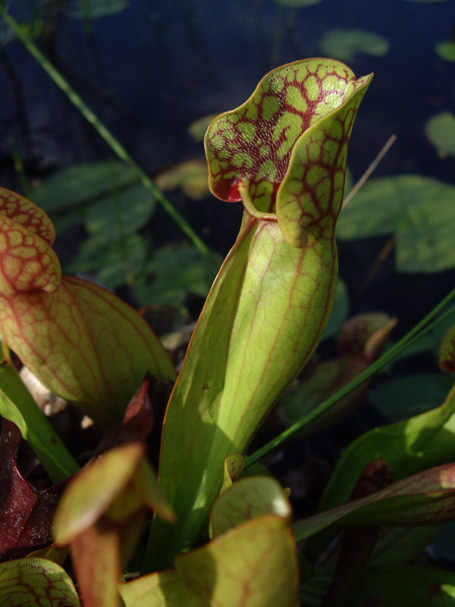
Below is a small selection of the species encountered during the 2010 Frontenac Biothon – hope you enjoy!

Graphocephala teliformis (Seabrooke Leckie)
Spatulate-leaved Sundew (Julia Marko Dunn)
Poison Sumac (Derbyshire)
Big Water Crayfish (Seabrooke Leckie)
Pitcher Plant (Julia Marko Dunn)
Swamp Milkweed Leaf Beetle

Frontenac Biothon this weekend!

Eastern Phoebe (Derbyshire)

At long last the biothon weekend has arrived and the weather looks absolutely fine! Our crew of six natural history buffs will be out searching for anything that lives for 24 hours in Frontenac Provincial Park. Our goal is to find 500 species and we are excited to give it our best shot. Thanks to all of our generous sponsors who have been wonderfully supportive of this fledgling initiative in 2010!

A detailed summary will be posted after the biothon so look for that early next week.

Wish us luck!

Dan Derbyshire
Seabrooke Leckie
Steve Gillis
Chris Dunn
Juiia Marko Dunn

Lizards in our midst

Five-lined Skink (Plestiodon fasciatus)

.

So strange to find a lizard in Ontario but they’re definitely here. Yesterday around noon, I found this adult male in a rocky outcrop laden with deadfall and thorn scrub. The Five-lined Skink is Ontario’s only native lizard species. They occur in two areas; the Carolinian region and along the Southern Shield ecotone. The two populations are genetically isolated and have differing habitat associations. The Southern Shield population favours rocky areas while the Carolinian version prefers sandy habitats. The Carolinian population, listed as Endangered, is small and restricted to just a few sites in southwestern Ontario. Five-lined Skinks of the shield are considered more numerous although relatively little is known about their ecology and abundance. The shield population is listed as a Species at Risk with a status of Special Concern. More information on this remarkable species can be found here.

.

.

Unlike this adult, the juvenile Five-lined Skink is quite colourful with its black body and bright azure blue tail. Click here for a photo of a younger individual. Apparently they lose their colour as they age. After first spotting this adult dart away I wondered if I might be lucky enough to get a photo. This little guy was fast and fidgety, making it difficult to get a view of more than just a tail tip or leg. I accumulated a large batch of poor photos before I opted to stand still and change some settings on my camera. The skink then proceeded to slowly amble over to check out my shoe!

.

.

the Nest Files – Red-winged Blackbird

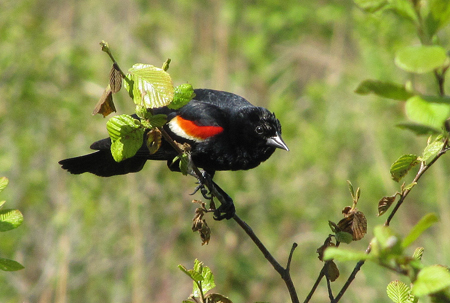
adult male Red-winged Blackbird (Derbyshire)

.

Red-winged Blackbird (Agelaius phoeniceus)

Nidiologicals – Peck and James (1987) and Yasukawa and Searcy (1995)

Habitat – Highly variable. Marshes, wetlands, fields, pastures and open woodlands.
Microhabitat – Nest usually woven into vertical shoots of a wide variety of substrates; commonly built within 1m of ground.
Spring arrival – March (Ontario)
Average nest height – .1m to 1.4m
Nest builder – female
Average # of broods/season – 1.7
Average egg laying date – 26 May-13 June (Ontario)
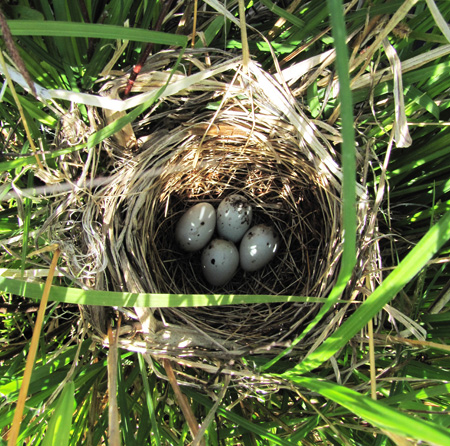
Average clutch size – 4 eggs
Incubation period – average 12.6 days
Egg colour – light blue-green or gray, marked with streaks, blotches and specks of black or brown. Markings are water soluble and fade during incubation (Nero 1984).
Incubation – female
Fledgling stage – young leave nest 10-12 days after hatching.
Parasitized by cowbirds – yes

.

Red-winged Blackbird nest contents

.

The Red-winged Blackbird is one of the most abundant and frequently studied bird species in North America. They are temperate migrants, returning to Ontario in early spring when males establish or reestablish territories in a wide variety of open habitats in upland and lowland environments. Red-wings breed across a vast range from boreal Alaska to Costa Rica. This range encompasses a considerable diversity of climatic and ecological conditions, which has certainly contributed to the total of twenty-six subspecies having been identified. Even more compelling is their complex social system. Up to fifteen females have been found to nest in the territory of a single male – making them one of the most highly polygynous of all bird species!

.

The nest pictured above was discovered in a medium sized palustrine marsh on Big Salmon Lake. The marsh was dominated by flooded grass and shrub growth as well as lesser quantities of cattail. Large numbers of Red-winged Blackbirds were present along with Swamp Sparrows, Yellow Warblers and Common Yellowthroats to name a few. The nest was located by accidentally flushing an incubating female. Given their abundant colonial populations, preference for open habitats and non-cryptic nature, it is not surprising that nests of this species are so frequently reported to nest record schemes. I was excited to find this one – a first for FBS. Red-winged Blackbirds can be found regularly in Frontenac Provincial Park but they occur in relatively small, isolated pockets where cattail and shrub cover is suitable.

.

Nest site

.

This last photo paints a picture of the nest site context (note the circled tuft of grass/shrub). The male held court over this section of the wetland while other occupied territories were being defended nearby. We don’t have waterbirds or wetlands as priorities for our studies at the moment but I expect we will turn our attention to these important areas in the future. Currently we are focused on species & habitats of conservation concern but we are fundamentally interested in keeping common birds common, such as the iconic spring harbinger – the Red-winged Blackbird.