Frontenac Bird Studies is a program of Migration Research Foundation – a non-profit organization dedicated to avian research and monitoring. Since its inception the FBS program has been successfully delivered through the annual support of environmental grant makers and private donors. The Frontenac Biothon was created as an event that would raise important funds for our work and make a beneficial contribution to science and conservation at the same time. Our inaugural biothon in 2010 was a great success as our three teams of nature nuts recorded 441 species, which included a pair of Red-headed Woodpeckers – a threatened species and only the second breeding record for Frontenac Provincial Park!
Mink Frog
This year our teams will have their sights on the 500 species barrier when we take to the woods and lakes on June 11-12, 2011. Our biologists will be identifying all plants, mammals, birds, amphibians, reptiles and insects encountered but will have a specific focus on rare species and designated Species at Risk. The Frontenac Arch is such a biodiverse region that we are guaranteed to have some exciting finds to share after the event!
.
How you can Help
.
While our biothon teams have all the fun battling bugs, swamps and steep terrain – it’s the sponsors that make the event happen! Frontenac Bird Studies is a program of the Migration Research Foundation – a registered charitable organization in the U.S and Canada. All sponsors receive a tax-creditable receipt for donations over $10. You can sponsor the Frontenac Biothon by mail (see below for details) or online through Paypal. 100% of donations will go directly to support FBS programs.
.
Sponsor a Frontenac Biothon Participant
Seabrooke Leckie & Dan Derbyshire
.
Julia Marko Dunn & Chris Dunn
.
Steve Gillis & Karina Dykstra
.
You can also sponsor the biothon by cheque through regular mail. Please complete the cheque to Migration Research Foundation. Simply include the name of the biothon participant you wish to sponsor on the memo line of the cheque and send the envelope to our address below.
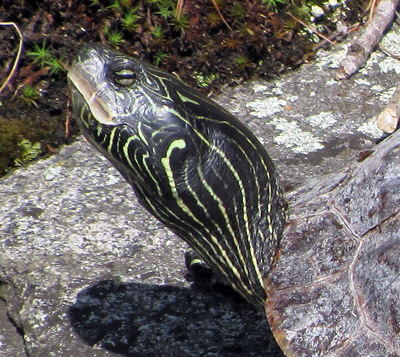
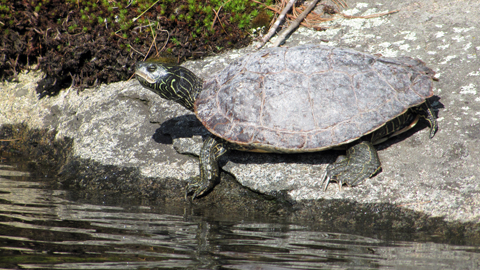
The Northern Map Turtle (Graptemys geographica) is a common inhabitant of medium to large lakes in Frontenac Provincial Park and is listed as a species of Special Concern by the Committee on the Status of Endangered Wildlife in Canada (COSEWIC). The Frontenac Arch region is also home to significant populations of Blanding’s Turtle (Emydoidea blandingii) and the Eastern Musk Turtle (Sternotherus odoratus), both of which are listed as Threatened species by COSEWIC.
Basking
The map turtles are easily the most frequently encountered turtle species during our fieldwork, followed by Blanding’s, Snapping and Painted. Unfortunately I have yet to encounter the Eastern Musk or “Stinkpot” Turtle in the park, which isn’t that surprising given their small size and strictly aquatic habits. Hopefully I’ll luck into one this summer. Click here for a very interesting account of this unique species by researchers at the Queen’s University Biological Station of nearby Opinicon Lake (~20km northeast of FPP office).
Despite lingering winter-like conditions our third season officially kicked off with an early Louisiana Waterthrush belting out its song from a creek near Canoe Lake Road on April 19, 2011 – a great start! Our first two years of Frontenac Bird Studies were very productive and we’re excited to begin our 3rd, which is shaping up to be our busiest field season so far.
The blueprints for 2011
In 2010 we launched inventories of two rare breeding warbler species within our core study area. We examined over twenty potential breeding sites for Louisiana Waterthrush last season, which produced several locations occupied by singing males, two previously unknown breeding sites and also a nest with four eggs in Frontenac Provincial Park. The results from 2010 have raised many more questions that compel us to investigate this species on an annual basis. This year we will increase our coverage by visiting previously unexplored habitat and also revisit occupied sites to bolster our data on productivity and fidelity. Perhaps the most exciting result of 2010 was our inventory of Prairie Warblers in the rock barrens of Frontenac Provincial Park. We have received word that the Frontenac colony is the largest away from the Georgian Bay core population. In 2011 we will be undertaking a detailed study of the Prairie Warblers in the park, which will involve extensive nest searching and colour banding to examine demography, ecology and stability of the population. In addition to these projects we will be operating our network of Monitoring Avian Productivity and Survivorship (MAPS) stations for a third consecutive year – Rock Ridge (RRID), Maplewood Bog (MABO) and Blue Lakes (BLAK). Lastly, as time permits we will be conducting area searches for Species at Risk and habitats that haven’t been adequately covered by our operations to date. In particular we will be looking for Red-headed Woodpecker (Threatened), Short-eared Owl (Threatened) and Golden-winged Warbler (Threatened) in Frontenac Provincial Park. It’s going to be a busy season for sure!
Frontenac Biothon 2011
Frontenac Bird Studies is made possible through the support of our many volunteers, sponsors and private donors. In July 2010 we held our first annual fundraiser, the Frontenac Biothon, which successfully raised funds for our work and also contributed to science and conservation at the same time. Over 400 species were documented and a pair of Red-headed Woodpeckers were discovered, a rapidly declining species and only the second breeding record for the park. This year our biothon team will be sifting through the flora and fauna of Frontenac Provincial Park for 24 hours on June 11-12.
Thanks to everyone who supported the biothon in 2010! We hope you will consider sponsoring one of our biothon participants this year. Please visit our biothon page for more information or to make a donation.
FBS on the Social Networks
As always, you can follow our progress throughout the spring/summer field season via our blog and twitter. You can now also find us on Facebook!
Sincerely,
Dan Derbyshire
Project Lead, Frontenac Bird Studies
Has it really been five months since our last update? While we’ve not done any work in-the-field (sadly) we have been active behind the scenes with data management, reporting, fundraising and planning. Funding permitting we are presently on course for another exciting season in 2011. Stay tuned for the reawakening of frontenacbirds.ca as the ice and snow gives way to early spring….
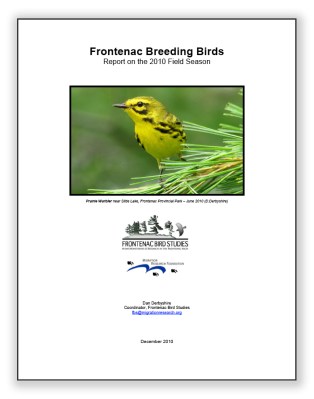
Prairie Warbler - Frontenac Prov. Park, June 2010.
.
Year two of our Frontenac Bird Studies program is now complete!
.
While our inaugural season in 2009 was chock-full of surveys, the 2010 season was all about Species at Risk. Weather during this year’s breeding season, like last year, was atypical, particularly in June with record high rainfall. We successfully completed another year of the Monitoring Avian Productivity and Survivorship Program (MAPS) and now have three stations sampling avian demographics for over 150 square kilometres of habitat in Frontenac County. Our results this year suggest that return rates and breeding success in the region was low, perhaps owing to the intemperate weather experienced during the last three breeding seasons. The MAPS season was not without its bright spots though as Pileated Woodpecker, Black-throated Blue Warbler, Chestnut-sided Warbler and Yellow-throated Vireo were added to the list of species being monitored by our growing MAPS network.
A primary objective for this year was to conduct inventories of two rare Ontario breeders – the Louisiana Waterthrush and Prairie Warbler. The Louisiana Waterthrush inventory began in late April and concluded in June. Sixteen streams and creeks were surveyed using an area search/playback method, which resulted in the identification of five breeding sites. Two of the sites were previously unknown, including an interior site in Frontenac Provincial Park where a nest with four eggs above a waterfall was discovered.
Once classified a Species at Risk, the Prairie Warbler was delisted in 2004 but remains one of the rarest breeding birds in Ontario and Canada. In contrast to the Louisiana Waterthrush, which occupies cool, shaded ravines in mature forest, the Prairie Warbler inhabits dry, barren habitat dominated by exposed rock, juniper and scrub. Building off our discovery of a few singing males along Slide Lake in 2009, we launched the first thorough inventory of Prairie Warblers in Frontenac Provincial Park this year. The effort was worthwhile as what is likely the largest colony outside of the Georgian Bay “core” population was found – a significant discovery. Between 20 and 30 singing males were found this summer along with four females and an exciting encounter of a pair feeding fledged young in late June.
We also conducted nest monitoring for all active nests encountered during the breeding season. Highlights of 2010 include the first documented breeding records of Ring-billed Gull and Herring Gull for Frontenac Provincial Park, the aforementioned Louisiana Waterthrush nest as well as records of Yellow-billed Cuckoo, Red-shouldered Hawk, Veery, Ovenbird, Yellow-throated Vireo and Chestnut-sided Warbler, to name a few.
In July five nature nuts got together to run our first ever Frontenac Biothon fundraiser. After gathering sponsorships our biothon team travelled to Frontenac Provincial Park with an aim to identify as many species of living things as possible in a 24-hour period. A total of 441 species were recorded. The highlight of the weekend was the discovery of a pair of Red-headed Woodpeckers occupying a flooded swamp near Devil Lake. This species, now classified as Threatened, has rapidly declined in Eastern Ontario and to my knowledge hasn’t been found in Frontenac Park in many years.
There were many other highlights of the field season, too many to list here. A detailed report will be written in the fall and all of our data will be disseminated to the appropriate agencies as soon as possible. Please feel free to contact us for further information.
The Frontenac Arch region continues to astound us with its biodiversity and its significance to Ontario’s vibrant bird populations. We hope that our work will improve the understanding of the region’s birds and bring some attention to its conservation.
Frontenac Bird Studies exists through the support of many individuals and organizations. A big thanks are due to the following for their contribution to FBS in 2010!
Pierre Robillard and Jan McDonald
Don Johnston
Andrew Jano
Ian Sturdee
David Mcintosh
Julia Marko Dunn
Christopher Dunn
Steve Gillis
Karina Dykstra
Seabrooke Leckie




 Has it really been five months since our last update? While we’ve not done any work in-the-field (sadly) we have been active behind the scenes with data management, reporting, fundraising and planning. Funding permitting we are presently on course for another exciting season in 2011. Stay tuned for the reawakening of frontenacbirds.ca as the ice and snow gives way to early spring….
 Frontenac Bird Studies