News and Articles

Whites, Ceruleans and Louisianas

.

West Virginia White (Pieris virginiensis)

Great to be back in Frontenac this week! My first memorable observation of the season was of two black bears encountered along Devil Lake Road on an early morning commute – interesting start. This week I began revisiting stream and swamp woodland sites for Louisiana Waterthrush (Parkesia motacilla). This will be our third and final season of inventory and monitoring for this species of concern. In spring 2010 and 2011 we emphasized the maximization of coverage for potentially viable breeding sites in the study area. We have a handful of hitherto unexplored locations to check this year but most of our available time in May will be dedicated to historically occupied sites to procure assessments of breeding status in 2012.
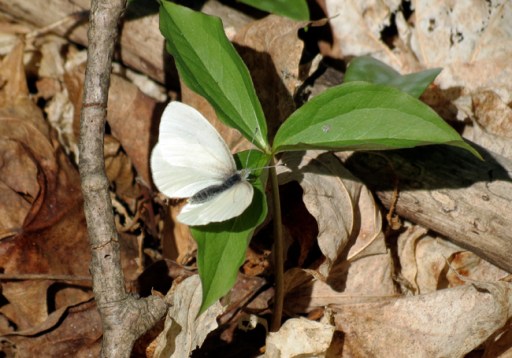
WVW on trillium

These West Virginia Whites (Pieris virginiensis) have been faithful companions on my travels to mature forested ravines and swamps in the region. Once considered a Species at Risk, they remain quite rare, known to occur in only about 50 sites in Ontario. They are common in Frontenac Provincial Park on warm days in April and May. West Virginia Whites are threatened by habitat loss and the invasive Garlic Mustard (Alliaria petiolata), which is a close relative of their host plant, the Toothwart (Dentaria diphylla). Adults will lay their eggs on Garlic Mustard but the hatched larvae will not feed on the invasive plant and perish.

Cerulean Warbler (trust me!)

The birding was excellent this week thanks to the recent warm front. Cerulean Warblers were particularly numerous. Eleven males were counted en route to one of our Louisiana Waterthrush sites. Over the years I’ve amassed an impressive collection of hopelessly blurry photos of Ceruleans or the perches they left behind. This is the best I’ve managed to come up with so far – sadly. It was pleasing to find that Louisiana Waterthrushes have returned to the breeding site we first described in 2010! A pair has been detected here for three consecutive years, which makes this site in Frontenac Prov. Park one of just a few annual breeding locations in the region. High fidelity to these sites make them important “footholds” at the range limit where contraction and expansion can be marked. These Frontenac louies are true pioneers!

.

Scarlet Tanager

Frontenac Bird Studies in 2012

Migration Research Foundation is excited to announce that fieldwork for the Frontenac Bird Studies program will recommence in early May 2012! Here is the lineup of activities for the spring and summer field season.

.

Prairie Warblers

This year will find us back in familiar territory, the expansive granitic rock barrens in Frontenac Provincial Park. Swept by intense fires in the 1930s, the barrens have been a refuge for several bird species in decline such as, Common Nighthawk, Prairie Warbler, Field Sparrow and Eastern Towhee, to name a few. Our efforts in 2011 were successful – male Prairie Warblers were located and colour-banded and nests were found. It wasn’t exactly easy, though. The late spring, extreme heat, abundant biting flies and hundreds of kilometers walked made for a challenging month of June (there’s a reason these barrens are explored by few!). Fortunately, the experience will make our studies substantially more efficient and productive for our return this year. Prairie Warblers are exceptionally rare in Canada and Frontenac remains a significant stronghold for the Ontario population clinging to life along the southern edge of the shield.

.

M.A.P.S

In addition to our work in the barrens, we are looking forward to our fourth year of Monitoring Avian Productivity & Survivorship (MAPS). Our data indicate a short-term but marked reduction in forest bird abundance, perhaps owing to late spring and/or summer weather anomalies in recent years. A thorough analysis of demographic rates will be conducted following the 2013 season. Here is a snapshot of one of “our” thrushes from the Maplewood Bog (MABO) station in South Frontenac, ON:

.

Rare Species Inventory and Monitoring

For a third spring in-a-row we will survey high potential breeding locations for Louisiana Waterthrush within the study area.  Additionally, targeted area searches will be conducted in Frontenac Provincial Park for other rare/sensitive bird species and habitats such as Golden-winged Warbler and Red-headed Woodpecker. This exercise is part of an annual initiative to inventory and map distribution and abundance of breeding avifauna within the study area, particularly the park itself. This year our efforts will be focused on meadow/shrubland and wetland environments.

.

The Frontenac Biothon fundraiser returns for another blitz in 2012! This year our biothon team will be racking up the species in Frontenac Provincial Park for 24 hours on June 9-10. Thanks to everyone who supported the biothon in 2011! We hope you will consider sponsoring one of our biothon participants this year. Visit our biothon page for more information or to make a donation.

.

FBS Online

As always, you can follow our progress throughout the spring/summer field season via our blog, twitter and Facebook.

.

.

Remembering Andrew Jano

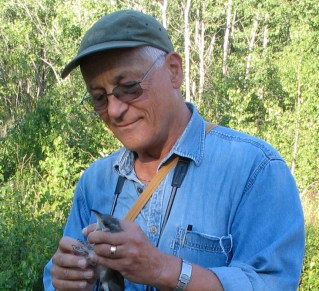
Andrew Jano with Yellow-billed Cuckoo

We were deeply saddened to learn that Andrew Jano, a champion and regular supporter of Frontenac Bird Studies (FBS), passed away peacefully on February 5, 2012, at the age of 73. Andrew was passionate about birds and a dedicated proponent of conservation projects that he believed in. His yearly sponsorship and encouragement was invaluable in the development and evolution of our field programs in the Frontenac Arch. He was a terrific man and will be missed by many.

The 2012 field season will be dedicated to Andrew Jano, our dear friend.

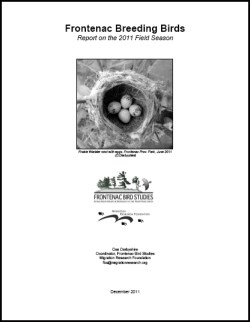
Frontenac Bird Studies – 2011 Report

Year three of Frontenac Bird Studies was officially completed with the draft of the final report yesterday. The document, with over 40 pages of data summaries and analysis, will be available on the Migration Research Foundation website in the coming weeks. It was a fascinating season – cold and wet then hot and dry, always buggy but so choc-full of wonder and discovery.

Thanks to all of the volunteers, donors and supporting staff from Ontario Parks for another successful year!

All the best to you and yours in 2012

Dan Derbyshire, FBS Coordinator

Frontenac Bird Studies – The 2011 Season

Undoubtedly, the 2011 edition of our program was our most action-packed and challenging to date

The third consecutive spring/summer field season came to an end with this year’s final session of the Monitoring Avian Productivity & Survivorship (MAPS) program on August 6, 2011. The three years of MAPS data point to a marked reduction in abundance of many landbird species in forest habitats of the region. The pattern is particularly evident at our Maplewood Bog station near Devil Lake, where season capture totals have dropped from 197 individuals in 2009 to just 89 in 2011. The apparent declines are concurrent at all three stations, which are spatially disjunctive and representative of a broad spectrum of landscape conditions. It is likely that the current negative trend will be short-lived and a product of natural population shifts but continued monitoring for at least two more years is needed to strengthen analysis and assess cause and effect.

In 2010 we completed basic inventories of Prairie Warbler and Louisiana Waterthrush populations in the study area, primarily in Frontenac Provincial Park. This year we repeated these exercises and expanded area coverage to begin monitoring year-to-year variation in population size and breeding status. We also began a more in-depth assessment of Prairie Warblers in the area to examine breeding status, survivorship and breeding ecology. These studies were very productive and will be fully explored in the year-end report later this year.

Weather in May was extremely wet, which created exceptionally fertile conditions for black flies and mosquitos. Endlessly attended by the biting swarms, our studies carried us by foot and by canoe over ridges and valleys, to lakes, bogs, barrens and creeks throughout the study area – over 250km in all. Many notable finds were made, which included active nests of Red-headed Woodpecker, Cerulean Warbler, Yellow-billed Cuckoo and Prairie Warbler. Also notable were records of eight at-risk bird species as well as locally significant observations of Yellow-bellied Flycatcher, Five-lined Skink, Sedge Wren, Sandhill Crane and Red-bellied Woodpecker, to name a few.

Our second annual Frontenac Biothon fundraiser was a tremendous success thanks to the generosity of our sponsors and volunteer naturalists. We searched high and low for species during a 24-hour period on June 11-12 in Frontenac Provincial Park. We surpassed our 2010 total of 441 with a final tally of 468. In the end, we raised some important funds for the project, produced an impressive array of records and had a memorable weekend to boot!

Frontenac Bird Studies exists through the support of many individuals and organizations. The Migration Research Foundation thanks the following for their contribution to FBS in 2011!

Funding

The John Hackney Foundation for the Noosphere
Ontario Parks
Frontenac Biothon sponsors

FBS MAPS Assistant

Seabrooke Leckie

Frontenac Biothon

Chris Dunn
Karina Dykstra
Steve Gillis
Seabrooke Leckie
Julia Marko Dunn

Support

Corina Brdar
Ontario Parks

Monique Charette
OMNR

Peter Dawson
Ontario Parks

Audrey Heagy
Bird Studies Canada

Bert Korporaal
Ontario Parks

Chris Robinson
Ontario Parks

Ken Shepherd

Don Sutherland
OMNR, NHIC

Sincerely,

Dan Derbyshire
Project Lead, Frontenac Bird Studies
Migration Research Foundation