This male Louisiana Waterthrush has been singing away since May 7, 2012 but has yet to attract a female. Breeding was successful at this location in 2010 and 2011 but given that it’s nearly June already, the prospects are looking bleak for 2012. He sang constantly for the 1.5 hrs I was in the area – averaging one song every 7-10 seconds. This is typical of males arriving on territory in late April and early May. Song frequency drops considerably after pair bond and nearly stops entirely during advanced nesting stages. His spirited singing is indicative of an unmated male advertising for a mate. Hopefully his luck will change soon.
Fieldwork has kicked into full gear as the action-packed month of June is just a week away. Our Louisiana Waterthrush surveys are nearing completion for the 2012 season. Soon I will be racking up the mileage while scouring the barrens for Prairie Warblers and other goodies in the southeast section of the park. It’s such a wonderful contrast to transition from damp mature forests to the hot and dry expanses of bedrock, poverty grass and junipers. Yesterday I found this Barred Owl in a wooded swamp about 40m from where my truck was parked on Salmon Lake Road. Barred Owls are easily the most common owl species in the area. Great Horned Owls are comparatively rare in the hardwood forests but are found with some regularity in mature mixed coniferous zones. Owl populations would be an excellent subject FBS in the future.
Violets in Arab Gorge
Louisiana Waterthrushes have been very scarce this spring, even more so than last year. The species was recorded at seven sites in 2010, our first year, but only evident at two sites so far in 2012. Fortunately, they are paired and probably nesting at the two sites. The steep sided stream corridors seem so empty without their voices.
Nesting Black-throated Green Warbler
Many species are well into their nesting cycles. While observing the Barred Owl I tracked a female Black-throated Green Warbler, which had just finished bathing in the swamp. After a bit of preening and some flitting it plunked itself into a fork at the main trunk of a young Yellow Birch. Raising binoculars to the spot revealed a surprisingly deep and bulky nest. The earliest nest record for this species in Ontario is June 5 so a nest with eggs on May 24 is quite early. This particular record is also somewhat unusual in its location in a deciduous tree species within purely deciduous forest. In Frontenac Provincial Park the Black-throated Green is more typically found in woodland with tall Eastern White Pine and/or Eastern Hemlock. However, a quick search of our point count data revealed that they are present, albeit in low numbers, within hardwood stands as well.
Female incubating
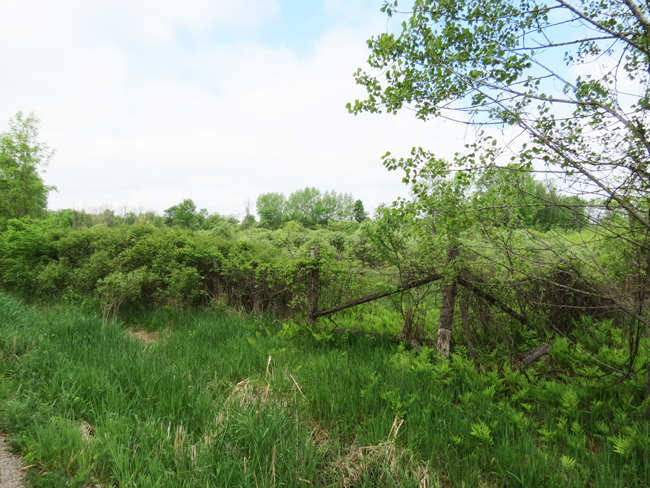
Below is a photo of habitat suitable for Golden-winged Warblers. This was taken just southwest of Westport, ON where there are many small, family-run farms with low-intensity agricultural practices. The presence of dense shrub cover at edges of property lines provides appropriate conditions for Golden-wings, which were designated as Threatened by COSEWIC in 2006. A total of six male Golden-winged Warblers were located yesterday morning with relatively little effort. The Frontenac Arch and the southern shield ecotone are important regions for the protection of this species. In these areas, the rugged terrain and shallow till have been effective deterrents to large scale/intensive agriculture, so far…..
Golden-winged Warbler habitat near Westport, ONGolden-winged Warbler at MABO, 2011
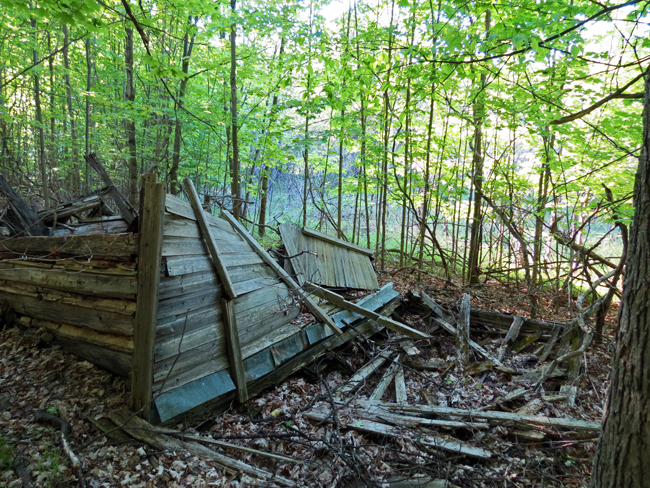
Land O’ Lakes indeed! Frontenac Provincial Park lies at the southern tip of the great Canadian Shield with its astounding proliferation of lakes, wetlands and rivers. The map clipping above provides a glimpse of the difficult terrain here and also the number and distribution of lakes. The landscape is rich and beautiful but often very harsh too. The park has an impressive history – of miners, farmers and loggers who endured extreme hardship eking out a life here. The route I took this morning passes by abandoned homesteads and mines as well as the old log roll way at Hardwood Bay on Devil Lake. A century ago the land was mostly cleared and the air would have been filled with the sounds of men and women working the land. Decades of regeneration later, the area provides mature oaks, maples and hickories for troubled bird species, Cerulean Warblers and Red-headed Woodpeckers.
Very pleased to find that the Red-headed Woodpeckers have returned! Hopefully this means that they were successful rearing young last summer. I watched the pair fending off Common Grackles from a nest site and also observed the pair copulate twice. I’ll make a point to return to locate the nest later on in the season and hopefully get some footage of the young being fed at the nest.
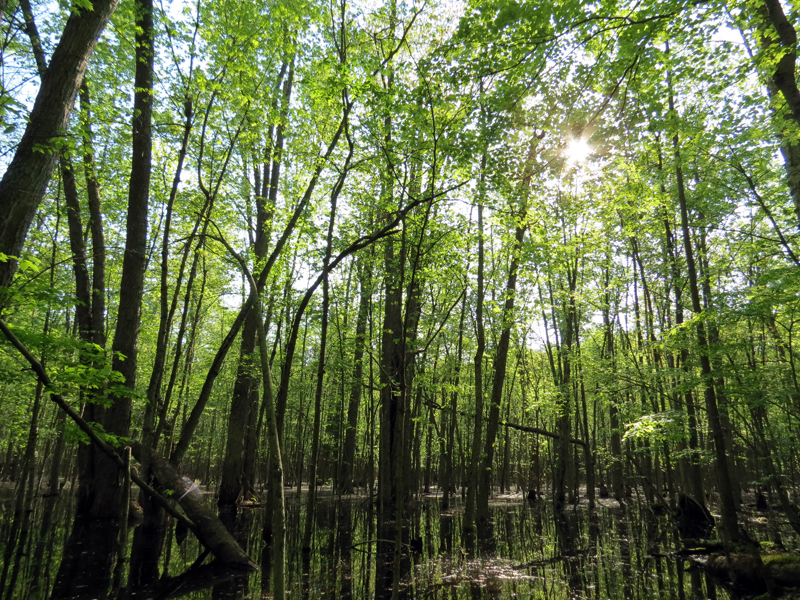
RHWO Habitat in Frontenac Provincial ParkSwamp Woodland near Gibson Lake
I sought out this fantastic forest swamp for our ongoing project to inventory Louisiana Waterthrush habitat in the study area. This was a site that had not been visited before. I took the liberty of naming it Devil’s Swamp in my records. Northern Waterthrushes were present but no Louisianas today. This would be a high priority site for future monitoring, especially in years when the population is healthier in the region. Once again, Louisiana Waterthrushes are present this year at only a few sites in the region but we are also finding a dearth of unmated “wanderers”.






 Frontenac Bird Studies