News and Articles

Migration Update: May 4-6, 2009

img_3703
Golden-winged Warbler- May 4, 2009

Spring migration along Canoe Lake Road continues to impress as new species arrive from the south with each passing day. Highlights of the census on May 4th include a Sora calling from one of the small wetlands along the roadside and the remarkably late first appearance of Hermit Thrush for the survey route this spring. Hermit Thrushes are now on territory and can be heard regularly, particularly along conifer-bearing shorelines of lakes in the area. There are few sounds in nature more haunting than the ethereal song of a Hermit Thrush on a calm spring or summer evening. Their vocalizations are uniquely complex amongst the songbirds as they, and other thrush species, possess the equivalent of two sets of vocal chords, which enables them to intertwine two songs at the same time. Donald Kroodsma, the heavily recognized authority on avian vocalization, has done some fascinating work on thrushes, a sample of which you can listen to in this clip from NPR’s Fresh Air program. The male Golden-winged Warbler pictured above has been recorded actively singing from the same “spot” since May 2 and appears to be setting up a territory for the summer. This species was recently listed by COSEWIC as threatened. The Frontenac Axis is a core breeding zone for this species in Ontario.

On May 6 a total of 36 species were tallied, which included season firsts of Wood Thrush, Savannah Sparrow and a pair of lingering Ring-necked Ducks. White-throated Sparrows and kinglets continue to elude our eyes and ears during the surveys, although a couple of White-throats and Ruby-crowns were observed on the 6th. There are roughly four weeks remaining in this year’s spring migration and the majority of local breeding species have yet to arrive. The Spring Migration Census program will continue on a semi-daily basis until May 31st when our core program, Frontenac Breeding Birds, will kick off.

Spring Species Total: 77
Average # individuals/census: 149
Average # species/census: 32
In Memory of Gail Woolnough

trio

h

Friends and Family of the late Gail Woolnough have generously supported the establishment of Frontenac Bird Studies. Donations in memory of Gail, who had a strong appreciation for birds and the outdoors, will go directly to support the inauguration of our Frontenac Breeding Birds program, which will commence in late May, 2009. We are very grateful to have received this honour and extend our sincere appreciation to all of the friends and families for their support.

Migration Update- May 2, 2009

l2
Frontenac Provincial Park

Just a quick note for today. We’ve been quite busy of late getting ready for the upcoming Frontenac Breeding Birds program. I ended up hiking a little over twenty kilometres for various treks between Thursday and Saturday, which I am pleased to say was a very enjoyable and productive endeavour. The high winds of recent days were a help in keeping some of the voracious Black Flies at bay! The image included above is from one of the most scenic vantage points encountered during these travels. Results from Saturday’s migration census are posted below. Migration has slowed in the past week due to some cooler weather with less favourable winds but the total of 41 species counted yesterday was a respectable tally. The highlight of the census was finding a singing male Golden-winged Warbler at the very end of the count. Warm temps and south winds are forecast for the overnight and into tomorrow, which should provide some great birding in the area! The next spring migration census along Canoe Lake Road is scheduled for bright and early tomorrow morning.

Results (first of season species in bold)

Hooded Merganser 2
Common Loon 1
Red-shouldered Hawk 3
Herring Gull 1
Mourning Dove 3
Yellow-bellied Sapsucker 2
Hairy Woodpecker 1
Northern Flicker 3
Pileated Woodpecker 2
Eastern Phoebe 2
Great Crested Flycatcher 2
Yellow-throated Vireo 1
Blue Jay 5
American Crow 4
Common Raven 1
Tree Swallow 2
Black-capped Chickadee 9
Red-breasted Nuthatch 2
White-breasted Nuthatch 1
American Robin 5
European Starling 3
Golden-winged Warbler 1
Yellow Warbler 1
Yellow-rumped Warbler 2
Black-throated Green Warbler 1
Pine Warbler 2
Palm Warbler 1
Black-and-white Warbler 4
Ovenbird 1
Northern Waterthrush 1
Chipping Sparrow 3
Song Sparrow 7
Swamp Sparrow 2
White-throated Sparrow 1
Rose-breasted Grosbeak 2
Red-winged Blackbird 30
Rusty Blackbird 1
Common Grackle 11
Baltimore Oriole 2
Pine Siskin 4
American Goldfinch 7

Spring species total=70
Average # individuals/census=141
Average # species/census=31

Migration Update- April 30, 2009

home
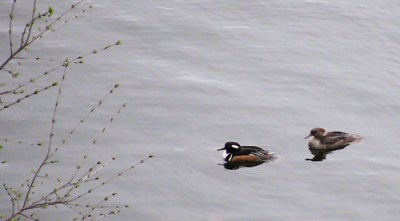
Hooded Mergansers, Kingsford Lake

Census results from yesterday morning show a reduction in diversity and abundance of migrants but there was still a pleasing variety of species present. The first Yellow-throated Vireo, Nashville Warbler and Baltimore Oriole of the spring surveys were recorded. I have been pondering the mysterious near-absence of White-throated Sparrows and kinglets along this stretch of Canoe Lake Road. A total of just ten White-throats and ten Ruby-crowns have been tallied from ten surveys since mid-April! Also, not a single Hermit Thrush has been recorded during the spring counts, although they have been spotted regularly in forest-interior locations. These three species are abundant migrants, representing a significant portion of migrants tallied at most Great Lakes migration hotspots in April and early May. It is reasonable to suspect that migrants in this area are afforded a significantly greater selection of habitats and array of foraging opportunities. Predominant edge habitats in the area such as those along roadsides and at the borders of agricultural fields and meadows have been noticeably quiet for migrants compared to forest interiors. This pattern is opposite to that for autumn 2009 when edges with marginal habitats in early succession were key features for concentrating migrants. More study needed……

Results (first of season species in bold)

Canada Goose 83
Common Loon 2
Belted Kingfisher 1
Yellow-bellied Sapsucker 2
Hairy Woodpecker 1
Northern Flicker 6
Eastern Phoebe 3
Great Crested Flycatcher 2
Yellow-throated Vireo 1
Warbling Vireo 1
Blue Jay 4
American Crow 9
Black-capped Chickadee 6
Red-breasted Nuthatch 2
White-breasted Nuthatch 1
European Starling 4
Nashville Warbler 1
Yellow Warbler 3
Yellow-rumped Warbler 3
Black-throated Green Warbler 2
Pine Warbler 2
Chipping Sparrow 7
Song Sparrow 4
Swamp Sparrow 1
Rose-breasted Grosbeak 2
Red-winged Blackbird 28
Rusty Blackbird 1
Common Grackle 9
Baltimore Oriole 1
Purple Finch 1
American Goldfinch 5

Spring Species Total=67
Average # Individuals per Census=150.4
Average # Species per Census=30.1

Red-shouldered Hawks-Canoe Lake Road

rsha4
Incubating Red-shouldered Hawk

The Red-shouldered Hawk (Buteo lineatus) occurs across much of the eastern half of North America with a northern limit of central Ontario and Maine. Formerly Ontario’s most abundant hawk species, Red-shouldered Hawks declined sharply in the last century due to habitat loss and fragmentation and resulting inter-specific competition with the Red-tailed Hawk. Red-shouldered Hawks are an area-sensitive species, preferring large tracts of mature, contiguous and primarily deciduous forest cover.  This species also prefers a closed canopy of 70% or greater for successful breeding (Badzinski 2005). Territory size for the lineatus subspecies averaged 192 hectares in a Maryland study with distance between nesting pairs ranging from .37 km to 1.27 km (Steward 1949). Interestingly, this species is considered a partial migrant as it is only those individuals that breed in the northern portion of the continental range that are known to migrate south. These migrant Red-shouldered Hawks that breed in Ontario migrate relatively short distances to the United States.

The rather unimpressive photo above was taken of a incubating parent, probably a female, along Canoe Lake Road on April 27, 2009.  A pair returned to this nesting location from previous years in late March and were highly vocal during the first two weeks of courtship. The male and female were often observed together coasting on thermal updrafts around mid-day near the nest site. The pair have been nearly silent since that time and are much more inconspicuous in general since eggs were laid in the last week or so. The nest itself, compacted and disheveled by the winter, was extensively renovated by the pair in the first few weeks, and has nearly doubled in overall size since late March. It is located in a mature ash between two small ridges. The presiding male has been observed on multiple occasions bringing food (mostly small mammals) to the incubating female. The incubation period is about 33 days, which suggests that young will hatch around late May (Palmer 1988).

rsha2
Cruising Red-shouldered Hawk

The Red-shouldered Hawk was listed as a Species At Risk (Special Concern) in Canada (COSEWIC) and Ontario (COSSARO) until 2007 when it was delisted largely based on results of a pioneering citizen science project. Bird Studies Canada (BSC) and Ontario Ministry of Natural Resources (OMNR) completed a thorough assessment of the population status of this uncommon raptor species by conducting annual roadside counts in southern and central Ontario from 1990-2006. The Red-shouldered Hawk and Spring Woodpecker Survey concluded that populations during that time period seemed to be stable in regions of Ontario with suitable habitat (central) and that the species was expanding northward. Of over 141 survey routes conducted during the project, there were a few that stood out in terms of the average number of hawks per route. Canoe Lake, Opinicon Lake, Otty Lake and Christie Lake, all routes located within the northern portion of the Frontenac Arch, had significantly higher counts of this species than anywhere else. This pattern of high population density in this region as well as The Land Between ecotone is also indicated by abundance and breeding evidence maps of the Ontario Breeding Bird Atlas.

Protecting the ecological integrity of the Frontenac Arch and the Southern Shield region of Ontario is important to a vast array of species, including the Red-shouldered Hawk. The contributions of the Red-shouldered Hawk and Spring Woodpecker Survey and the continued efforts of the Kingston Field Naturalists have been of considerable significance to our understanding of this species in the Frontenac Arch region. While not a focal species at this time, Frontenac Bird Studies will be conducting surveys and nest-monitoring to lend further support for this remarkable hawk in Ontario’s woodlands.