News and Articles

Ravens at Clearwater

Nesting site along the cliffs across the lake

In this post from early June of last year I wrote about three recently fledged Common Ravens that were found near Clearwater Lake. This is a small but deep oligotrophic lake that is probably best known for its population of Brook Trout. I regularly pass through this area at this time of year and usually notice the clamorous activity of ravens along the lake edge. The noise reminded me to check the cliff for active nests when I passed by last week. It didn’t take long to spot the nest immediately above some rock covered in white wash. The following photos show an adult brooding and three youngsters waiting for food. Unfortunately the photos were taken from a distance of about 100m, which made them pretty grainy but the idea of leaning over the cliff for a better closeup just didn’t appeal.  Common Ravens are regular breeders in the area however this particular record was the first for us since we began in 2009 – very cool!

Incubating adult
Three nestlings

Where art thou Parkesia Motacilla?


f
[ Note that Louisiana Waterthrush (formerly Seiurus motacilla) was recently moved to the new genus Parkesia with Northern Waterthrush, which leaves Ovenbird as the only remaining Seiurus species ]

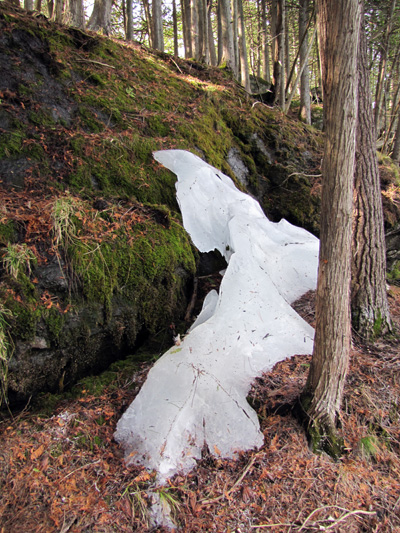
There has been lots of noteworthy observations in recent days but the most significant development continues to be the late arrival of spring and apparent scarcity of Louisiana Waterthrushes in the study area. The mass of ice pictured below was found yesterday near Little Salmon Lake, Frontenac Prov. Park – a late spring indeed. I’ve now surveyed 23 streams and creeks in and around Frontenac Provincial Park with only a few sightings of the target species to show for it. As the above video shows the sites are in excellent condition owing to high precipitation in late winter and early spring. Water levels and flow are higher than a year ago and insect forage is abundant (particularly the black flies!). Click here for a larger version of the clip.

Lingering ice under cedars
Range Map (Cornell Lab of Ornithology)

The Louisiana Waterthrush has a very limited range in Canada. Breeding occurs primarily in Southern Ontario where remnants of mature deciduous and mixed forest remain. Looking at the map above, the small green dot at the east end of Lake Ontario indicates a cluster of breeding sites corresponding to mature woodlands of the Frontenac Arch and Thousand Islands. There is evidence that this species is expanding northward probably in response to maturing and regenerating forest cover since the logging boom of the 1800s. The population in the Frontenac Arch is essentially the northernmost outpost for this species in North America and somewhat disjunctive from the core range. It has been suggested that Ontario’s population is dependent upon immigration from the source population further south and could therefore be subject to more variable rates of fidelity and productivity. Perhaps 2011 will be a down year for our north-wandering pioneers? We still have a few weeks of surveys to complete and will have a much better handle on the situation by early June – I have a good feeling that results will improve.

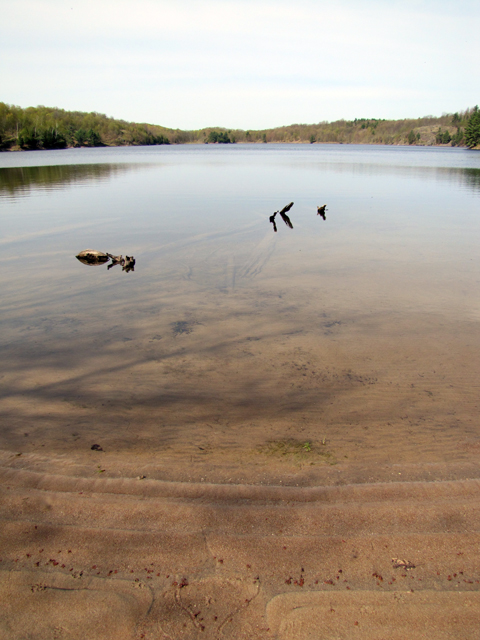
Little Salmon Lake

The Louisiana Waterthrush recon work took me to a network of streams flowing to and from Little Salmon Lake in the park’s interior. There are some very promising sites in the area but the relatively young age of the forest is probably not suitable for the species at the present time. Regardless of whether the birds are there or not the effort is still worthwhile to describe and index potential breeding locations for the future. This was my first foray into this area, which made for an interesting day. Sandy beaches like the one pictured above are very scarce in the park.

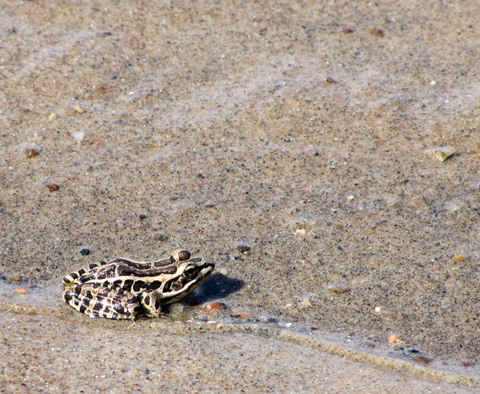
Pickerel Frog on the beach

The only sunbather I found was this Pickerel Frog (Rana palustris) – a nice find. While not exactly rare they are uncommon compared to their close relative, the very similar and more numerous Northern Leopard Frog (Rana pipiens). Pickerel Frogs are always brown in coloration and have squared spots aligned into two neat rows down their backs. The Northern Leopard Frog is usually green, although sometimes brown too, but have circular, more randomly distributed dark markings.

Back to the streams…

Frontenac Provincial Park, May 7, 2011

Our fieldwork is well underway in spite of what has been a late arriving and slow moving spring season. The leaf-out is at least a week or two behind schedule and the woods have been unusually quiet for this time of year. However, migrants and returning breeders are appearing in small numbers. A pleasing variety of neotropicals was observed yesterday, which included Wood Thrush, Great Crested Flycatcher and Cerulean, Black-throated Green and Black-throated Blue Warblers. Of particular interest were sightings of Pine Siskin (two occurrences) and Evening Grosbeak – both rare but potentially nesting species in the park. Our official duties at this time of year focus on the Louisiana Waterthrush (Parkesia motacilla), which have been trickling back into Ontario since mid-April. Over the winter a thorough inspection of high resolution aerial photography was conducted, which revealed over 30 potentially suitable nesting sites within our core study area (not including sites visited in 2010). Needless to say I’ve got a ton of walking and canoeing to do in the next few weeks! I will update on our survey results throughout the month of May.

Darvic Colour Bands

In addition to the LOWA reconnaissance we’ve been preparing switch our attention to Prairie Warblers in late May-early June. This year will involve a more extensive ground search of granite barrens in Frontenac Provincial Park for Prairie Warblers. We will also be assessing habitat, nest searching as well as colour banding and tracking males. The project represents our first in-depth look at a breeding species in the Frontenac Arch. The granite barrens scattered along the southern edge of the Canadian Shield in south-central Ontario have received relatively little attention but are important to several species currently in decline such as Common Nighthawk, Field Sparrow, Eastern Towhee and Prairie Warbler.

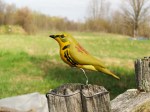
Prairie Warbler by Seabrooke Leckie

In order to safely capture and mark the birds we will be deploying a mistnet and using a playback/decoy method to lure territorial males. I contemplated various approaches to the construction of a reasonably lifelike decoy, none of which really fit my needs. Fortunately Seabrooke, being both crafty and creative, came up with this little guy, which was handmade from Sculpey – just the ticket ; )

Frontenac Bird Studies in 2011

Year three is underway….

Despite lingering winter-like conditions our third season officially kicked off with an early Louisiana Waterthrush belting out its song from a creek near Canoe Lake Road on April 19, 2011 – a great start! Our first two years of Frontenac Bird Studies were very productive and we’re excited to begin our 3rd, which is shaping up to be our busiest field season so far.

The blueprints for 2011

In 2010 we launched inventories of two rare breeding warbler species within our core study area. We examined over twenty potential breeding sites for Louisiana Waterthrush last season, which produced several locations occupied by singing males, two previously unknown breeding sites and also a nest with four eggs in Frontenac Provincial Park. The results from 2010 have raised many more questions that compel us to investigate this species on an annual basis. This year we will increase our coverage by visiting previously unexplored habitat and also revisit occupied sites to bolster our data on productivity and fidelity. Perhaps the most exciting result of 2010 was our inventory of Prairie Warblers in the rock barrens of Frontenac Provincial Park. We have received word that the Frontenac colony is the largest away from the Georgian Bay core population. In 2011 we will be undertaking a detailed study of the Prairie Warblers in the park, which will involve extensive nest searching and colour banding to examine demography, ecology and stability of the population. In addition to these projects we will be operating our network of Monitoring Avian Productivity and Survivorship (MAPS) stations for a third consecutive year – Rock Ridge (RRID), Maplewood Bog (MABO) and Blue Lakes (BLAK). Lastly, as time permits we will be conducting area searches for Species at Risk and habitats that haven’t been adequately covered by our operations to date. In particular we will be looking for Red-headed Woodpecker (Threatened), Short-eared Owl (Threatened) and Golden-winged Warbler (Threatened) in Frontenac Provincial Park. It’s going to be a busy season for sure!

Frontenac Biothon 2011

Frontenac Bird Studies is made possible through the support of our many volunteers, sponsors and private donors. In July 2010 we held our first annual fundraiser, the Frontenac Biothon, which successfully raised funds for our work and also contributed to science and conservation at the same time. Over 400 species were documented and a pair of Red-headed Woodpeckers were discovered, a rapidly declining species and only the second breeding record for the park. This year our biothon team will be sifting through the flora and fauna of Frontenac Provincial Park for 24 hours on June 11-12.

Thanks to everyone who supported the biothon in 2010! We hope you will consider sponsoring one of our biothon participants this year. Please visit our biothon page for more information or to make a donation.

FBS on the Social Networks

As always, you can follow our progress throughout the spring/summer field season via our blog and twitter. You can now also find us on Facebook!

Sincerely,

Dan Derbyshire
Project Lead, Frontenac Bird Studies

2010 Report Completed

Has it really been five months since our last update? While we’ve not done any work in-the-field (sadly) we have been active behind the scenes with data management, reporting, fundraising and planning. Funding permitting we are presently on course for another exciting season in 2011. Stay tuned for the reawakening of frontenacbirds.ca as the ice and snow gives way to early spring….