A Summer for the Birds

3668800446_1eb3dbbe3f
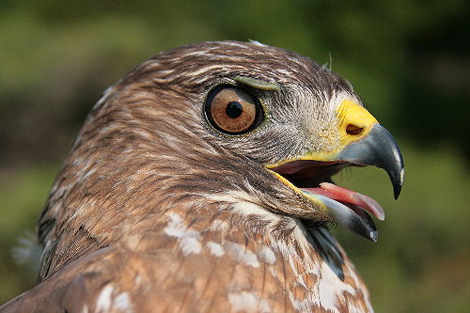
Broad-winged Hawk banded at Rock Ridge MAPS Station (Seabrooke Leckie)


FBS kicks avian research and monitoring into high gear!


Year one of the Frontenac Bird Studies (FBS) program has been a great success!  Over 200 surveys of breeding birds were completed in June and July throughout the FBS study area, which encompasses over 15,000 hectares between Sydenham and Westport, Ontario. This substantial effort, which included roughly 42 kilometres of walking in Frontenac Provincial Park, revealed an incredibly rich avian community. Several Species at Risk in the area were encountered including Whip-poor-will, Common Nighthawk, Louisiana Waterthrush, Golden-winged Warbler and a remarkably high number of Cerulean Warblers. We also established a new network of Monitoring Avian Productivity and Survivorship (MAPS) stations to index and monitor critical demographic patterns for breeding landbirds in the Frontenac Arch. Over 300 birds were banded and recaptured during the summer for this program, the most unusual of which was an adult Broad-winged Hawk captured at our Rock Ridge site in June. A nest monitoring effort was also initiated this summer to assist in the collection of demographic statistics for local bird populations. Over 70 nests were carefully monitored in 2009, which included records of Winter Wren, Brown Creeper, Common Nighthawk, Whip-poor-will, Scarlet Tanager, Northern Waterthrush, Osprey and Red-shouldered Hawk, to name a few. And finally, Project Whip-poor-will successfully took flight with over 30 roadside surveys conducted in late June and early July. These nocturnal surveys were timed to coincide with the full moon – peak time for vocalizing Whip-poor-wills. Impressively, over 50 Whip-poor-wills, now classified as a threatened species, were detected during the surveys!

These are just a few of the highlights from our busy summer that further support the Frontenac Arch as a region of significance to bird populations in Ontario and Canada. Frontenac Breeding Birds in 2009, our first year of the project, will serve as an integral foundation for us going forward. The program was made possible by a network of spirited and generous volunteers, collaborators and donors. Staff and directors of the Migration Research Foundation extend a big thanks to the following for their integral support in 2009!

Funding

The John Hackney Foundation for the Noosphere
The McLean Foundation

Volunteers and Sponsors

Andrew Jano
Don Johnston
Friends and family of Gail Woolnough
Ian Sturdee
Jan McDonald
Julia Marko Dunn
Kerry Adams
Larry Menard
Matthew MacGillivray
Pierre Robillard
Sally Wills
Seabrooke Leckie (Research Assistant)
Steve Gillis
Wendy Derbyshire

Support

Peter Dawson
Ontario Parks

Bert Korporaal
Ontario Parks

Chris Robinson
Ontario Parks

Staff, Ontario Ministry of Natural Resources

Mark Peck
Royal Ontario Museum

Ron Weir
Kingston Field Naturalists

Don Ross & David Bull
Frontenac Arch Biosphere Reserve

Audrey Heagy & Jon McCracken
Bird Studies Canada

We are already looking forward to 2010, our second year of the Frontenac Breeding Birds project, and encourage everyone to visit our website for more information on FBS programs (www.frontenacbirds.ca), or contact us at fbs@migrationresearch.org.

Sincerely,

Dan Derbyshire
Project Lead, Frontenac Bird Studies
Migration Research Foundation
2386 Bathurst Concession 5
RR7 Perth, ON
K7H 3C9
fbs ‘AT’ migrationresearch.org
http://www.migrationresearch.org
http://www.frontenacbirds.ca

On the Road: Frontenac Turtles

IMG_0008

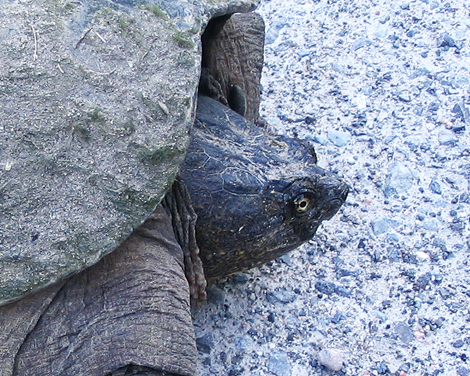
Nesting season for turtles has been in full swing the past two weeks. I’ve probably moved about 15-20 turtles off paved and gravel roads in the area since early June.  Turtles frequently fall victim to collisions with cars as they slowly cross roadways in search of nesting sites. I always prioritize stopping the car and moving them to a safe spot in their intended direction. Female Map Turtles and Snapping Turtles have been observed nesting in the soft gravel at the road edge throughout the FBS study area but these “roadies” are most frequently observed at dusk when one can easily find as many as 5-10 of them on the road in maybe a kilometre or two.

IMG_0010

The Snapping Turtles have a certain air of intimidation about them but can be moved easily without risk of being bitten if you know where to hold them by their shells. I can’t seem to find any decent links to descriptions of this procedure so I will refrain from recommending that these creatures be handled-they do have a powerful bite.  They will often move quickly (for a turtle) if approached from behind so you can often move them out of harm’s way in this manner.

Update from the field


Hummingbird at FBS feeders on May 24, 2009 (click here for HD version)

Crunch time has arrived as we make final preparations for the start up of the Frontenac Breeding Birds program in early June. Establishing the MAPS sites has been the main task on the agenda but we’ve also been delving into establishing over 180 point count stations, getting ready for Project Whip-poor-will and the usual administration duties. Things should clear up by early next week and I should be back to regular blogging by the end of the weekend. I have yet to start nest searching in an “official” manner but have already found nests of a dozen species. I was very pleased to find a Winter Wren nest yesterday evening and have since added Red-eyed Vireo, Rose-breasted Grosbeak and a second Hairy Woodpecker nest to the list from this afternoon. No sign of a nest yet for the residing pair(s) of Ruby-throated Hummingbirds at the FBS headquarters….

Queen’s University Biological Station

operationscentre
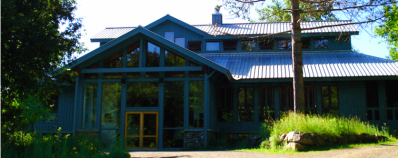
QUBS Operations Centre (source: Queen's University)

I had the pleasure of visiting with some of the staff and students at the Queen’s University Biological Station this past Friday. The station is located approximately 20 kms to the east of the Frontenac Bird Studies boundary (west boundary). The drive over was spectacular, starting southbound on Canoe Lake Road where I noticed Cerulean and Prairie Warblers singing from the edge of the road. I then traveled along the narrow and winding Little Long Road (southern boundary of FBS study area), which is certainly little but not terribly long. Boisterous Ovenbirds, Rose-breasted Grosbeaks and American Redstarts were abundant along this stretch. A short trip north along Perth Road took me to Opinicon Road. Opinicon Road is known as Cerulean Warbler “central” to most birders and this area in tandem with the FBS study area has one of the densest populations of this species in the world. I reached the turnoff to QUBS, which was conveniently marked “Queen’s University Road” and headed down a meandering gravel roadway to the station.

The Queen’s University Biological Station has been in operation for over 50 years on Opinicon Lake and has since grown into a world class facility for biological research. On the day of my visit, the station was a hive of activity as student and faculty researchers from all over North America and beyond were engaged in the day-to-day operations of field projects and courses. QUBS has acquired over 2000 hectares of habitat in the area for the purposes of conservation and study, making the university one of the largest stewards of protected land in the Frontenac Arch. This impressive list of theses and publications produced at QUBS includes the names of many distinguished biologists including Bridget Stutchbury and Adrian Forsyth.

I arranged to meet with Dr. Paul Martin, the Baillie Family Chair in Conservation Biology at QUBS, to discuss the FBS initiative and to stimulate ideas for collaboration and support. I also met Frank Phelan (QUBS Manager) and grad students Mark Conboy and Vanya Rowher. It was a very productive and enjoyable visit and I look forward to future contact and collaboration with the people of QUBS.