Red-shouldered Hawks-Canoe Lake Road

rsha4
Incubating Red-shouldered Hawk

The Red-shouldered Hawk (Buteo lineatus) occurs across much of the eastern half of North America with a northern limit of central Ontario and Maine. Formerly Ontario’s most abundant hawk species, Red-shouldered Hawks declined sharply in the last century due to habitat loss and fragmentation and resulting inter-specific competition with the Red-tailed Hawk. Red-shouldered Hawks are an area-sensitive species, preferring large tracts of mature, contiguous and primarily deciduous forest cover.  This species also prefers a closed canopy of 70% or greater for successful breeding (Badzinski 2005). Territory size for the lineatus subspecies averaged 192 hectares in a Maryland study with distance between nesting pairs ranging from .37 km to 1.27 km (Steward 1949). Interestingly, this species is considered a partial migrant as it is only those individuals that breed in the northern portion of the continental range that are known to migrate south. These migrant Red-shouldered Hawks that breed in Ontario migrate relatively short distances to the United States.

The rather unimpressive photo above was taken of a incubating parent, probably a female, along Canoe Lake Road on April 27, 2009.  A pair returned to this nesting location from previous years in late March and were highly vocal during the first two weeks of courtship. The male and female were often observed together coasting on thermal updrafts around mid-day near the nest site. The pair have been nearly silent since that time and are much more inconspicuous in general since eggs were laid in the last week or so. The nest itself, compacted and disheveled by the winter, was extensively renovated by the pair in the first few weeks, and has nearly doubled in overall size since late March. It is located in a mature ash between two small ridges. The presiding male has been observed on multiple occasions bringing food (mostly small mammals) to the incubating female. The incubation period is about 33 days, which suggests that young will hatch around late May (Palmer 1988).

rsha2
Cruising Red-shouldered Hawk

The Red-shouldered Hawk was listed as a Species At Risk (Special Concern) in Canada (COSEWIC) and Ontario (COSSARO) until 2007 when it was delisted largely based on results of a pioneering citizen science project. Bird Studies Canada (BSC) and Ontario Ministry of Natural Resources (OMNR) completed a thorough assessment of the population status of this uncommon raptor species by conducting annual roadside counts in southern and central Ontario from 1990-2006. The Red-shouldered Hawk and Spring Woodpecker Survey concluded that populations during that time period seemed to be stable in regions of Ontario with suitable habitat (central) and that the species was expanding northward. Of over 141 survey routes conducted during the project, there were a few that stood out in terms of the average number of hawks per route. Canoe Lake, Opinicon Lake, Otty Lake and Christie Lake, all routes located within the northern portion of the Frontenac Arch, had significantly higher counts of this species than anywhere else. This pattern of high population density in this region as well as The Land Between ecotone is also indicated by abundance and breeding evidence maps of the Ontario Breeding Bird Atlas.

Protecting the ecological integrity of the Frontenac Arch and the Southern Shield region of Ontario is important to a vast array of species, including the Red-shouldered Hawk. The contributions of the Red-shouldered Hawk and Spring Woodpecker Survey and the continued efforts of the Kingston Field Naturalists have been of considerable significance to our understanding of this species in the Frontenac Arch region. While not a focal species at this time, Frontenac Bird Studies will be conducting surveys and nest-monitoring to lend further support for this remarkable hawk in Ontario’s woodlands.

Birds at the feeders

Common Grackle (Quiscalus quiscula)

Common Grackles have been second only to Red-winged Blackbird in terms of abundance in the area of late. A dedicated group of about 20-40 individuals have been frequenting the feeders at the FBS “office”. This species has already begun nesting in the region and will be commonly encountered during the Frontenac Breeding Birds program in late spring through summer.

Purple Finch (Carpodacus purpureus)

Purple Finches were scarce during the past winter but have returned to the area en masse in the last month or so. Much like other northern finch species, populations of the Purple Finch are closely tied to seed crops and also outbreaks of budworm catterpillars in the north. Distribution and abundance maps from the Ontario Breeding Bird Atlas mark a strong association of this species to the Southern Shield region where high quantities of suitable habitat can be found (coniferous and open mixed-deciduous forest). Despite its more robust features, interspecific competition with the introduced House Finch (Carpodacus mexicanus) has significantly reduced population size of the Purple Finch.

Our first Rose-breasted Grosbeaks of the spring were recorded this morning and we’ve been fortunate in having two males join the finches and grackles at the feeders this afternoon.

Rose-breasted Grosbeak (Pheucticus ludovicianus)

Migration Update- April 28. 2009

piwa
Pine Warbler, Canoe Lake Road

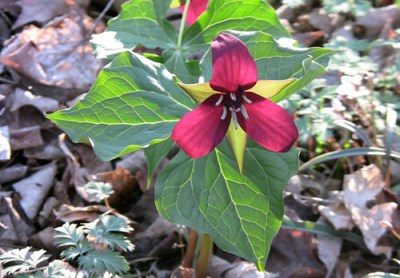
Migrants arrived in high numbers over the weekend! The recent warm front was brief but a “cooker” nonetheless, bringing an excellent variety of insectivorous migrants to southern Ontario. This mornings survey along Canoe Lake Road featured overcast skies, warm temperatures and a sharp increase in budding foliage. Emerging ground cover species including Dutchman’s Breeches, Bloodroot and Large-flowered Trillium have brightened up the forest floor and American Toads are suddenly the most vocal of amphibians in the area.  I also spent the 60 minutes of the survey entertaining an attendant mob of excited Black Flies, which was a less welcome change from recent days!

redtrillium
Large-flowered Trillium (red morph)

Semi-daily surveys of migrant birds along Canoe Lake Road have been very interesting to say the least and some patterns of habitat relation and orientation are beginning to emerge. Other than the usual icterid species (Red-winged Blackbird and Common Grackle), there were no particular species in great supply this morning. A total of fifteen new arrivals were tallied, which included eight newly arrived warbler species. Also new to the scene were singles of Rose-breasted Grosbeak and Eastern Towhee, both common breeders in the region. The next update on spring migration along Canoe Lake Road will be posted on April 30, 2009.

Results (“first of season” species in bold)

Canada Goose    5
Mallard    2
Ruffed Grouse    1
Common Loon    1
Red-shouldered Hawk    1
Mourning Dove    2
Belted Kingfisher    1
Yellow-bellied Sapsucker    4
Downy Woodpecker    1
Northern Flicker    4
Eastern Phoebe    3
Great Crested Flycatcher    2
Warbling Vireo    1

Blue Jay    4
American Crow    7
Black-capped Chickadee    8
Red-breasted Nuthatch    1
House Wren    3
Ruby-crowned Kinglet    3
American Robin    5
Brown Thrasher    2
European Starling    4
Orange-crowned Warbler    1
Yellow Warbler    3
Yellow-rumped Warbler    11
Black-throated Green Warbler    1
Pine Warbler    5
Black-and-white Warbler    2
Ovenbird
2
Common Yellowthroat    1
Eastern Towhee    1
Chipping Sparrow    4
Song Sparrow    3
Dark-eyed Junco    1
White-throated Sparrow    5
Rose-breasted Grosbeak    1
Red-winged Blackbird    26
Eastern Meadowlark    2
Rusty Blackbird    2
Common Grackle    14
Purple Finch    1
Pine Siskin    6
American Goldfinch    3

Spring Species Total=63
Average # Individuals per Census=144.6
Average # Species per Census=30

Migration Census- 24/04/2009

hepatica
Round-lobed Hepatica

Results (first of season species in bold)

Canada Goose 7
Ruffed Grouse 1
Common Loon 1
Turkey Vulture 1
Red-shouldered Hawk 2
Ring-billed Gull 1
Mourning Dove 1
Yellow-bellied Sapsucker 2
Downy Woodpecker 1
Hairy Woodpecker 2
Northern Flicker 4
Pileated Woodpecker 1
Eastern Phoebe 4
Blue Jay 9
American Crow 1
Horned Lark 1
Tree Swallow 1
Black-capped Chickadee 4
White-breasted Nuthatch 3
Ruby-crowned Kinglet 3
American Robin 10
European Starling 6
American Tree Sparrow 1
Chipping Sparrow 4
Song Sparrow 17
Swamp Sparrow 1
Dark-eyed Junco 7
Red-winged Blackbird 14
Common Grackle 25
Purple Finch 2
Pine Siskin 8
American Goldfinch 13

Season Species Total=47

Funding Announcement

rsha2
Red-shouldered Hawk

The Migration Research Foundation is pleased to announce that financial support for Frontenac Bird Studies has been received from The John Hackney Foundation for the Noosphere! This grant will go directly to support operating costs of the upcoming Frontenac Breeding Birds program. Our sincere thanks to the foundation and Bruce Gill for this generous pledge to the protection of bird populations and habitats in the Frontenac Arch.