

The first spring survey of migrant birds along Canoe Lake Road was windy and cold with just a few migrants recorded. The route begins on Canoe Lake Road, opposite Kingsford Lake and continues south along the road for 1.2 kilometres. This stretch of road encompasses a representative range of habitats in the area, which includes mature deciduous and mixed-deciduous forest, wetlands and small meadows. This route is appropriate for counting migrants as the presence of the gravel road and also several properties used for low-intensity agriculture has created edges where migrants congregate. Surveys along this same route during autumn 2008 revealed a substantial abundance and variety of migrant species. This will be the first spring season of migration surveys in the immediate area and it will be very interesting to compare and contrast to the fall season of last year.
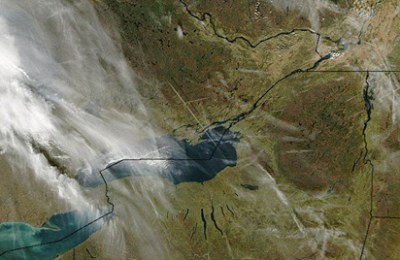
The Frontenac Arch is a massive habitat corridor, which supports a wide range of migratory fauna. The FBS study area, over 15,000 hectares in size, is but a sample of a landform spanning two countries and five ecoregions! Unlike Point Pelee or any other “migrant trap” near large geographic barriers, our study area is inland with few conditions for producing the extreme funnel effect observed at typical migration hotspots. This means that our Spring and Fall Migration Census will certainly yield a lower sample from comparable effort. However, the vast majority of migration studies have been focused on migrants at coastal sites where abundances of birds reach incredibly high densities and where surveys and other studies can produce large samples. Dedicated migration studies for the Frontenac Arch may provide a unique assessment as the projects will focus on the characteristics and value of a habitat corridor that is contrastingly large, relatively intact and is largely inland. Our Frontenac Migratory Owl Watch program as well as the Spring and Fall Migration Census will give us some essential benchmarks and direction for further research and monitoring.
This morning’s census produced 27 species, which included singles of Field Sparrow and Yellow-bellied Sapsucker as well as low numbers of Eastern Phoebe and Fox Sparrow. Purple and American Goldfinches have increased substantially in recent days while a surprising number of Pine Siskins and even Common Redpolls remain in the area (3 redpolls on April 11). Despite the weather, it was great to be out counting birds and we are looking forward to the warmer weather and new arrivals coming our way! The next census will be April 14, 2009.
Results
Canada Goose 69
Common Merganser 1
Red-shouldered Hawk 1
Mourning Dove 4
Yellow-bellied Sapsucker 1
Downy Woodpecker 1
Hairy Woodpecker 4
Northern Flicker 2
Pileated Woodpecker 1
Eastern Phoebe 3
Blue Jay 8
American Crow 7
Black-capped Chickadee 16
White-breasted Nuthatch 2
American Robin 9
European Starling 4
Field Sparrow 1
Fox Sparrow 3
Song Sparrow 5
Dark-eyed Junco 6
Red-winged Blackbird 29
Common Grackle 13
Brown-headed Cowbird 2
Purple Finch 4
Pine Siskin 7
American Goldfinch 5

 While our flagship program, Frontenac Breeding Birds, will not begin officially until mid-May, 2009, we will have several activities to keep us going in the meantime. Starting on April 12, we will commence bird surveys on alternating days along Canoe Lake Road for the Spring and Fall Migration Census program. This program will continue on a regular basis until May 31 for the spring and will start-up again in August for the autumn season. In the next couple of weeks, we will also initiate nocturnal surveys of breeding owls in the FBS study area. April is the best window for conducting these surveys as owls of all species breeding in the area will be active. All of these activities will be heavily featured in the blog, along with other noteworthy sightings, events and developments.
 Frontenac Bird Studies