Common Grackles have been second only to Red-winged Blackbird in terms of abundance in the area of late. A dedicated group of about 20-40 individuals have been frequenting the feeders at the FBS “office”. This species has already begun nesting in the region and will be commonly encountered during the Frontenac Breeding Birds program in late spring through summer.
Purple Finch (Carpodacus purpureus)
Purple Finches were scarce during the past winter but have returned to the area en masse in the last month or so. Much like other northern finch species, populations of the Purple Finch are closely tied to seed crops and also outbreaks of budworm catterpillars in the north. Distribution and abundance maps from the Ontario Breeding Bird Atlas mark a strong association of this species to the Southern Shield region where high quantities of suitable habitat can be found (coniferous and open mixed-deciduous forest). Despite its more robust features, interspecific competition with the introduced House Finch (Carpodacus mexicanus) has significantly reduced population size of the Purple Finch.
Our first Rose-breasted Grosbeaks of the spring were recorded this morning and we’ve been fortunate in having two males join the finches and grackles at the feeders this afternoon.
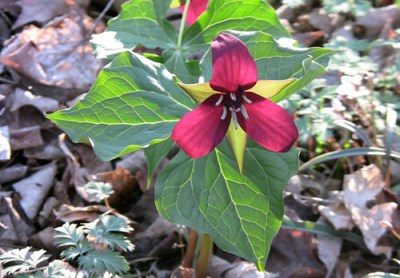
Migrants arrived in high numbers over the weekend! The recent warm front was brief but a “cooker” nonetheless, bringing an excellent variety of insectivorous migrants to southern Ontario. This mornings survey along Canoe Lake Road featured overcast skies, warm temperatures and a sharp increase in budding foliage. Emerging ground cover species including Dutchman’s Breeches, Bloodroot and Large-flowered Trillium have brightened up the forest floor and American Toads are suddenly the most vocal of amphibians in the area. I also spent the 60 minutes of the survey entertaining an attendant mob of excited Black Flies, which was a less welcome change from recent days!
Large-flowered Trillium (red morph)
Semi-daily surveys of migrant birds along Canoe Lake Road have been very interesting to say the least and some patterns of habitat relation and orientation are beginning to emerge. Other than the usual icterid species (Red-winged Blackbird and Common Grackle), there were no particular species in great supply this morning. A total of fifteen new arrivals were tallied, which included eight newly arrived warbler species. Also new to the scene were singles of Rose-breasted Grosbeak and Eastern Towhee, both common breeders in the region. The next update on spring migration along Canoe Lake Road will be posted on April 30, 2009.
Results (“first of season” species in bold)
Canada Goose 5
Mallard 2
Ruffed Grouse 1
Common Loon 1
Red-shouldered Hawk 1
Mourning Dove 2 Belted Kingfisher 1
Yellow-bellied Sapsucker 4
Downy Woodpecker 1
Northern Flicker 4
Eastern Phoebe 3 Great Crested Flycatcher 2
Warbling Vireo 1
Blue Jay 4
American Crow 7
Black-capped Chickadee 8
Red-breasted Nuthatch 1 House Wren 3
Ruby-crowned Kinglet 3
American Robin 5 Brown Thrasher 2
European Starling 4 Orange-crowned Warbler 1
Yellow Warbler 3
Yellow-rumped Warbler 11
Black-throated Green Warbler 1
Pine Warbler 5
Black-and-white Warbler 2
Ovenbird 2 Common Yellowthroat 1 Eastern Towhee 1
Chipping Sparrow 4
Song Sparrow 3
Dark-eyed Junco 1
White-throated Sparrow 5 Rose-breasted Grosbeak 1
Red-winged Blackbird 26
Eastern Meadowlark 2
Rusty Blackbird 2
Common Grackle 14
Purple Finch 1
Pine Siskin 6
American Goldfinch 3
Spring Species Total=63 Average # Individuals per Census=144.6 Average # Species per Census=30
The Migration Research Foundation is pleased to announce that financial support for Frontenac Bird Studies has been received from The John Hackney Foundation for the Noosphere! This grant will go directly to support operating costs of the upcoming Frontenac Breeding Birds program. Our sincere thanks to the foundation and Bruce Gill for this generous pledge to the protection of bird populations and habitats in the Frontenac Arch.
I spent the better part of yesterday afternoon scouting possible sites for our intended MAPS stations in the FBS study area. Frontenac Breeding Birds is the flagship program of Frontenac Bird Studies set for launch in mid-May, 2009. This program is being developed for the purpose of long-term inventory, monitoring and research of the region’s breeding bird populations. The Ontario Breeding Bird Atlas (OBBA) and North American Breeding Bird Survey (BBS) are two excellent sources of data that reveal long-term changes in population size and distribution of breeding birds. Across the continent, state/provincial atlas programs and BBS survey routes are extensive in coverage, providing an important foundation for monitoring bird populations. You may be thinking “why bother establishing Frontenac Breeding Birds?”
Both the OBBA and the BBS programs are devoted to monitoring bird populations at a broad scale, such as a province, state, country and/or continent. These programs are therefore “extensive” in their focus rather than “intensive”. Used in conjunction, these programs are a critical barometer of population trends that pinpoint regions or species of particular concern for conservation. The recently published 2nd edition of the Ontario Breeding Bird Atlas clearly indicated a marked association of the Frontenac Arch ecotone as a sort of “stronghold” for many of Ontario’s bird species, including a high number of Species at Risk. The goal of our Frontenac Breeding Birds program is to take this important direction and further the understanding and awareness of bird populations in the Frontenac region by way of increased effort, an integrated approach to monitoring and by initiating more specific studies. Observational survey methods used by the OBBA and BBS were designed to index population size and range for North American bird species. Having this knowledge is a critical first step in the process of establishing priorities for conservation and research. The Frontenac Breeding Birds program represents an intensified and more comprehensive monitoring regime for breeding birds in the Frontenac Arch, a region of high conservation concern. Our approach will include annual monitoring of breeding bird demographics through the installation of a network of Monitoring Avian Productivity and Survivorship (MAPS) stations.
Modeled after the Constant Effort Ringing scheme in the United Kingdom, the Monitoring Avian Productivity and Survivorship (MAPS) program was initiated in 1989 to provide long-term demographic data for North American landbirds. After a four-year pilot study, the MAPS program was endorsed by Partners in Flight, U.S. Geological Survey and the U.S. Fish and Wildlife Service indicating that MAPS was “the most important project in the nongame bird monitoring arena since the creation of the Breeding Bird Survey”. Over 1000 MAPS stations have been activated in the United States since 1989 contributing heavily to research, land management and conservation strategies. So far, Ontario has lagged behind in having less than 10 active MAPS stations in total. A MAPS network in the FBS study area will procure the first-ever index of demographics for local breeding bird populations and with subsequent annual monitoring, will serve as a barometer of the health and vitality of associated habitats. At the local and regional level, the incorporation of a MAPS network is a cost-efficient strategy for evaluating ecological stability in the landscape as a single station alone can yield vital rate statistics for an area up to 12,000 hectares from the centre of each station (due to post-fledging dispersal). This MAPS network would provide a valuable tool to evaluate management actions and various magnitudes and types of environmental and anthropogenic influence. We are also hoping to promote the MAPS program across southern and central Ontario where increased effort and participation could be of considerable ornithological and conservation value.
The majority of the FBS study area is privately-owned, which presents a challenge to find sites of a suitable nature and where permission to do the work can be obtained. Fortunately, the region has a good selection of protected land owned by the crown and municipal government. We are still in the process of selecting sites for MAPS but we are intending to install two or more stations in 2009 that will sample representative species and habitats of the region. The following is a sneak preview of some of these potential sites.
Frontenac Provincial Park (near Dipper Bay, Birch Lake)
Mature deciduous forest interspersed with lakes, beaver ponds and ephemeral creeks is a dominant habitat type in the area. Valleys often contain a denser shrub layer, vernal pools and flooded forest. Ridges typically have characteristic upland oak-juniper savannah. Charactertistic tree species include Oak, Maple, Ash, Birch, Beech and lesser quantities of Ironwood, Basswood and Shagbark hickory to name a few. Barred Owl, Red-shouldered Hawk and Cerulean Warbler are common to these forests.
Large Beaver Pond in hemlock forest type
This is an example of a large pond created by beavers in another tract to the north of Frontenac Provincial Park. This habitat is mixed-coniferous with cedar and hemlock being dominant tree species. These areas are characteristically wet with a dense understory of coniferous saplings and herbaceous plants. Wetlands occur throughout and include some bog environments. Typical bird species of this forest type should be Winter Wren, White-throated Sparrow, Magnolia Warbler and Hermit Thrush to name a few. The picture above is classic of the Frontenac Arch where the landscape transitions to Canadian Shield.
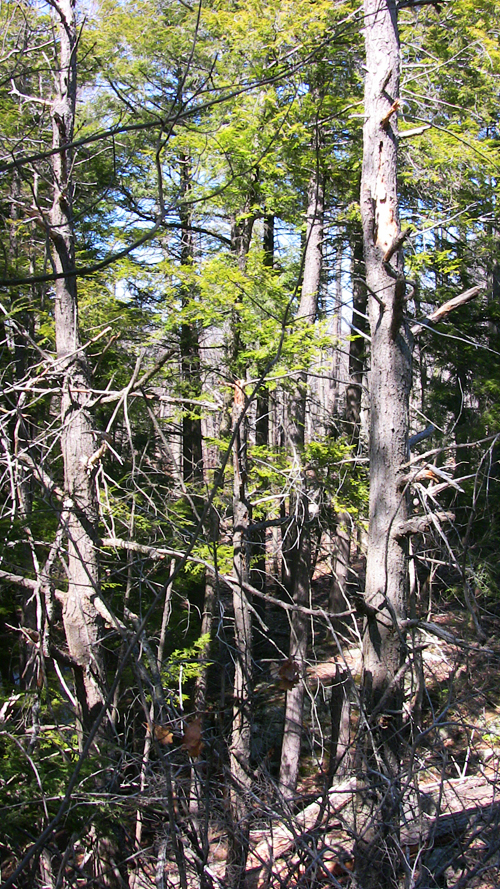
Dan's eye-view of the forest interior
Here is a closer view of this habitat type. This will certainly be the most difficult terrain to navigate due to the dense growth and preponderance of wet and mossy dead snags and stumps. However, we will happily sacrifice our shins for the opportunity to learn more about this fascinating habitat and its inhabitants!
Bog environment near Devil Lake Road
I visited this bog habitat in another tract to the east. This wetland already contains Swamp Sparrow and Wood Ducks and various woodpecker species (and a varied cast of vocal amphibians!). The number of wetlands of various kinds in the area is quite remarkable, which provides an interesting and ever changing blend of aquatic and terrestrial birds on any given hike. There are also acidic tamarack-spruce bogs in the area, which consist of carniverous plants and other truly northern specialties (more on these spruce bogs later).
The MAPS stations will begin operating in late May-early June, which gives us some time to finalize our site plans, order equipment and look forward to many early mornings with birds in summer 2009! Stay tuned for more details……






 Frontenac Bird Studies