News and Articles

Scouting for M.A.P.S-Maplewood Bog

IMG_9465
Maplewood Bog MAPS Station

This is our preview of the Maplewood Bog MAPS site, one of three stations in our soon to be realized MAPS network in the FBS study area. The Hemlock Lake MAPS station was previewed here last week. Maplewood Bog (MABO) is another very interesting site and has more of a deciduous “flavour” than the other two stations in the area. The site was named after the abundance of maple here and the presence of several rich bog environments. A visit to the site yesterday afternoon revealed a diverse abundance of breeding birds, which included Black-and-white Warblers, Scarlet Tanagers, American Redstarts, Ovenbirds, White-throated Sparrows, Blue-headed Vireo, Veery and a “good” number of Wood Thrushes.

Much like the Hemlock Lake site, the 20 hectare Maplewood Bog station is highly varied with dry oak-juniper savannah, mature decidous forest & patchy mixed forest as well as many streams, bogs and a large lake to the west. Eastern Towhee and Field Sparrows were common in the dryer open habitats, while Scarlet Tanagers and a Yellow-throated Vireo sang from the mature woodland less than 50m away.

Edges can be hard to find in this heavily wooded area of the Frontenac Arch. These edges are important features for sampling dispersing young birds in mid-late summer. Adult birds can be readily captured and banded in forest interior locations during the early part of the summer but these locations are often vacated once young have fledged. Therefore, in establishing a new MAPS site, we try to arrive at a balanced selection of interior and edge locations for mistnets, which should maximize sample for the extent of the breeding season. In this region, wetlands and clearings provide the important balance to forest-interior netting sites.

For me the most compelling aspect of this site is the abundance of deciduous forest species, particularly the thrushes. I encountered several Veery and at least three Wood Thrushes that seemed to be holding territories. With many more birds yet to arrive, this site should have a great mix of species and will be a very nice compliment to the more coniferous obligate species of Hemlock Lake. I managed to record this singing Wood Thrush with my new microphone and have uploaded a short piece of it below (click play button).

h

j

Highlights of Species from Maplewood Bog (MABO) on May 13, 2009

Veery
Wood Thrush
Yellow-throated Vireo
Red-eyed Vireo
Blue-headed Vireo
American Redstart
Chestnut-sided Warbler
Common Yellowthroat
Yellow-bellied Sapsucker
Great Crested Flycatcher
Swamp Sparrow
White-throated Sparrow
Field Sparrow

Migration Update- May 11, 2009B

IMG_3999
Black-capped Chickadee with nesting material

k

There is no clean division between the migration and breeding seasons. While new migrants continue to arrive in the Frontenac Arch, many are well into their first nesting cycles including this resourceful Black-capped Chickadee. The migration census of May 11 revealed a total of 40 species during the one-hour survey. One of the strengths of monitoring avian migration at coastal sites is that these locations attract a high number of migrants, which stay for very brief periods and also that these sites are generally low in breeding bird abundance and diversity. Conversely, surveys of birds along Canoe Lake Road in May include a disproportionate sample of species that breed in the area and it is therefore difficult to decipher the passage migrants from the “locals”. Repeating these surveys in mid-late June would be necessary to compare and contrast with our spring migration results.

Highlights of the latest census include another singing male Cerulean Warbler, two Golden-winged Warblers and the first arrival of Chestnut-sided Warbler for the spring. Also of note was the discovery of this Yellow-bellied Sapsucker nest, which is unusually positioned within a narrow band of trees at the roadside between two cattle pastures.

IMG_3994
Yellow-bellied Sapsucker nest

g

Results (first of season species in bold)

Canada Goose    2
Common Loon    1
Mourning Dove    3
Ruby-throated Hummingbird    3
Belted Kingfisher    2
Yellow-bellied Sapsucker    2
Northern Flicker    1
Eastern Phoebe    2
Great Crested Flycatcher    4
Warbling Vireo    2
Red-eyed Vireo    6
Blue Jay    5
American Crow    1
Black-capped Chickadee    6
Red-breasted Nuthatch    2
White-breasted Nuthatch    2
Wood Thrush    2
American Robin    3
European Starling    2
Golden-winged Warbler    2
Nashville Warbler    1
Yellow Warbler    3
Chestnut-sided Warbler    1
Yellow-rumped Warbler    1
Pine Warbler    1
Cerulean Warbler    1
Black-and-white Warbler    2
Ovenbird    4
Common Yellowthroat    3
Scarlet Tanager    1
Chipping Sparrow    9
Song Sparrow    3
Swamp Sparrow    1
Rose-breasted Grosbeak    6
Bobolink    1
Red-winged Blackbird    9
Common Grackle    5
Baltimore Oriole    6
Pine Siskin    2
American Goldfinch    8

Season Species Total-89

Migration Update-May 9,2009

sunset
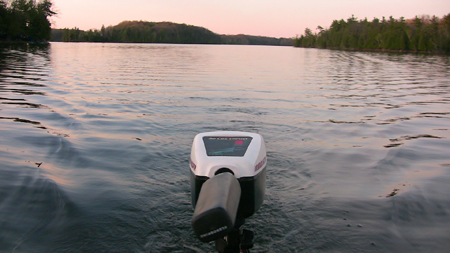
Returning from the field on Kingsford Lake

I’ve been slowly transitioning from the office to the field since May began, which has been a welcome change. The image above was taken during a recent boat trip to one of various field sites in the area. Our modest watercraft will be used extensively throughout the summer to access key sites along the western edge of Frontenac Provincial Park via Kingsford and Birch Lakes. Powered by an electric motor, our fiberglass vessel is appropriate for us in being environmentally sound and quiet, although perhaps a little lacking in the speed department!

The migration census scheduled for the 8th was postponed by a day and conducted instead on Saturday, May 9th. At the first step of the survey it was obvious that birds were plentiful, many of which were newly arrived to the area. I decided it might be instructive to examine habitat associations of migrants along Canoe Lake Road. The normal census route (CLR1) travels south along the narrow graveled road for 1.2 kilometers through a varied mix of habitats, which includes mixed-age deciduous forest stands, meadow and various successional habitats along edges. Cottage residences and farm fields create a more open landscape along the length of the route. Conversely, traveling north from the start point passes through a much less open environment with predominantly mature deciduous forest with fewer clearings and edge components. Yesterday morning, upon completion of CLR1, I returned to the start point and conducted a survey with the same methodology but this time in the opposite direction through the mature forests (CLR2).

Results

A total of 38 species were recorded along CLR1, which included seasons firsts of Barn Swallow, Barred Owl, Bobolink and a striking Cerulean Warbler during the final minute. A pair of Yellow-throated Vireos in a hedgerow near the large meadow was a treat along with first records of Wood Thrush and Ruby-throated Hummingbird for the spring surveys. A season high of six Ovenbirds was also a highlight of the survey. Upon return to the start point, I flipped to a new page of my field notes and began an independent survey of birds along the length of CLR2 (1km). There were some notable contrasts, the most apparent of which was the tally of 19 Ovenbirds, a substantial increase in density compared results for CLR1! A total of 40 species were recorded, consisting of thirteen not recorded at all on CLR1. Scarlet Tanager, Black-and-white Warbler, Great Crested Flycatcher and the aforementioned Ovenbirds were substantially more common in the mature, less fragmented habitats of CLR2. Results in the table below are likely reflective of species-specific preferences of habitat size, type, structure and continuity.

The stopover ecology of various species is a growing subject of study for scientists and for good reason. Migratory bird populations are dependent on the availability of viable habitats for rest and refueling. Without these “stopover sites”, most migratory bird species would fail to reproduce each summer. Relatively little is known about the characteristics and function of the Frontenac Arch as a stopover area for migrating birds. Simultaneous surveys of migrants in divergent habitat types on a regular basis in both the spring and fall would be an instructive first step toward a basic description of landbird migration in the region.

table

Scouting for M.A.P.S- Hemlock Lake

Hemlock Lake MAPS Site

All of the needed permits and agreements are now in place to move forward with more detailed planning for the installation of three Monitoring Avian Productivity and Survivorship (MAPS) stations in our study area. With the study area being over 15,000 hectares in size, it has been a big project just to develop a basic framework for maximizing the utility of the MAPS program for the purposes of our Frontenac Breeding Birds initiative. From the beginning it was clear that one station would be good, two would be better and that three could be a powerfully instructive network of stations that could calculate and monitor avian demographics for an area of approximately 22,000 hectares (not bad for 21 days of fieldwork!). This initiative also represents the first major expansion of the MAPS program in Ontario since 1995 when a total of six stations were simultaneously initiated in 1995 at Kakabeka Falls in Northwestern Ontario, all of which closed in 1998 (there have been a few isolated stations added in the province since that time). It is our intention to continue adding stations in strategic areas as we move forward. However, establishing these first three will be important to understand appropriate criteria for future expansion and to test feasibility of specific landscape components for the MAPS program in this region.

HELAswamp
Young hardwood forest swamp

Selecting suitable sites for MAPS is a slightly tricky business as many factors have to be considered including access, habitat components, species assemblage as well as proximity of infrastructure, development and agricultural activity. In developing our MAPS network we were careful to consider sites that could be accessed relatively comfortably and that were fairly consistent in degree and type of anthropogenic pressure, habitat maturity and habitat structure. However, a hallmark of the Frontenac Axis is its heterogeneity, and it is true that something quite different can be found at any turn. All three of our sites are similar but will have distinct characteristics of slope, vegetation, hydrology and representative bird species. This will allow us to sample a broad array of breeding bird species and also provide the opportunity to study some species shared by all three stations that are occurring in differing landscape contexts.

The panoramic image above was taken from our new Hemlock Lake (codename HELA) site, which is a site that I’ve been very keen on since my first visit in January, 2009. The site is a spectacular example of the Frontenac Axis with shield-like features and characteristically southern forest elements. The 20ha site is focused around a small lake with hundreds of flooded snags. The perimeter of this lake is very rocky with meandering creeks and small wetlands. The habitat is predominantly successional coniferous forest with young hardwood communities, however mature mixed-forest and juniper-rock barrens are also abundant in the area. A visit to the site yesterday was very buggy to say the least but I did find an impressive community of birds, which seemed to be on territory within the site. A shortlist of the species mix is provided below. We will return to this site once the Black Flies have relented to set up for our first banding day in early June, 2009. It is going to be an absolute pleasure to spend seven summer mornings with the birds at Hemlock Lake!

Hemlock Lake (HELA) Species on May 7, 2009

Black-throated Green Warbler
Black-and-white Warbler
Nashville Warbler
Northern Waterthrush
Yellow-rumped Warbler
Ovenbird
Brown Creeper
Hermit Thrush
Winter Wren
Pileated Woodpecker
Yellow-bellied Sapsucker
Yellow-throated Vireo
Rose-breasted Grosbeak
Eastern Towhee
White-throated Sparrow
Red-shouldered Hawk