Crunch time has arrived as we make final preparations for the start up of the Frontenac Breeding Birds program in early June. Establishing the MAPS sites has been the main task on the agenda but we’ve also been delving into establishing over 180 point count stations, getting ready for Project Whip-poor-will and the usual administration duties. Things should clear up by early next week and I should be back to regular blogging by the end of the weekend. I have yet to start nest searching in an “official” manner but have already found nests of a dozen species. I was very pleased to find a Winter Wren nest yesterday evening and have since added Red-eyed Vireo, Rose-breasted Grosbeak and a second Hairy Woodpecker nest to the list from this afternoon. No sign of a nest yet for the residing pair(s) of Ruby-throated Hummingbirds at the FBS headquarters….
Of the three MAPS stations we’re establishing for the Frontenac Breeding Birds project, I’ve definitely had the most difficulty finalizing a layout for the Maplewood Bog station to the north of Frontenac Provincial Park. This particular site seemed to have the most uniformly structured forest and the least number of readily identifiable edges. It was however, the closest thing to pure deciduous forest of the three, which presented our best opportunity to sample species typical of this forest type. My last visit on May 14th, just ten days ago, gave me a bit more confidence that a viable MAPS station could be conducted there but I still had some lingering doubts.
I returned to MABO (station codename) this morning with the hope that I might find some lovely rock outcrops, forest clearings or wetlands that I’d missed on previous visits and also that some new species had arrived since mid-May. Today was my day as I found both! The most notable change since the last visit was the rather sudden appearance of Cerulean Warblers at the site (second only to a mass irruption of Mosquitos!). I hadn’t encountered them previously at MABO but they have been numerous along Canoe Lake Road this spring. In Ron Weir’s latest edition of Birds of the Kingston Region, he makes note of a high count of 25 singing males along Canoe Lake Road on May 15, 1979. Cerulean Warblers seem to have a tendancy to aggregate into colonies, although the reasons for this habit are unclear. Each MAPS station is 20 hectares, inside of which standardized misnetting of breeding birds occurs within an 8 hectare plot. I was delighted to find a total of five singing males within the banding area itself, none of which were audible from the nearby road where the site is accessed. Some of these vocal males may be unmated bachelors but I was able to confirm two pairs and found some evidence of nesting. Ceruleans were located in younger portions of the woodland with an uneven canopy and open understory and seemed to be favouring spots with mature oak sp. protruding through the canopy. The Cerulean Warbler is one of the most heavily declining bird species in North America and is a species of Special Concern in Canada and Ontario.
In addition to the parade of Cerulean Warblers, I also found a great abundance of other deciduous species, the most conspicuous of which were Veery, American Redstart, Red-eyed Vireo and Scarlet Tanager. Other birds of note were Yellow-throated Vireo, Barred Owl, Wilson’s Snipe, Swamp Sparrow, Black-throated Blue Warbler and Magnolia Warbler. The foliage was markedly further along today than my last visit and this was a great help in finalizing the layout of the MAPS station. I didn’t have much time for nest searching but I was very happy to find a Scarlet Tanager nest about 10 feet above the ground at the edge of a blanket bog!
With the layout for MABO now having been properly visualized, we are set to begin site prep next week in advance of our first visit to all three sites in the first week of June. The MAPS work will operate in tandem with an extensive network of on and off-road point count stations throughout the 15,000 hectare study area. An intensive nest-monitoring effort will also commence during the first of June. It will be an eventful and probably very tiring two months of fieldwork but we are in an excellent position to deliver this exciting new initiative. I wonder how many Cerulean Warblers can be found in 15,000 hectares of forest in the northern Frontenac Arch?
This is the final preview in a three part series profiling our network of Monitoring Avian Productivity and Survivorship (MAPS) network in the Frontenac Arch. The panoramic image posted above is from the eastern boundary of our Rock Ridge MAPS site, which is 7 kilometers away from the Hemlock Lake station and 5 kilometers from Maplewood Bog. Rock Ridge is the most remote of the stations, being accessible by portage and a short paddle to the western shoreline of a point jutting into a large deep lake in Frontenac Provincial Park. An alternate route to the site is via a roundabout hike of about an hour, which wasn’t an appealing prospect for seven visits at 4am while lugging equipment!
h
h
The site itself is a spectacular mixture of rock barrens, steep cliffs, successional forest/scrub and mature mixed forest. The avian communities are similarly diverse and includes species characteristic of open forest habitats such as Warbling Vireo, Baltimore Oriole, Red-eyed Vireo and Brown Thrasher. Large portions of the site consist of rock barrens with juniper, red cedar and oak-savannah, which host dense populations of Eastern Towhee and Field Sparrow among others. The northern and western slopes are more densely vegetated with mixed-age forest containing pine, cedar and various deciduous tree species. These forested slopes contain large numbers of Black-and-white Warblers, Nashville Warblers and White-throated Sparrows with lesser numbers of Scarlet Tanager, Northern Waterthrush, Yellow-rumped Warbler and Hermit Thrush. Also of interest in the area are black spruce-tamarack bogs, which are probably too small in size for Ruby-crowned Kinglets and other “spruce” specialists of the north. There are larger stands of black spruce in the region, which the extensive point count network will begin to survey in a couple of weeks time.
h
h
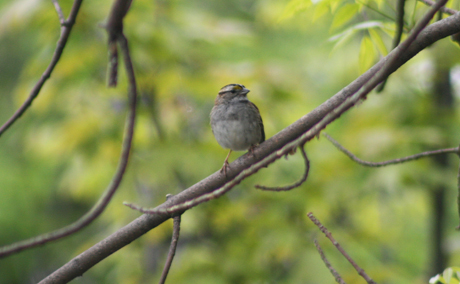
Traversing these rock barrens revealed a surprisingly high number of White-throated Sparrows, many of which are well into their first nesting attempts of the year. I didn’t have time to do any formal nest searching but I did GPS several locations of suspected nest sites.
f
h
Obviously there was more than just interesting birds in the area and I took particular interest in some of the recently sprouted wildflowers. With the help of our assistant Seabrooke Leckie, we were able to identify this attractive plant as Hook-spur Violet.
Returned to the Hemlock Lake site yesterday to begin searching for mistnet locations and to get a better picture of the breeding bird community for our study. The visit was considerably more comfortable than my last when black flies were particularly menacing! This latest visit was cool with very few biting insects, which afforded me a great opportunity to get to know the site a bit better. What a difference a couple of weeks can make in the late spring! The emerging foliage was substantially further along, which created a much different looking landscape. Site visits in winter and early spring gave me a solid understanding of the scale, topography and structure of the site but I knew that it wouldn’t be possible to even consider positoning net locations until the canopy and understory had matured.
Upon entry to the site, I heard Eastern Towhee, Scarlet Tanager, Nashville Warbler and a concert of voice-battling Ovenbirds. Further along to where the forest turns from deciduous to mixed-coniferous, I encountered Black-and-white, Magnolia, Black-throated Blue and Blackburnian Warblers, all species we were expecting at the site. Also of interest were at least two territories of Winter Wren, one of the most vocally adept species on the planet! I was able to record a few seconds of one of our talented males holding territory in the site along with one of the unavoidable male Ovenbirds (click play to listen).
h
Evidence of active nesting by many species included alarm calls, adults carrying nesting material and territorial disputes. I didn’t find a great number of nests but I did mark locations where a nest was suspected. I will have to return in a few days to a week to confirm presumed nest sites of Ovenbird, Black-and-white Warbler and Eastern Towhee among others.
h
h
However, I did manage to find the nest of a Brown Creeper, which was discovered by patiently watching movements and behaviour of a pair in the standing dead timber at the edge of Hemlock Lake. After sitting quietly for about 45 minutes, I was finally rewarded with the observation of an adult entering a tree with nesting material. The Brown Creeper places its nest almost exclusively in dead trees, between a loose flap of bark and the trunk. They build a hammock shaped nest of sticks and fibres, which is secured to the bark with insect-egg casings and spider silk. The nest will now be monitored with the goal of deriving a nest outcome. The information will be important to our demographic studies of breeding birds in the FBS study area and will be submitted to the Ontario Nest Records Scheme and Project Nestwatch for province-wide monitoring efforts. A closer view of the nest site is provided below.
h
Brown Creeper nest site
h
The most exciting discovery of the day led to this short video of a waterthrush carrying material to a nest in roots of an upturned tree along a clear moving stream. Northern Waterthrushes were quite vocal in the vicinity but this particular pair were all but silent except for some occassional contact calls between male and female. The calls were diagnostic of Louisiana Waterthrush but I will have to confirm identify of the nest owners at a later date. Northern Waterthrush are very similar in appearance with some subtle differences. It is best to distinguish the two by song, which are distinct. The Louisiana Waterthrush is a Species At Risk and a specialty of the Frontenac Arch region where an abundance of mature forest and clear moving streams provide suitable nesting habitat. The video is of less than ideal quality but one can clearly see an adult entering the roots about halfway up the screen to the left of the small tree trunk. The bird is more clearly seen at the end of the clip as it cryptically runs through the stream and out of the frame. Click here for HD version of this video clip.
h
h
The Hemlock Lake MAPS station will begin operating in early June and continue with one visit per ten-day block through the final visit in late July. We will also be conducting a standardized nest monitoring study at this and the other two MAPS stations in the FBS study area. The site is turning out to be a terrific find and hopefully a long-term home for our research and monitoring programs.
Notable Species at Hemlock Lake (May 18,2009)
Great Blue Heron
Red-shouldered Hawk
Eastern Kingbird
Brown Creeper
Winter Wren
Wood Thrush
Swainson’s Thrush (migrant)
Northern Parula (migrant)
Nashville Warbler
Yellow Warbler
Chestnut-sided Warbler
Magnolia Warbler
Cerulean Warbler
Black-throated Blue Warbler
Black-throated Green Warbler
Blackburnian Warbler
Black-and-white Warbler
Ovenbird
Northern Waterthrush
Louisiana Waterthrush
Common Yellowthroat
Scarlet Tanager
Eastern Towhee
Field Sparrow
Song Sparrow
White-throated Sparrow
Rose-breasted Grosbeak
Baltimore Oriole
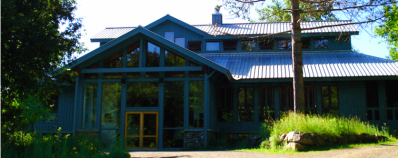
QUBS Operations Centre (source: Queen's University)
I had the pleasure of visiting with some of the staff and students at the Queen’s University Biological Station this past Friday. The station is located approximately 20 kms to the east of the Frontenac Bird Studies boundary (west boundary). The drive over was spectacular, starting southbound on Canoe Lake Road where I noticed Cerulean and Prairie Warblers singing from the edge of the road. I then traveled along the narrow and winding Little Long Road (southern boundary of FBS study area), which is certainly little but not terribly long. Boisterous Ovenbirds, Rose-breasted Grosbeaks and American Redstarts were abundant along this stretch. A short trip north along Perth Road took me to Opinicon Road. Opinicon Road is known as Cerulean Warbler “central” to most birders and this area in tandem with the FBS study area has one of the densest populations of this species in the world. I reached the turnoff to QUBS, which was conveniently marked “Queen’s University Road” and headed down a meandering gravel roadway to the station.
The Queen’s University Biological Station has been in operation for over 50 years on Opinicon Lake and has since grown into a world class facility for biological research. On the day of my visit, the station was a hive of activity as student and faculty researchers from all over North America and beyond were engaged in the day-to-day operations of field projects and courses. QUBS has acquired over 2000 hectares of habitat in the area for the purposes of conservation and study, making the university one of the largest stewards of protected land in the Frontenac Arch. This impressive list of theses and publications produced at QUBS includes the names of many distinguished biologists including Bridget Stutchbury and Adrian Forsyth.
I arranged to meet with Dr. Paul Martin, the Baillie Family Chair in Conservation Biology at QUBS, to discuss the FBS initiative and to stimulate ideas for collaboration and support. I also met Frank Phelan (QUBS Manager) and grad students Mark Conboy and Vanya Rowher. It was a very productive and enjoyable visit and I look forward to future contact and collaboration with the people of QUBS.




 Frontenac Bird Studies