News and Articles

American Redstarts at the nest

Click here for HD version (a little less than HD resolution due to use of digital zoom)

This two minute video was recorded yesterday afternoon at one of our field sites in Frontenac Provincial Park. I stumbled across this site on a point count route that spans predominantly young deciduous forest from the Trail Centre to Big Salmon Lake. The site is an unusual “island” of mature hardwoods surrounded by rock barren meadows and successional forest. Arriving at my point count station in the interior of this mature woodlot, I knew it was going to be a busy ten-minute survey as a dizzying variety of breeding birds were wheeling about in all directions. Scarlet Tanager, Yellow-throated Vireo, Ovenbird, Least Flycatcher and American Redstarts were the most conspicuous species noted. The male redstarts were particularly memorable, singing from everywhere and seemingly at all times. In this region of the Frontenac, American Redstarts are most numerous in wet deciduous woodland with a dense shrub understory and this site has it in spades.

I spent a good 3-4 hours at this site on a previous visit in search of nests for the purposes of gathering data on breeding demographics of regionally “common” landbird species. The American Redstart nest featured above took over an hour to locate as I followed the male on a proverbial “wild goose chase” to an array of curious locations throughout the forest without any success until I finally tracked down a female carrying food to a nest about 7m high in the main fork of a young maple. Males can be polygynous, often holding court with multiple nests, mates and territories within the same breeding season. This might explain why the male seemed to be leading me around through such a large area.

I revisited the nest on the following day, a rather wet and dreary afternoon, with the intention of filming the adults feeding young at the nest. The chicks were just a few days from fledging and were therefore demanding a lot of attention in the form of proteins and household maintenance. The chicks were no doubt getting restless with the cramped conditions as no less than four of them, nearly full grown, were packed into this little cup nest. The chicks frequently stretched and flapped their wings in the time I was there. Both male and female were appropriately attentive, visiting the nest equally as much, about 5 visits/hour per adult individual. Both sexes carried away fecal sacs from the young and the male seemed to bring a substantially larger total mass of food to the nestlings. It was hard to identify the offerings from a distance but it seemed as though moth caterpillars were the food of choice. I also noted that the female would brood the young during brief periods of the heaviest precipitation. The pair were fascinating to watch, particularly the male, who was an amazingly adept hunter of green larvae hiding in the foliage.
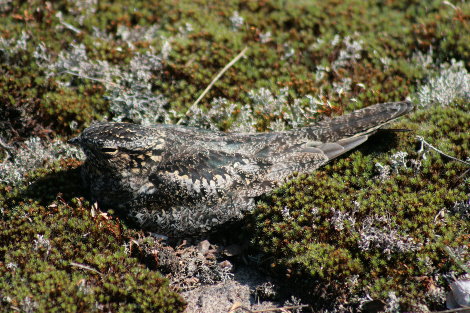
Common Nighthawk nest update

Incubating nighthawk (S.Leckie)

The Common Nighthawk nest first discovered at our Rock Ridge MAPS site is still active. This adult, probably a female, spent the morning of June 16th incubating eggs in the blistering sun and seemed to be catching up on some sleep as well. I called in Seabrooke to sweep by on a net check with her long lens for a photograph and it turned out very nicely as usual. The eggs have been incubated since at least June 2, which means that the chicks should hatch no later than June 21 if they haven’t already. We will be back for our third visit to the site around the middle of next week and will hopefully find two “nighjarlets” at the little rock outcropping. I will also be conducting two point count routes in rock barren habitat next week. Each route will be four kilometres long, which gives me a good opportunity to turn up some more of these fascinating birds.

Whip-poor-wills, waiting for the next full moon to approach, have been quiet of late but we did flush three individuals from Canoe Lake (1 bird) and Perth (2 birds) Rds on our pre-dawn drive to Rock Ridge on the 16th.

the Nest Files – Chipping Sparrow

3608411621_1ccabe97bf
Chipping Sparrow (S.Leckie)

Nidiologicals (from Peck and James 1987 and Middleton 1998)
Chipping Sparrow (Spizella passerina)

Habitat=open woodlands, parkland and treed fields
Spring arrival=April-May
Average nest height=0.9-2.4m
Nest builder=female
Average # of broods/season=2 (rarely 3)
Average Egg Date=June 4-June 20
Area sensitive=no
Average clutch size=4
Nest building period=~4 days
Incubation period=10-11 days
Microhabitat=high variable across geographic range; strong preference for conifers.
Egg colour=sky blue (rarely white) with irregular streaks, blotches and spots mostly at larger end
Incubation=female
Parasitized by cowbirds=yes

Nest searching in the FBS study area has been generally productive, although we’ve been forced to reduce the amount of time for dedicated searching due to time constraints in June. I’ve been monitoring about forty nests in the last two weeks and have been pleased with success thus far in finding nests at a good rate when time is available. Yesterday in two hours, I was able to find active nests of Blue Jay, American Robin, Eastern Wood-Pewee, Baltimore Oriole and American Redstart. This post is an in-depth profile of Frontenac nesting species number three (only about 190 to go!).

The Chipping Sparrow is one of North America’s most abundant songbirds, a species that has benefited from the creation of suitable habitat by human settlement and infrastructure from Newfoundland to Alaska through Central America. Unlike most sparrows, the Chipping Sparrow prefers open woodlands and treed edges of waterways and fields. They seem to occur in higher densities in urban settings than undisturbed habitats. I recall my surprise in encountering an abundance of Chipping Sparrows in taiga habitats near the treeline in the Northwest Territories where Chipping Sparrows nested on the ground or slightly elevated in spruce saplings. Here in the Frontenac Arch, “chippers” are abundant in most areas where natural or man-made forest clearings occur. Our point counts are revealing a strong preference for mixed forest sites containing Eastern White Pine and/or juniper.

IMG_9682
Chipping Sparrow nest contents (Derbyshire)

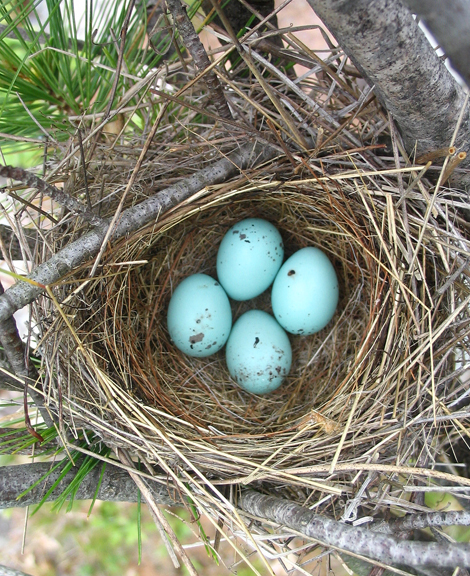
This Chipping Sparrow nest was discovered in Frontenac Provincial Park in early June within transitional habitat from young deciduous forest to mixed forest/rock barren. I was alerted to the presence of the nest by alarm calling adults. The nest was easily found at the outer end of a low pine bough, not terribly well hidden. The nest itself is a loosely formed cup consisting of dried grass with a more densely formed inner bowl of animal hair and fine plant fibers. The four eggs are a distinctive sky blue with irregular dark markings, mostly at the larger end. It was recently discovered that male Chipping Sparrows copulate with multiple females in neighboring territories (extra-pair copulations).

IMG_9683

These last three shots visually describe the nest position and the habitat. It is unusual for a Chipping Sparrow to select such an exposed location for the nest as this particular one is clearly visible from the sides and especially from below. Not surprisingly, the preference of Chipping Sparrows for wooded edges has exposed them to high rates of brood parasitism by Brown-headed Cowbirds. Interestingly, of the forty nests (all species) I have discovered thus far, I have yet to find a single case of parasitism. This is, in part, due to the habitat where nests have been found, interior forest sites where cowbirds are rare. I have begun nest searching in a forest plot adjacent to open habitats and will be interested to observe any divergence in rates of parasitism.

IMG_9679
Nest position (Derbyshire)

IMG_9684
Nest site (Derbyshire)

MAPS Visit 2-Maplewood Bog

Male Yellow-rumped Warbler

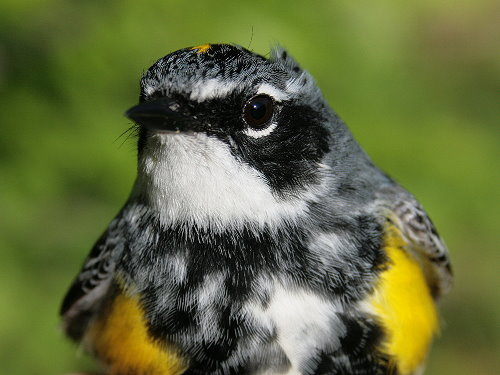
This will have to be quick update on our MAPS progress as I will be up at 3am in the morning for the second visit to the Rock Ridge site in Frontenac Park. We visited Maplewood Bog (MABO) for the second time this season on June 14th. The weather was splendid and the fieldwork was even better as a total of twenty birds were captured, of which six were recaptures of birds banded during our first visit on June 6. The forest birds seemed a little quieter than last time but activity picked up as the sun rose and the heavy dew was burned off. Perhaps the most interesting of the captures was a pair of Yellow-rumped Warblers in net 2 at about 6am. There is quite a large contingent of Yellow-rumps breeding in a nearby pine forest but we hadn’t noticed any at the station until these two showed up in the nets. Both the male and female showed evidence of active breeding so they likely have or had a nest nearby.

IMG_9853
Early morning sun at the banding station

This is the location of our banding station for the duration of the morning. This spot is next to a long and narrow clearing next to the main bog. The clearing seems to be a key “highway” of sorts where lots of adult birds congregate. The three nets along the edge of the clearing should be quite productive later in the season when the juveniles and adults move to more open and successional habitats to forage.

3627390418_31fbc6f6c3
The largest bog at Maplewood

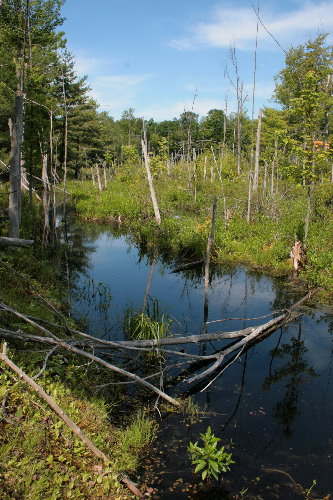
This is the largest of several bogs at the site, which all have complete rings or moats of deepish water along the perimeter and thick mats of sphagnum moss. Water Arum and irises have started to bloom along the water’s edge. It would be possible to walk on the moss if you could get past the moat but you would slowly sink and get very wet-very quickly (trust me on that one!). I suppose one could stay dry by skittering along really fast like a Western Grebe in courtship display but there wouldn’t be much point in doing such a thing:). The shrubs and stunted conifers in the middle of the blog always seem to have a large population of nesting birds but they are quite inaccessible to the terrestrial nest searcher/bander.

3626576621_1a562b818f
Seabrooke Leckie looking for breeding evidence

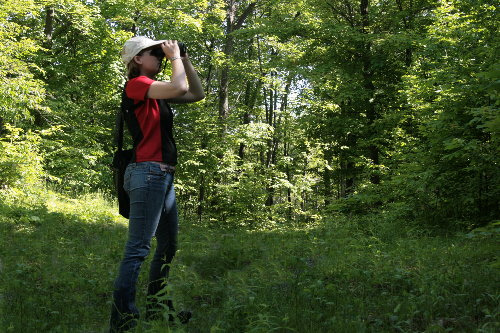
In addition to the six hours of mistnetting and banding, we also compile a daily breeding status code for each species recorded at the station. This information helps to weed out the actual breeders from transients and non-breeding residents. Seabrooke and I are often watching for adults carrying food or nest material and also keeping an eye out for recently fledged young.

3627388344_e22e2b2621
Veery nest now with five hungry chicks!

The Veery nest (detailed earlier here) is located in a small juniper near one of our net lanes, which has given us a convenient window into the world of a pair of Veerys raising a family. Our first capture of the morning was of an adult female with a caterpillar intended for one of these gaping maws. We later caught the male with another green caterpillar! It always amazes me how fast the eggs and chicks develop. Just nine days ago this nest contained five eggs and is now full to the brim with five chicks who already have their primaries coming through. Our next visit won’t be for another six to seven days, by which time these chicks will have fledged. These young Veerys, less than a week old, will begin a perilous southbound journey to central and southern Brazil in just a month or two from now.

A summary of results for our visit is provided below. Lights out…

Maplewood Bog- Visit 2 of 7

Banding Results

Yellow-rumped Warbler-2
Black-capped Chickadee-1
Veery-4
Rose-breasted Grosbeak-2
Gray Catbird-2
Yellow-bellied Sapsucker-2
American Robin-1

Recaptures

Ovenbird-1
Northern Waterthrush-2
American Redstart-1
Veery-2

Notable Observations

Chestnut-sided Warbler
Wood Thrush (nest found)
Ovenbird (nest found)
Yellow-billed Cuckoo
Yellow-throated Vireo
Red-shouldered Hawk

the Nest Files – Common Nighthawk

IMG_9621
Common Nighthawk nest contents

j

Although arguably the most studied nightjar in North America, the Common Nighthawk remains poorly known (Poulin et.al. 1996).

h

Species Abstract
Common Nighthawk (Chordeiles minor)

Habitat=primarily nests in open habitats such as rock barrens (also gravel roofs in urban areas)
Area sensitive=?
Average clutch size=2
Nest building period=0 (no nest built)
Incubation period=19 days
Microhabitat=on ground on substrates of either rock, sand, gravel, lichens etc.
Egg colour=variable; creamy white to pale olive gray, heavily speckled with greys, browns and blacks.
Nest site selection=female
Incubation=primarily female
Parasitized by cowbirds=no
k

This Common Nighthawk nest was first discovered at our Rock Ridge MAPS site on June 2, 2009. The female was inadvertently flushed from the nest when traversing one of the countless rocky flats at the site. Incidentally, a Whip-poor-will nest was also discovered on this day, less than 1km from the nighthawk nest. There won’t be many days of nest searching where that happens! Both of these species of the nightjar family have been much in the news of late because of their concurrent and precipitous decline in populations. Common Nighthawk was officially designated as a Species at Risk by COSEWIC in 2007 (Threatened) while Whip-poor-will was just recently recommended for listing in April of this year (Threatened). Nightjars are most active at dawn and dusk and are uniquely adapted to a food source of flying insects such as moths. It is suggested that the presence of a tapeta lucidum, a reflective structure of the choroid part of the eye, aids their vision during low light levels (Nicol and Arnott 1974). Relatively little is known about the breeding ecology and population dynamics of these two species, both of which commonly breed in the Frontenac Arch region of Ontario. Project Whip-poor-will will be starting up soon and will be designed to survey all nightjar populations in the FBS study area.

g

The photo of the “nest” above is typical for Common Nighthawks where the eggs, usually two in a full clutch, are laid directly on the ground without any addition of materials or linings. They will sometime excavate a small scrape to contain the clutch but this activity seems to be determined by the habitat in which they choose to nest. The habitat for nesting nighthawks is quite variable, ranging from gravel rooftops in urban locations to a variety of open habitats adjacent to forests. They frequently inhabit rock barrens as in this particular case but will also nest in recently burned or clearcut forests as well as agricultural fields and grasslands throughout the continent.

g


g
This short video clip was recorded of a defensive adult just after it was flushed off the nest. The Birds of North American account for the species describes defensive behaviour by both sexes as follows:

Male does not directly guard the nest (Dexter 1952) but may dive and boom over nest sites (Rust 1947); in addition, male may defend nest by wing-beating and hissing with mouth wide open (Dexter 1952). Female may use injury-feigning behaviour (fly away, then hiss at intruder) when flushed from eggs or young (Tomkins 1942).

j
I spent no more than three minutes in the vicinity of the nest as I didn’t want to cause any excess amount of distress to the adult tending the eggs. I have a precise fix on its location and will be able to check on its progress at a distance from now on. The photos below provide a longer perspective on the nest site in terms of habitat. I have flushed several of both Common Nighthawk and Whip-poor-will in the area of our Rock Ridge MAPS station since the initial discovery of this nest but have not yet turned up any additional nest sites. The park has a large amount of suitable habitat for Common Nighthawks, perhaps about 1200 hectares worth, which suggests that the species might be common throughout rock barren areas. I will be traveling through much of the barrens starting next week for point count surveys and hope to encounter more of these fascinating birds.
j

IMG_9616
Nest site on rocky slope
IMG_9628
nesting habitat