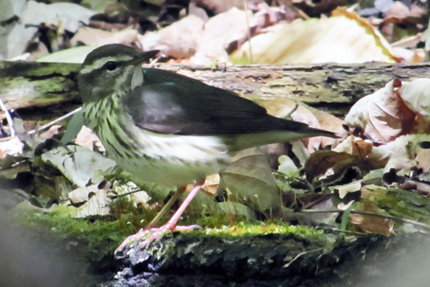
News and Articles

the Nest Files – Yellow-billed Cuckoo

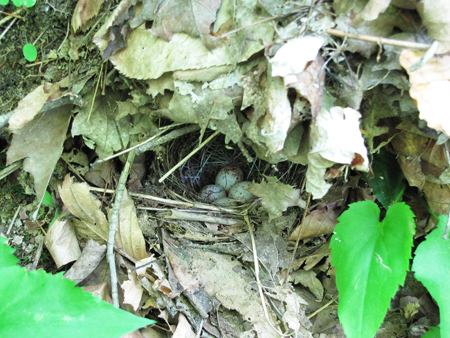
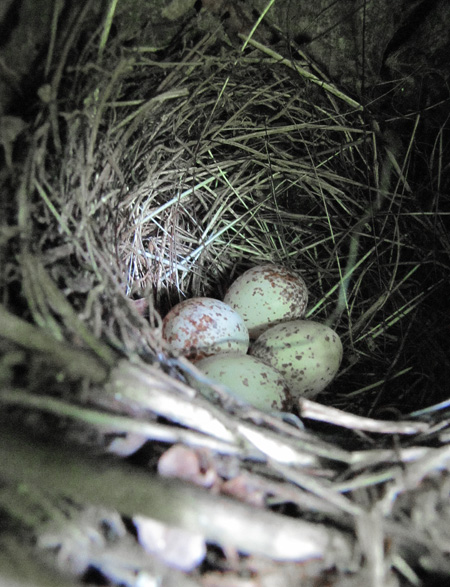
Yellow-billed Cuckoo nest with eggs

.

Yellow-billed Cuckoo (Coccyzus americanus)

.

Nidiologicals – Peck and James (1987) and Hughes, J.M. (1999)

Habitat – Open woodland habitats with clearings and dense shrub cover.
Microhabitat – Nest concealed by foliage on outer branch or main fork of tree or shrub.
Spring arrival – Early to late May (Ontario)
Average nest height – 1m-2m (Ontario)
Nest builder – Male and female
Average # of broods/season – 1 (multiple broods may occur when food sources abundant)
Average egg laying date – 9 June-4 July (Ontario)
Average clutch size – 2-3 eggs
Incubation period – Average 9-11 days
Egg colour – Unmarked pale bluish green.
Incubation – Male and female
Brown-headed Cowbird host – Yes

.

Adult incubating

The cuckoo family (Cuculidae) is a diverse group of over sixty species that inhabit all continents of the globe except for Antarctica. The Yellow-billed Cuckoo, like its relatives, has an unusual and complex breeding system. Yellow-billeds are non-obligate brood parasites, meaning that they will tend to their own nests but also lay eggs in nests of other birds, especially when food sources are abundant. They will deposit eggs in other Yellow-billed Cuckoo nests (intraspecific parasitism) but also target Black-billed Cuckoo, Wood Thrush, Gray Catbird and American Robin (interspecific). These species lay eggs that are most similar in appearance to their own (unmarked blue to greenish), thus suggesting egg-mimicry is involved.

Male and female Yellow-billed Cuckoos build their nests within a few metres of the ground, usually in areas with a dense shrub layer. Nests are loosely constructed platforms composed of twigs and sparsely lined with dried leaves, plant tendrils and bark strips (Hughes 1999). The nest pictured above was discovered on May 25, 2010. The lining of this nest included fresh leaves while a sprig of Reindeer Lichen was added later. Both sexes incubate but the male brings new material to the nest when subbing in for the female. There is a vast list of fascinating factoids about Yellow-billed Cuckoo nests but I was particularly struck when I read that young are reared from egg to fledgling in just 17 days! This particular observation is astounding….

At age 6-7 d (26-29 g), feather sheaths burst open; nestling methodically preens off sheaths with bill; within 2 h nestling is fully feathered, but tail is still short (Hughes 1999).

This almost supernatural feather growth is colourfully described by Dr. A.H. Cordier in 1932 as follows:

The first picture was made at nine o’clock. . . . This shows the young by the unhatched egg; the horny, sheathed feathers were fully two inches long, making the bird look like a porcupine. About ten-thirty the sheaths began to burst, and with each split a fully formed feather was liberated. This process took place with such rapidity that it reminded me of the commotion in a corn popper or a rapidly blooming flower. All the while I was within three feet of the bird, and could see every new feather, as it blossomed, so to speak.

At three p.m., six hours after the first picture was taken, I made another photograph, showing this same bird in the full plumage of a Cuckoo, except the long tail.

.

.

I will be back to this nest very soon to check on its progress and also to sneak a peek at the young, which were described by Bendire in 1895:

The young when first hatched are repulsive, black, and greasy-looking creatures, nearly naked, and the sprouting quills only add to their general ugliness

This is the first Yellow-billed Cuckoo nest for our project but probably not the last. Both Yellow-billed and Black-billed Cuckoos are regular breeders throughout the Frontenac region. While much of the region is heavily forested with mature deciduous woods that are normally avoided by cuckoos, clearings created by wetlands, rock outcrops and ridgetops are abundant. Here in the arch, it is plausible that the Yellow-billed Cuckoo is yet another species benefiting from the rugged southern shield topography, low-intensity agricultural practice, shallow till and historical fires.
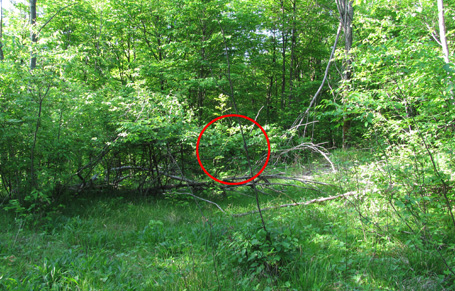

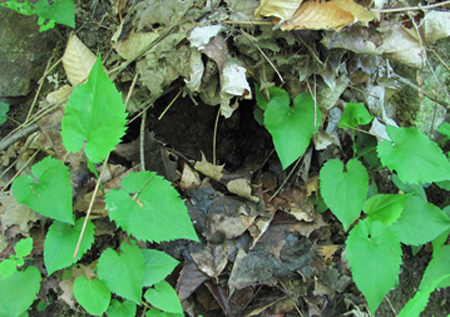
Cuckoo nest site

the Nest Files – Louisiana Waterthrush

Female LOWA entering nest

.

Louisiana Waterthrush (Seiurus moticilla)

Nidiologicals – Peck and James (1987) and Douglas Robinson (1995)

Habitat
– Gravel bottomed streams flowing through mature deciduous or mixed forest. Also nests in wooded swamp habitats on occasion.
Microhabitat – Nest built in cavities of stream banks, upturned tree roots or fallen logs.
Spring arrival – mid to late April (Ontario)
Average nest height – 0m (always nests on the ground)
Nest builder – male and female
Average # of broods/season – 1 (multiple broods not reported)
Average egg laying date – May 3 – June 12 (New York)
Average clutch size – 5 eggs
Incubation period – average 13 days
Egg colour – Whitish, spotted or blotched with ruddy brown, usually concentrated at large end
Incubation – female
Brown-headed Cowbird host – yes

.

Nest building in progress

.

Another FBS first – a Lousiana Waterthrush nest! A territorial pair was first located on May 10th at this site but no further breeding evidence was obtained at that time. A followup visit on May 20th revealed both the male and female building this nest in the stream bank above a waterfall. So why the delay? It’s possible that an earlier nest was abandoned but it is more likely that nest construction was delayed after the pair bonded, which is typical according to previous studies (Robinson 1990). On May 20th the pair were observed entering the nest site, which at that time was bascially a mud bowl with a bulky leaf exterior.  The pathway of leaves visible here is a common feature of a Louisiana Waterthrush nest but is not always built. The above photo illustrates this ‘pathway’ constructed of dead leaves, which are noticeably damp and likely collected from the water. The wet leaves and the addition of mud are probably used for adhesion and support of the nest exterior and pathway.

.

Nest complete with eggs

.

There were four eggs in the nest this morning, which suggests that egg laying began by May 22nd at the latest (1 egg is deposited per day). There might be one more egg still to come as the average clutch size is five (Bent 1953). I watched the female incubate for about an hour before she slipped away for a break. The male was present, he sang on two occasions nearby and made short excursions to the waterfall but never approached the nest. With the female on break, I approached the nest to check its contents and snap a few quick photos.

.

Nest contents

.

The interior of the nest had transformed since my last visit. What was formerly an excavated mud bowl had become a neatly constructed cup nest lined with fine grasses, rootlets and animal hair.

.

.

This last photo shows the nest site context. This would be considered a fairly exposed nest site for the species. This spot wasn’t on my radar during my initial scan of the banks along the waterfall. There were several other sites that would have been more enclosed, shaded and difficult for non-avians to access. You can just barely see the stream bottom in the lower left corner. Luckily, relocating this nest has always been instantaneous thanks to the convenient tree root pointing to its location! Waterthrushes never fly directly to their nests, instead, they approach the nest by walking from a distance as great as 10m – very typical behaviour for ground nesters. This is nicely demonstrated by the following video of the female at the nest from this morning – whom I could have watched for hours if not for the oppressive heat today. If all goes well, the eggs will hatch in 8-10 days and I’ll be back to check on the family in early June.

.

Finally, here is a short video of an adult female LOWA at the nest from today’s visit. Just to avoid any confusion, I should mention that during the video you might hear a Northern Waterthrush singing nearby. The two waterthrush species “get along” very well and exhibit little or no interspecific aggression (Craig 1984). The video can be viewed at higher resolution here.
.

Lizards in our midst

Five-lined Skink (Plestiodon fasciatus)

.

So strange to find a lizard in Ontario but they’re definitely here. Yesterday around noon, I found this adult male in a rocky outcrop laden with deadfall and thorn scrub. The Five-lined Skink is Ontario’s only native lizard species. They occur in two areas; the Carolinian region and along the Southern Shield ecotone. The two populations are genetically isolated and have differing habitat associations. The Southern Shield population favours rocky areas while the Carolinian version prefers sandy habitats. The Carolinian population, listed as Endangered, is small and restricted to just a few sites in southwestern Ontario. Five-lined Skinks of the shield are considered more numerous although relatively little is known about their ecology and abundance. The shield population is listed as a Species at Risk with a status of Special Concern. More information on this remarkable species can be found here.

.

.

Unlike this adult, the juvenile Five-lined Skink is quite colourful with its black body and bright azure blue tail. Click here for a photo of a younger individual. Apparently they lose their colour as they age. After first spotting this adult dart away I wondered if I might be lucky enough to get a photo. This little guy was fast and fidgety, making it difficult to get a view of more than just a tail tip or leg. I accumulated a large batch of poor photos before I opted to stand still and change some settings on my camera. The skink then proceeded to slowly amble over to check out my shoe!

.

.

the Nest Files – Red-winged Blackbird

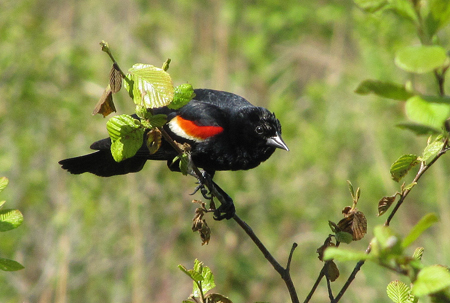
adult male Red-winged Blackbird (Derbyshire)

.

Red-winged Blackbird (Agelaius phoeniceus)

Nidiologicals – Peck and James (1987) and Yasukawa and Searcy (1995)

Habitat – Highly variable. Marshes, wetlands, fields, pastures and open woodlands.
Microhabitat – Nest usually woven into vertical shoots of a wide variety of substrates; commonly built within 1m of ground.
Spring arrival – March (Ontario)
Average nest height – .1m to 1.4m
Nest builder – female
Average # of broods/season – 1.7
Average egg laying date – 26 May-13 June (Ontario)
Average clutch size – 4 eggs
Incubation period – average 12.6 days
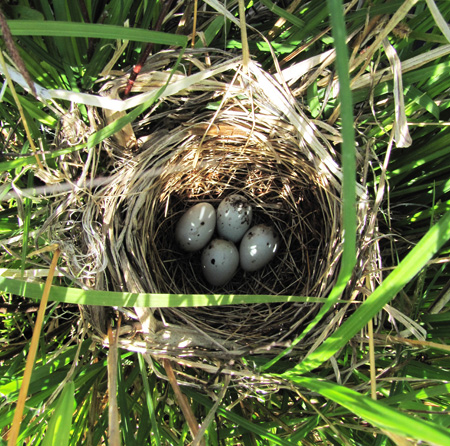
Egg colour – light blue-green or gray, marked with streaks, blotches and specks of black or brown. Markings are water soluble and fade during incubation (Nero 1984).
Incubation – female
Fledgling stage – young leave nest 10-12 days after hatching.
Parasitized by cowbirds – yes

.

Red-winged Blackbird nest contents

.

The Red-winged Blackbird is one of the most abundant and frequently studied bird species in North America. They are temperate migrants, returning to Ontario in early spring when males establish or reestablish territories in a wide variety of open habitats in upland and lowland environments. Red-wings breed across a vast range from boreal Alaska to Costa Rica. This range encompasses a considerable diversity of climatic and ecological conditions, which has certainly contributed to the total of twenty-six subspecies having been identified. Even more compelling is their complex social system. Up to fifteen females have been found to nest in the territory of a single male – making them one of the most highly polygynous of all bird species!

.

The nest pictured above was discovered in a medium sized palustrine marsh on Big Salmon Lake. The marsh was dominated by flooded grass and shrub growth as well as lesser quantities of cattail. Large numbers of Red-winged Blackbirds were present along with Swamp Sparrows, Yellow Warblers and Common Yellowthroats to name a few. The nest was located by accidentally flushing an incubating female. Given their abundant colonial populations, preference for open habitats and non-cryptic nature, it is not surprising that nests of this species are so frequently reported to nest record schemes. I was excited to find this one – a first for FBS. Red-winged Blackbirds can be found regularly in Frontenac Provincial Park but they occur in relatively small, isolated pockets where cattail and shrub cover is suitable.

.

Nest site

.

This last photo paints a picture of the nest site context (note the circled tuft of grass/shrub). The male held court over this section of the wetland while other occupied territories were being defended nearby. We don’t have waterbirds or wetlands as priorities for our studies at the moment but I expect we will turn our attention to these important areas in the future. Currently we are focused on species & habitats of conservation concern but we are fundamentally interested in keeping common birds common, such as the iconic spring harbinger – the Red-winged Blackbird.