the Nest Files – Prairie Warbler

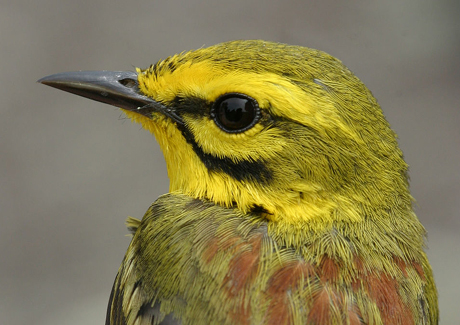
Adult male Prairie Warbler (D.Derbyshire)

.

Prairie Warbler (Dendroica discolor)

.
Nidiologicals – Peck and James (1987) and Nolan,V.,Jr., E.D.Ketterson, and C.A.Buerkle (1999)

Habitat – Dry, early successional shrubland habitats ranging from pine plantations, dunes, mangroves, barrens, clearcuts and abandoned fields.
Microhabitat – Cup nest usually well concealed in upper crotches of shrub
Spring arrival – Early to mid May (Ontario)
Average nest height – .6m-.9m
Nest builder – Female only
Average # of broods/season – 1-2 (variable with latitude and local conditions)
Average egg laying date – 8 June-19 June (Ontario)
Average clutch size – 3-5 eggs
Incubation period – Average 12 days
Egg colour – White to greenish white with variable brown spots, usually wreathed at larger end.
Incubation – Female only
Brown-headed Cowbird host – Yes
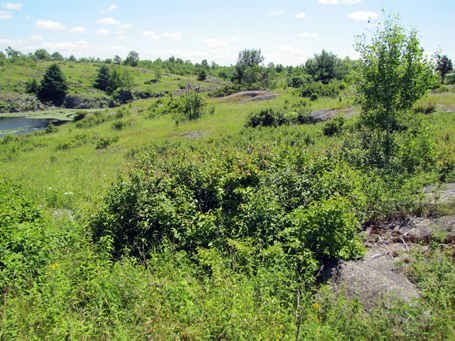
Prairie Warbler habitat (nest site in foreground)

The Prairie Warbler is a rare but regular breeding species in Ontario. It is estimated that about 300 pairs occur annually in the province, although there is some evidence of recent decline due to habitat succession of granitic rock barrens along the edge of the southern shield region. We’ve been surveying and studying Prairies in Frontenac Provincial Park for the last two years and have found a small but apparently healthy population in open barrens with scattered young trees and pockets of dense shrub cover. The above photo was taken within the core breeding area, which is about 20 hectares in size and characterized by low tree cover, exposed rock, dense ground vegetation and thick patches of vibernum sp. and junipers. Most Prairie Warbler territories here are associated with sloped shoreline edges of beaver ponds and lakes, which may be a function of denser shrub growth occurring in lower lying areas.

Shrubs along rocky slope (nest site in foreground)

This photo shows a typical nest site along a rocky slope where Downy Arrowwood (Viburnum rafinesqueanum) proliferates. Four nests have been found so far this summer and all but one were positioned near the top of a viburnum at heights between .7m-1.3m. All four nests have been located along slopes ranging from gentle to sharp and with no apparent preference for aspect.

Prairie Warbler Nest with eggs

Prairie Warbler nests resemble those of the Yellow Warbler (Dendroica petechia), a fairly close relative but less common inhabitant of the rock barrens. Prairie Warblers favour hot and dry environments while Yellow Warblers tend to occupy wetter shrubland habitats with a more flexible tolerance for shade/canopy closure. This nest with four eggs was discovered on June 26 when a female was flushed from a small clump of viburnum. When incubating female Prairie Warblers notoriously sit tight and only flush when very closely approached.

Nest in viburnum

This is a shot of the same nest within the shrub. Prior to nest searching this season I was anticipating that Ground Juniper (Juniperus communis) would be the most common host plant for nests but it seems that the viburnums are more abundant and probably preferred here. They are a stout and sturdy shrub with woody main stems and branches, while the leaf cover provides excellent concealment and weather shielding from all sides. The only non-viburnum nest was located in a lonicera sp. that grew within a large clump of Downy Arrowwood.

Prairie Warbler nest with five young (5-6 days old)

Two of the four nests were found by patiently following adults carrying beakfulls of plump, green caterpillars. One of our colour banded males (nickname “Whitey”) led me to this nest with five young. Thanks are due to Julie Zickefoose for helping Seabrooke and I age these nestlings. These little prairielets were identified as being 5-6 days old and only a few days away from leaving the nest.
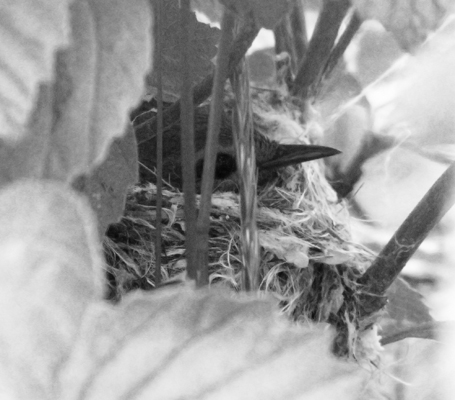
Incubating female

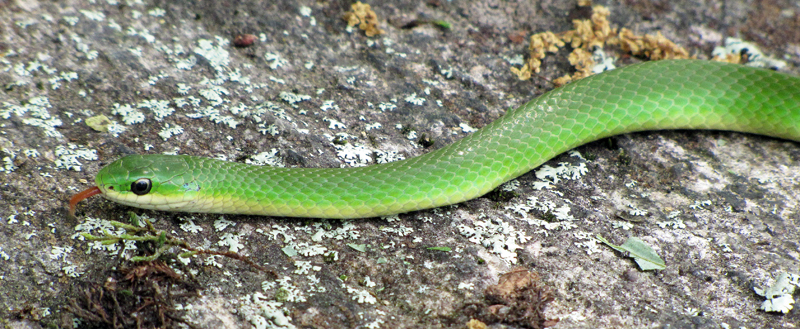
This female was photographed incubating on June 26. When I returned five days later I was disappointed to find that the nest had failed, probably due to predation. Common Grackles, Blue Jays and snakes would be the most likely nest predators in the barrens. I’ve twice found Ribbon Snakes (Thamnophis sauritus) above the ground within shrubs here. On the upside it appeared that the female, or perhaps a different female, was preparing to rebuild within the territory or perhaps even reuse the failed nest. The attached male (also colour banded) was singing vigorously while the female inspected forks of shrubs and called softly. On two occasions she was observed for five-minute periods shaping and touching up the failed nest. Hopefully the second attempt will fair better than the first!

Report on Frontenac Biothon 2011

Six-spotted Tiger Beetle (Seabrooke Leckie)

The second annual Frontenac Biothon was held on June 11-12 in various locations at Frontenac Provincial Park. The inaugural biothon in 2010 was a terrific event – full of interesting observations and we raised some much needed funds for Frontenac Bird Studies at the same time. Last year we compiled a total of 441 species, just shy of our target of 500 for the 24-hour blitz. This year we took to the park with a handicap as our plant guru was home with a recently hatched baby girl! We knew we had to step our game up and I’m happy to report that we did just that.

The 2011 biothon was a sort of grand tour for three of us. Chris, Steve and yours truly logged over 22 kilometres of hiking in just over 24 hours. We visited the abandoned farmlands and rock barrens in the park’s southeast corner, traveled some of the park’s main artery along Big Salmon Lake and also biothoned the length of Moulton Gorge, which took us to the mature forests of the park’s northern region.

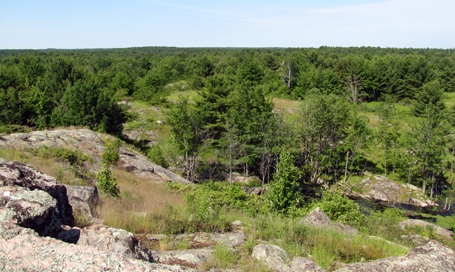
Rock Barrens near Flagpole Hill (Derbyshire)

All the effort paid off as we visited some markedly different zones. In the rock barrens we found unique plants and insects, Prairie Warblers, a Sandhill Crane and a singing Yellow-bellied Flycatcher. The crane and the flycatcher were highly unusual summer records for the park!

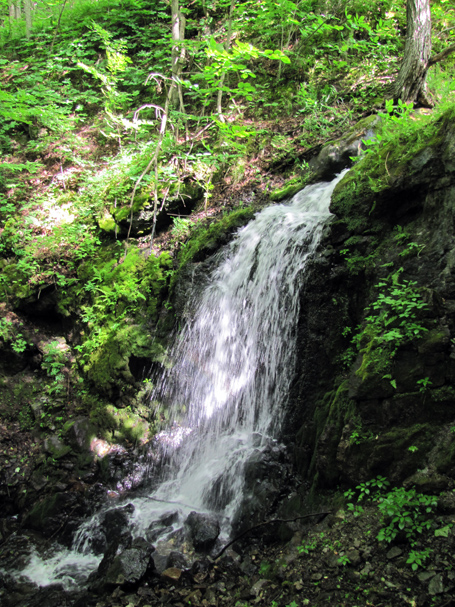
Waterfall near Moulton Gorge

The mature forests were a little more comfortable for hiking due to the shade and cooler temperatures. The diversity here was very high. The highlight for me was the Woodland Jumping Mouse that we startled near a waterfall – a fantastic creature. The excursion concluded with the observation of Cerulean Warblers and Louisiana Waterthrushes feeding young – two Species at Risk successfully raising young within 75m of eachother!

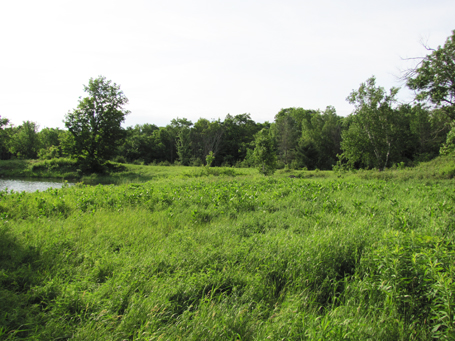
Meadows south of Slide Lake (Derbyshire)

And finally, actual meadow habitat! Lush wet meadows are very rare in Frontenac Provincial Park as nearly all of the abandoned homesteads and farms have returned to forest. The plant and insect life in these meadows south of Slide Lake was exceptional. It was great to have Chris and Steve there to help me sort through the all the non-avian species. Indigo Buntings and Chestnut-sided Warblers seemed to be most abundant during our stay but I’ll have to return another time for a more thorough search for grassland bird species.

Meanwhile, during all of our exhaustive hiking and paddling, Seabrooke was quietly racking up nearly 350 species just at her station near Campsite 6 on Little Salmon Lake! Seabrooke probably considers herself an insect specialist but is a very well-rounded naturalist, too. By the end of the biothon we had recorded 166 species of insects. Dragonflies and butterflies were much more evident this year than last and we still managed to ID a small selection of nocturnal moths despite the wind and rain that moved in during the evening of 11th. Our totals were a little higher for all taxa in 2011 with the exception of moths and fungi/lichens. The lower diversity in both of these groups is due to weather (moths) and event timing (fungi). We are still working on a few identifications but at present our total for Frontenac Biothon 2011 stands at 468, which is 27 species higher than last year. While not quite the 500 mark, our list for 2011 was quite an achievement given that we were missing a key team member and that the weather severely limited our mothing production. Much like our biothon from a year ago we found some truly great stuff, had an adventure and supported the FBS program to boot – all things that make the biothon a great event!

On behalf of the Migration Research Foundation I wish to extend our thanks to this year’s many sponsors who donated to the three biothon teams. Of course, the whole event would not have been possible without the efforts of our dedicated volunteer biothoners; Chris Dunn, Steve Gillis and Seabrooke Leckie! Lastly, thanks to the following Ontario Parks staff for their continued support of Frontenac Bird Studies and the Frontenac Biothon fundraiser; Corina Brdar, Peter Dawson and Bert Korporaal.

Below is a small selection of species recorded during this year’s biothon – hope you enjoy!

Prairie Warbler (Chris Dunn)
Sawfly larvae (Seabrooke Leckie)
Silver-bordered Fritillary
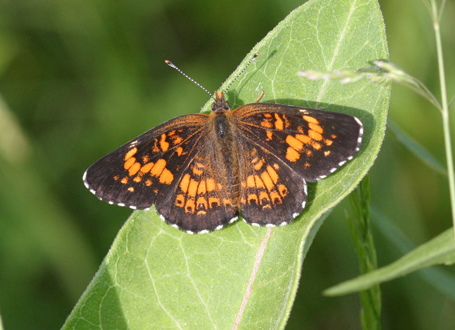
Harris’s Checkerspot (Chris Dunn)

A boreal bird in Frontenac

Spruce/tamarack bog in Frontenac (click to zoom)
Yellow-bellied Flycatcher (Seabrooke Leckie)

Lots of updates to share but no time or energy to write anything at length. However, I couldn’t resist sharing news from this morning of a territorial Yellow-belled Flycatcher (Empidonax flaviventris) , which sang constantly from a good size Black Spruce/Tamarack bog in Frontenac Provincial Park. The water surrounding the bog is quite deep and probably full of monsters so I didn’t venture into the bog itself – though I did seriously consider crafting some sort of crude watercraft for the short passage. This would be the first breeding record for the park and one of only a handful for the entire Kingston region. Yellow-bellied Flycatchers are a true northern breeder, preferring moist boreal forest and peatland for nesting. I’ll have to add this to our ever expanding to-do list for Frontenac Bird Studies!