
Frontenac Bird Studies – The 2013 Season

Our fifth straight season of avian monitoring and research in the Frontenac Arch was a success and is now officially wrapped up! A substantial amount of data was collected in 2013 and has now finally been proofed, entered, sorted and examined. Here’s a quick recap of the major highlights from 2013 – the season of the survey….
.
Point Counts Abound

This past year we conducted a lot of point count surveys – 258 in all, to be exact. Many of these (164) were repeat surveys at fixed stations that were first sampled in 2009. Overall, the effort required >40 kms of walking in Frontenac Provincial Park and stops every 500m along 56km of roadways throughout the study area. Over time, the data enables us to monitor changes in breeding bird populations in a broad array of landscape conditions. Overall, we observed a small decline since 2009 (-3.9%). Minor changes in abundance, positive or negative, are evident for most species, however some have shifted more markedly in recent years. Yellow-throated Vireos, for example, increased in abundance on point counts by a whopping 250% in 2013!
.
Cerulean Warblers in the Frontenac Arch
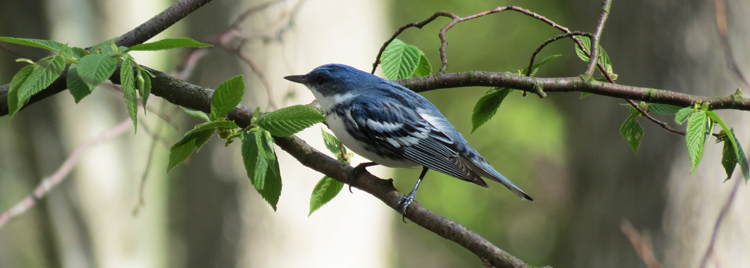
In 2013, we collaborated with Bird Studies Canada and Canadian Wildlife Service as part of a project to survey Cerulean Warblers. The study looked at populations across a 300 km extent from Georgian Bay to the Frontenac Arch. Results from this project and our own studies strongly support the value of Frontenac Provincial Park forests to Cerulean Warbler populations in Canada. Perhaps North America’s fastest declining wood-warbler, the Cerulean Warbler has been assessed as Endangered in Canada and Threatened in Ontario.
.
Monitoring Avian Productivity & Survivorship (MAPS): 2009-2013
Our fifth consecutive MAPS season came to a close on August 4, 2013. After the bumper 2009 season, a substantial decline in population diversity and abundance was detected, reaching a five-year low in 2011. This past season saw the first signs of a rebound with an overall record-high productivity index and also three-year high capture rates for many species. The program is a key component of our breeding bird monitoring objectives by providing annual assessments of forest bird demographics. We are pleased to report that “Mr.33”, a male Veery banded at MABO as a hatch-year in 2009 has returned each year since, including 2013! His travels from the Frontenac Arch to Brazil amount to >56,000 km over eight migrations. This distance is equivalent to one and a half trips around the globe – incredible!

.
These are just a few of many stories from the 2013 season of Frontenac Bird Studies. Our program exists through the assistance of many wonderfully supportive individuals and organizations. The Migration Research Foundation thanks the following for their contribution to FBS in 2013!
.
Funding
The John Hackney Foundation for the Noosphere
Frontenac Avian Atlas Day sponsors
Volunteers
Chris Dunn
Steve Gillis
Seabrooke Leckie
Project Support
Corina Brdar
Ontario Parks
Peter Dawson
Ontario Parks
Bert Korporaal
Ontario Parks
Chris Robinson
Ontario Parks
Ken and Vera Shepherd
To the woods
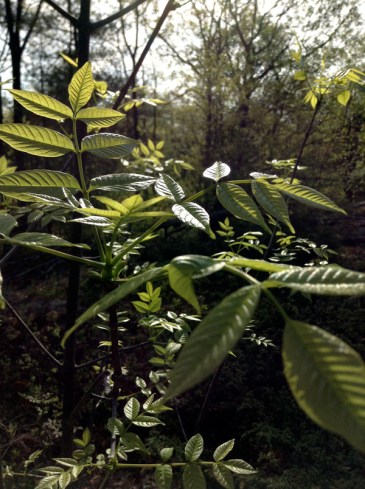
After a prolonged and complicated change of address it felt good to stroll through Frontenac woods again! The field season has begun. Our plans are full, as usual, but our focus will shift from the more specific pursuits of recent years back to the bigger picture. Point counts, point counts and more point counts are in order. In addition to widespread surveying there will also be demographic monitoring (MAPS and nest searching/atlassing) and a role in a collaborative project with Bird Studies Canada and Canadian Wildlife Service to examine the current population status of Cerulean Warblers in Ontario. The Frontenac Arch is THE hotspot for Cerulean Warblers in Canada. About a half dozen were heard singing this morning amongst the emerging foliage of the forest canopy.
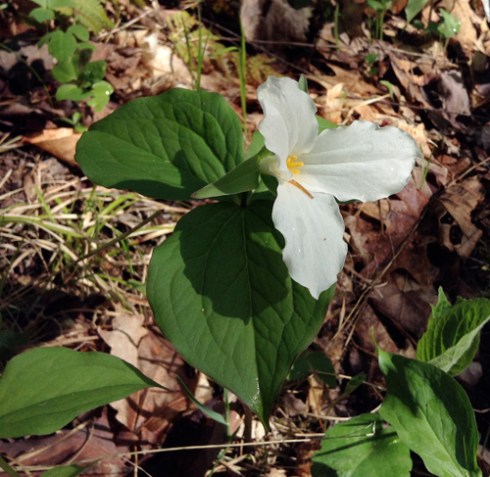

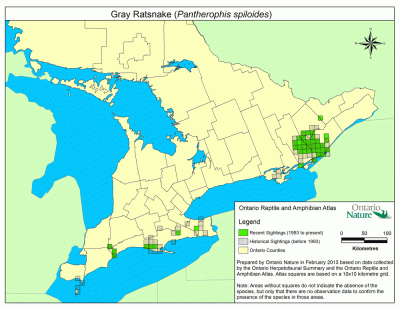
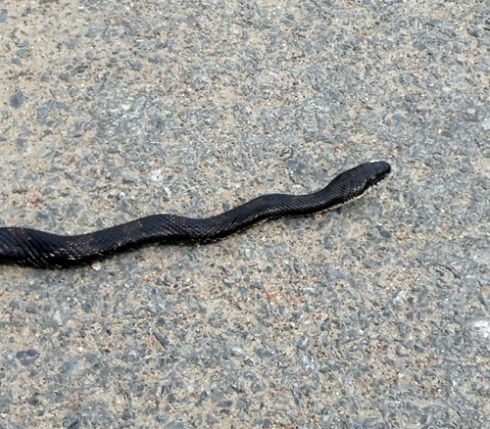
I still marvel at the number of species with provincially or nationally critical connections to the Frontenac Arch region. The Gray Ratsnake (Pantherophis spiloides) is a perfect example. This is Ontario’s largest snake, growing up to 2.5 meters in length. This species has retracted considerably from its historical range but they seem to be holding on in the Arch – a familiar trend. I found this meter-long individual warming itself on the road this morning. After a bit of resistance from it I was able to move it off the road to safety. Unfortunately, collisions with vehicles are one of its main threats.

Ceruleans are back in the Frontenacs
The Louisiana and the Cerulean
This video was recorded yesterday while revisiting the site where a Louisiana Waterthrush nest was found on May 26, 2010. The stream at this site is flowing with so much vigor that the two waterfalls severely limit the audibility of my playback system. Despite this I was able to locate a territorial male at the south end of the stream complex in a low valley sandwiched between two small ridges. I promptly ended playback as soon as the male responded and watched him for about ten minutes or so as he moved back and forth from the stream to higher perches. At one point he moved higher toward the canopy and was instantly chased off by a bill snapping small passerine, which turned out to be a female Cerulean Warbler (Dendroica cerulea). I followed the female for several minutes and hit an ornithological jackpot of sorts when she flew to a nest located on a horizontal branch of a large Sugar Maple (Acer saccharum), about 15m above the ground.
Cerulean Warblers build their nests high in the upper canopy of deciduous forests that have mature trees, little or no understorey and small gaps or breaks in canopy closure. These characteristics make their nests quite difficult to find and even harder to inspect and monitor! In this case I was able to get a decent view of the nest from either of the two ridges, which put me roughly 15 feet closer to the crown of the large trees growing in the valley. Even with this advantage I still had to zoom to 39x to get a low quality recording. Gotta thank the 749 mosquitoes for all the shakiness. I will definitely be returning to this site (with a tripod!) to monitor both of these important breeders in the next several weeks. Frontenac Provincial Park is one of the most significant protected areas for Canada’s population of Cerulean Warblers now listed as an Endangered species by COSEWIC.
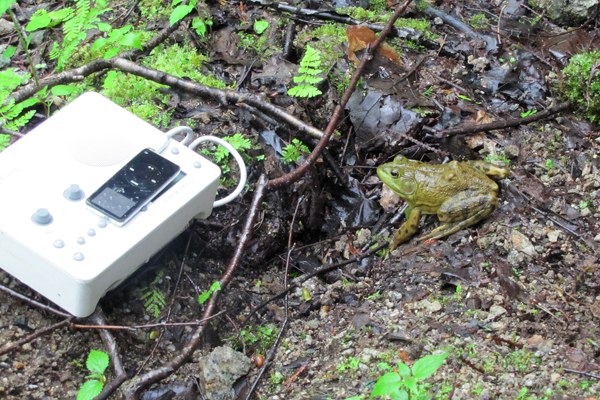
Back to the waterthrush surveys. Things have picked up a bit since my last post but it seems that 2011 will be marked as a down year for breeding Louisiana Waterthrushes in this region. I have not been successful at several reliable sites despite as many as four repeat visits. A review of historical records show some evidence of a downward trend occurring since the first half of the last decade. Despite an apparent population decrease coinciding with the initiation of our study in 2010 it is critical to monitor the sites through the good times and the bad times. Interestingly, the high number of unoccupied sites found this year has only buoyed my interest in the study going forward. Also, the 2011 season is not over yet as surveys at five more sites are yet to be completed and I do have four active sites to keep tabs on.

 Frontenac Bird Studies