Natural nest sites of the Eastern Phoebe

Eastern Phoebe Nest

.

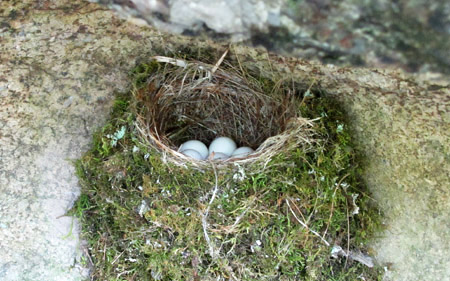
The Eastern Phoebe (Sayornis phoebe) is a common inhabitant of Southern Ontario. The 2nd edition of the Ontario Breeding Bird Atlas shows that peak abundance in the province aligns with the southern edge of the Canadian Shield. In these areas, the high forest coverage and availability of nest sites (e.g. cottages, bridges and other man-made structures) likely contribute to higher densities (Cadman et.al. 2007). It has been suggested that the species underwent a marked range expansion and population increase in unison with early development and human settlement, which greatly increased the availability of suitable nest sites (Weeks, H.P., Jr. 1994). Phoebes attach their nests directly to a vertically sloped surface, which provides overhead protection from the elements, in much the same manner as Barn Swallows (Hirundo rustica). Man-made structures such as bridges, culverts and eaves of buildings are just a few of many ‘unnatural’ features suitable for the species. What does this suggest for precolonial status of the Eastern Phoebe in Ontario? The nest pictured above was found last week and its location illustrates this question.

.
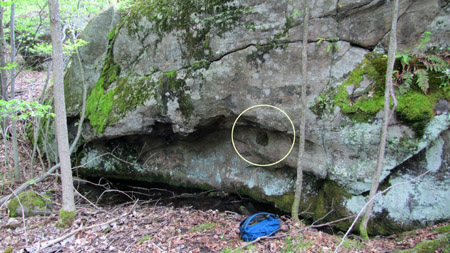
Nest site

.

The Eastern Phoebe has been a resident of Ontario’s woodlands since long before axe-wielding Europeans arrived. This particular nest was attached directly to a vertical rock wall below a cut in the rock. These rock formations occur throughout the FBS study area – in forest interiors, dry rock barrens and edges of lakes and ponds. It is plausible that the high numbers detected along the southern edge of the shield are also attributable to the proliferation of these naturally occurring nest sites. Click here for more info on nesting Eastern Phoebes in the Frontenac Arch.

Waterthrush survey update

Louisiana Waterthrush - May 10, 2010

.
It was a chilly start to this morning’s fieldwork but it turned into a great day on all fronts. Birds were more abundant and diverse today with many firsts of the year including Black-throated Blue Warbler, Broad-winged Hawk (two separate adults carrying food!), Solitary Sandpipers and a whopping great tally of 14 Cerulean Warblers. Yellow-throated Vireos and American Redstarts were also quite numerous.

I was thrilled to find a Northern Waterthrush in the midst of nest building along a creek near Birch Lake but the real star of the show today was the discovery of an actively nesting pair of Louisiana Waterthrushes. The pair were located in a deeply incised ravine in mature forest. I hung around for a bit to observe them and suspect that a nest containing eggs is likely to be found above the steep bank of a waterfall at the site. I didn’t have time to look for the nest but will return to the site at a later date for a checkup. To my knowledge this is a newly documented breeding location for the species.

The media file below includes pictures and a short recording of the male LOWA taken at the site this morning. Something went wonky with the image quality during conversion at Vimeo but the sound is accurate. The Louisiana Waterthrush (Seiurus motacilla) has a distinctive song, much softer, sweeter and melodic than the louder and more guttural warble of its cousin – the Northern Waterthrush (Seiurus noveboracensis).


..

Lookin’ for Louisiana Waterthrushes

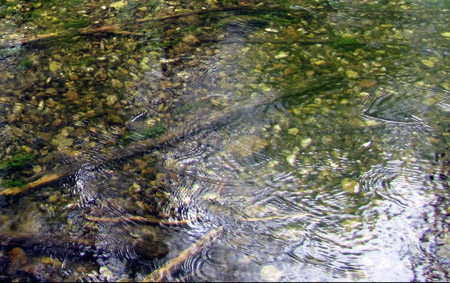
Devil Lake Creek

In Canada, the Louisiana Waterthrush (Seirus motacilla) has a small range limited to southern Ontario and Quebec. The population is small, estimated at <200 pairs, and restricted to mature forested ravines with clear, gravel-bottomed streams and/or woodland swamps. Louisianas are considered “area sensitive”. According to a Maryland study (Robbins 1979) a minimum of 100 contiguous hectares of mature habitat is needed for successful breeding (McCracken 2006). In Ontario, the Louisiana Waterthrush is a rare but regular breeder in southwestern Ontario. Smaller numbers also occur in deeply incised valleys of the Frontenac Arch where mature forest is present.

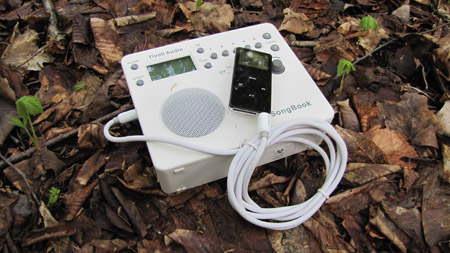
Playback equipment

The Frontenac Arch sits at the northern limit of the continental breeding range for Louisiana Waterthrush. Here, annual occupancy and productivity of breeding sites are probably influenced by weather cycles and periodic expansion/contraction of the source population further south, possibly upstate New York. It is suggested that north wandering immigrants cause a “rescue effect” for the Canadian population. There is also evidence of the species expanding its range northward, likely in response to maturing second growth forest cover. Climate change, beavers and water quality are also important influences on the status of the species in the Frontenac Arch.

We have started an inventory of Louisianas in Frontenac Provincial Park and in accessible habitats immediately surrounding the park. Louisianas will breed in woodland swamps and along clean creeks and streams, both of which occur in abundance in these areas. Potential nest sites have been identified from several sources and will be surveyed in May 2010 to determine occupancy and breeding status. This information will improve our knowledge of the local population’s size, demography and habitat preferences. The work will also enable monitoring through comparative analysis in future years.

A tortoiseshell leads the way

Compton Tortoiseshell

Yesterday I enjoyed another foray into the depths of Frontenac Provincial Park. I must have walked a good 4 kilometers or so in search of study sites for our growing MAPS network. I’ve started to learn that satellite and aerial photography is a useful tool but not a valid substitute for ground truthing. Yesterday, I was very lucky to find a good candidate study site by accident. The Compton Tortoiseshell pictured above was very shy and my persistence to ID the thing led me a ways off my intended track. I then noticed some intriguing habitat nearby and found what could be a new MAPS site for FBS!

Serviceberry blossoms

Serviceberry are blooming throughout the park. I am pretty sure this is Allegheny Serviceberry (Amelanchier laevis). They are the most eye catching plants out there right now but will soon fade into the background as their flowers drop and the other trees leaf out. Serviceberry are particularly common at the site found yesterday.

Upland hardwood forest

The site also has rich mature forest growing in steep valleys and upland slopes surrounding a small lake. Neither Rock Ridge (RRID) or Maplewood Bog (MABO) have this habitat, which makes this site particularly attractive. We know from last year’s surveys that Cerulean Warblers and Yellow-throated Vireos inhabit this forest around the lake. The problem with interior, mature forest like this is that the understorey is largely open and devoid of mistnetting opportunities. Fortunately, the mature forest surrounds a sizable area of regenerating woodland with lots of edges.

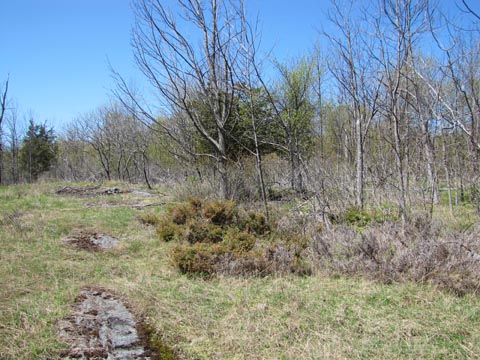
Thorn scrub

Here is a nice looking edge with thorn scrub, juniper and young trees. The combination of suitable edge habitat with mature forest is unique, which makes this a good candidate site for MAPS. One or two more visits to the area will be needed as I would like to see how it ‘greens’ out. It would also be helpful to learn a bit more about the bird community residing in the site before announcing any grand openings!

Large-flowered Trilliums