In this post from early June of last year I wrote about three recently fledged Common Ravens that were found near Clearwater Lake. This is a small but deep oligotrophic lake that is probably best known for its population of Brook Trout. I regularly pass through this area at this time of year and usually notice the clamorous activity of ravens along the lake edge. The noise reminded me to check the cliff for active nests when I passed by last week. It didn’t take long to spot the nest immediately above some rock covered in white wash. The following photos show an adult brooding and three youngsters waiting for food. Unfortunately the photos were taken from a distance of about 100m, which made them pretty grainy but the idea of leaning over the cliff for a better closeup just didn’t appeal. Common Ravens are regular breeders in the area however this particular record was the first for us since we began in 2009 – very cool!
f
[ Note that Louisiana Waterthrush (formerly Seiurus motacilla) was recently moved to the new genus Parkesia with Northern Waterthrush, which leaves Ovenbird as the only remaining Seiurus species ]
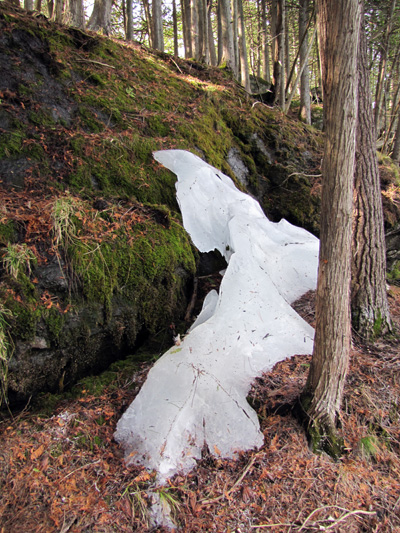
There has been lots of noteworthy observations in recent days but the most significant development continues to be the late arrival of spring and apparent scarcity of Louisiana Waterthrushes in the study area. The mass of ice pictured below was found yesterday near Little Salmon Lake, Frontenac Prov. Park – a late spring indeed. I’ve now surveyed 23 streams and creeks in and around Frontenac Provincial Park with only a few sightings of the target species to show for it. As the above video shows the sites are in excellent condition owing to high precipitation in late winter and early spring. Water levels and flow are higher than a year ago and insect forage is abundant (particularly the black flies!). Click here for a larger version of the clip.
Lingering ice under cedarsRange Map (Cornell Lab of Ornithology)
The Louisiana Waterthrush has a very limited range in Canada. Breeding occurs primarily in Southern Ontario where remnants of mature deciduous and mixed forest remain. Looking at the map above, the small green dot at the east end of Lake Ontario indicates a cluster of breeding sites corresponding to mature woodlands of the Frontenac Arch and Thousand Islands. There is evidence that this species is expanding northward probably in response to maturing and regenerating forest cover since the logging boom of the 1800s. The population in the Frontenac Arch is essentially the northernmost outpost for this species in North America and somewhat disjunctive from the core range. It has been suggested that Ontario’s population is dependent upon immigration from the source population further south and could therefore be subject to more variable rates of fidelity and productivity. Perhaps 2011 will be a down year for our north-wandering pioneers? We still have a few weeks of surveys to complete and will have a much better handle on the situation by early June – I have a good feeling that results will improve.
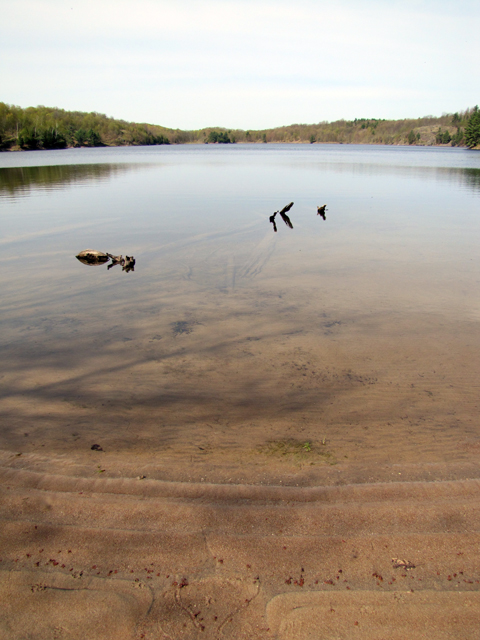
Little Salmon Lake
The Louisiana Waterthrush recon work took me to a network of streams flowing to and from Little Salmon Lake in the park’s interior. There are some very promising sites in the area but the relatively young age of the forest is probably not suitable for the species at the present time. Regardless of whether the birds are there or not the effort is still worthwhile to describe and index potential breeding locations for the future. This was my first foray into this area, which made for an interesting day. Sandy beaches like the one pictured above are very scarce in the park.
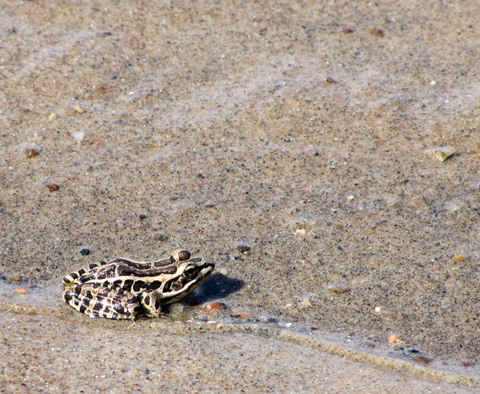
Pickerel Frog on the beach
The only sunbather I found was this Pickerel Frog (Rana palustris) – a nice find. While not exactly rare they are uncommon compared to their close relative, the very similar and more numerous Northern Leopard Frog (Rana pipiens). Pickerel Frogs are always brown in coloration and have squared spots aligned into two neat rows down their backs. The Northern Leopard Frog is usually green, although sometimes brown too, but have circular, more randomly distributed dark markings.
Our fieldwork is well underway in spite of what has been a late arriving and slow moving spring season. The leaf-out is at least a week or two behind schedule and the woods have been unusually quiet for this time of year. However, migrants and returning breeders are appearing in small numbers. A pleasing variety of neotropicals was observed yesterday, which included Wood Thrush, Great Crested Flycatcher and Cerulean, Black-throated Green and Black-throated Blue Warblers. Of particular interest were sightings of Pine Siskin (two occurrences) and Evening Grosbeak – both rare but potentially nesting species in the park. Our official duties at this time of year focus on the Louisiana Waterthrush (Parkesia motacilla), which have been trickling back into Ontario since mid-April. Over the winter a thorough inspection of high resolution aerial photography was conducted, which revealed over 30 potentially suitable nesting sites within our core study area (not including sites visited in 2010). Needless to say I’ve got a ton of walking and canoeing to do in the next few weeks! I will update on our survey results throughout the month of May.
Darvic Colour Bands
In addition to the LOWA reconnaissance we’ve been preparing switch our attention to Prairie Warblers in late May-early June. This year will involve a more extensive ground search of granite barrens in Frontenac Provincial Park for Prairie Warblers. We will also be assessing habitat, nest searching as well as colour banding and tracking males. The project represents our first in-depth look at a breeding species in the Frontenac Arch. The granite barrens scattered along the southern edge of the Canadian Shield in south-central Ontario have received relatively little attention but are important to several species currently in decline such as Common Nighthawk, Field Sparrow, Eastern Towhee and Prairie Warbler.
Prairie Warbler by Seabrooke Leckie
In order to safely capture and mark the birds we will be deploying a mistnet and using a playback/decoy method to lure territorial males. I contemplated various approaches to the construction of a reasonably lifelike decoy, none of which really fit my needs. Fortunately Seabrooke, being both crafty and creative, came up with this little guy, which was handmade from Sculpey – just the ticket ; )
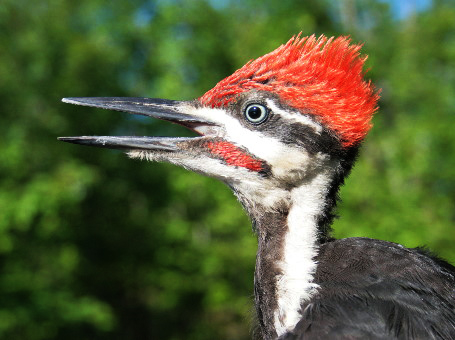
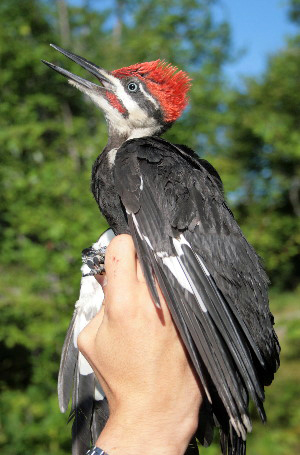
This monster of a woodpecker was a an exciting bird to band – a first for FBS! As I emerged from some dense pines en route to net 7 this Pileated Woodpecker began to struggle its way out of the net before I quickly corralled it into my hands. It left twelve small puncture wounds on my fingers before I could free its tangled feet and put him into a carrying bag – a very swift and powerful avian hammerhead! Seabrooke was delighted to receive it back at the station, it was the first she’d had in-the-hand for banding.
The rest of the morning was very much a continuation of the last visit on July 14 – dreadfully quiet! A total of seven birds were captured during the visit, one less than the previous record low of 8 at Blue Lakes on July 14 of this year! The site is so contrastingly empty of birds compared to our first few visits in June. The once common Yellow-throated Vireos, Chestnut-sided and Black-throated Blue Warblers, Veerys and Ovenbirds are all gone and the area is not attracting many dispersing birds of any kind. We remain undeterred by this curious development as it is vitally important to monitor both the highs and the lows.
Our last visit to Blue Lakes in 2010 will be held in early August, which should coincide with the peak of post-breeding dispersal for the region. Perhaps our first season at the station will end with a final flourish? Either way, we’ve had some fantastic birds there and will have better breeding seasons to look forward to….
I have no idea where the last two weeks went! We’ve completed visits 4 and 5 to all of our MAPS sites and not a word was posted here about it – until now. Our fourth round of visits were done during the heat wave when the ghastly humidity forced to shut down a bit early at Maplewood and Rock Ridge. Temperatures were more moderate during visit 5 but we ended up with even lower capture totals despite logging more net hours at both stations!
I’ll start this summary of round five with the Rock Ridge (RRID) station in Frontenac Provincial Park. The weather was perfect and post-breeding dispersal was evident for the first time in 2010. Our first Yellow-billed Cuckoo of the year was banded along with small numbers of the usual suspects.
Early morning along the ridge (Derbyshire)
The day started off well with lots of young birds moving along the ridge – primarily Eastern Towhees, Yellow Warblers and Pine Warblers. The first half of the morning was quite productive, which was followed by the latter half ending with five consecutive empty net rounds – a record for us! We finished the visit with 17 total captures – 3 less than visit 4 when the heat and humidity were extremely high. On the bright side, we’ve somehow eclipsed last year’s pace at Ridge Ridge in terms of total birds banded and recaptured.
juv Pine Warbler (Seabrooke Leckie)
This juvenile Pine Warbler is the first we’ve captured at any of our MAPS stations! Pine Warblers nest in the tall pines on either side of the ridge near the banding station but they never seem to come down low enough to be captured. It makes sense that our first would be a dispersing youngster, which are less tied to the canopy foraging.
Adult Veery in moult (Derbyshire)
Our fifth visit to the Blue Lakes (BLAK) station was somewhat shocking as it ended up being the slowest day we’ve had since we started MAPS in 2009! The Black-throated Blue Warblers that were abundant earlier in the summer had vanished and the morning had this eerily quiet feel to it. The Veery, like the Black-throated Blue Warbler, was a dominant species earlier in the season but were noticeably missing during visit 5. We did recapture one Veery during the morning, an adult male in the midst of basic moult.
Chestnut-sided Warbler (Seabrooke)
Always nice to find Chestut-sided Warblers in the nets. This male was recaptured for the first time since it was banded in mid-June. Fortunately there are still a number of these holding territories on the shorelines of lakes and ponds in the area. We ended visit 5 with 8 birds captured in six hours of sampling – REALLY quiet. I’m looking forward to getting back there to see how the season unfolds.
Scarlet Tanager (Seabrooke)
We can always expect birds at Maplewood (MABO)! This is the most consistent station of the three in our MAPS network. At the end of the day we tallied up the results and noted that 22 birds were captured, which is a quiet day for MABO. We sampled the first real wave of young birds at the station in 2010, which included this juv Scarlet Tanager as well as American Redstart, Hairy Woodpecker and Yellow-bellied Sapsucker.
Other noteworthy records included our first captured Ruby-throated Hummingbird of the year and two more Scarlet Tanagers! Multiple Wood Thrushes are still singing at the site and at least one Wood Thrush youngster has been banded in 2010. The exodus of Veerys at Blue Lakes is being echoed at MABO where the species was not encountered at all during visit 5. The Veery is normally an abundant species at MABO but our results in 2009 and 2010 have suggested widespread breeding failure. The weather conditions in both years have been atypical and likely a factor impacting nest success for at least some species. It will be exciting to begin analysis of the data after a few more seasons, preferably with more ‘average’ conditions. I will be particularly interested in statistics on survivorship, productivity and recruitment for Veerys.







 Frontenac Bird Studies