M.A.P.S Visit 2 – 2011

Scarlet Tanager (S.Leckie)

Our third season of M.A.P.S is now approaching its halfway point. Our second round of visits to the three stations was a little more active than the first, especially at Blue Lakes (BLAK) and Maplewood (MABO). This striking male Scarlet Tanager (Piranga olivacea) was one of 23 birds captured on June 16 at MABO. Veery was the most abundant species captured that day followed by the ubiquitous Red-eyed Vireos – the most prolific forest songbird in the Frontenac Arch.
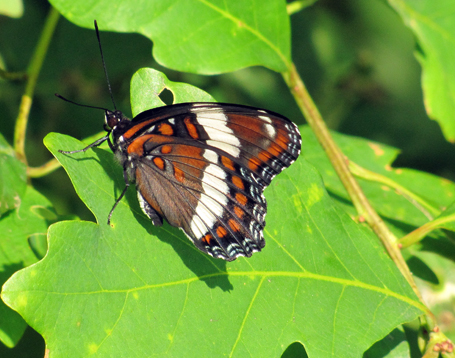
White Admiral (D.Derbyshire)

After capturing just 10 individuals in early June at BLAK, we expected another quiet day when we set the nets up at dawn on June 15. Perhaps the fairer weather helped as the vireos finally showed up and a bunch of other species seemed to be more evident. We ended the day with a meager but respectable 15 birds captured. Butterflies and other non-avian critters seemed to catch our attention throughout the morning, including the White Admiral (Limenitis arthemis) pictured above – a personal favourite.
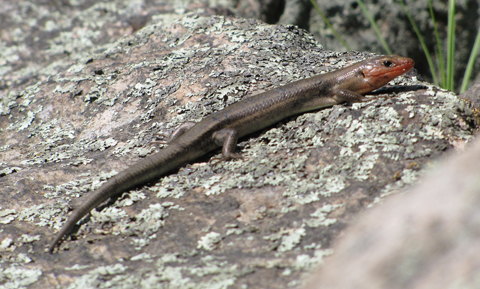
Five-lined Skink (S.Leckie)

There is no substitute for sitting patiently and quietly when you want to find wildlife. During our first visit a couple weeks earlier we had a Smooth Green Snake approach us at the banding station. During our next visit while I was out on a net round, Seabrooke was approached by this adult Five-linked Skink (Plestiodon fasciatus) at the station! We also had a brief look at a blue immature individual just yesterday at the same spot.
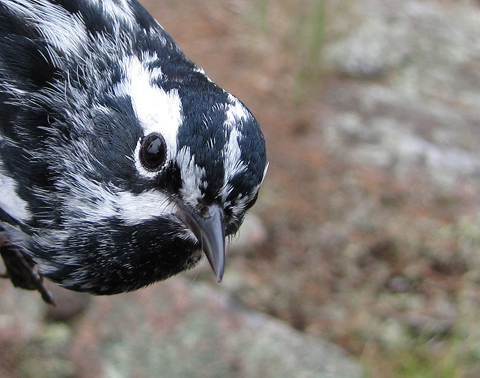
Black-and-white Warbler (D.Derbyshire)

Normally I pull the plug on any planned M.A.P.S visit when the forecast indicates a 50/50 or greater chance of precipitation – too risky for me. However, I had little choice with visit 2 to Rock Ridge (RRID) on June 17. There was a brief 30 minute shower near dawn, which delayed net opening, but the rest of the morning was generally just damp and cloudy. We closed slightly early due to the forecast late morning thunderstorms – don’t want to be caught in that when a couple of kilometres out on Big Clear Lake. We noted much more bird song and chatter on this visit compared to our first but it seemed that the dreary weather was limiting bird activity. We ended the abbreviated visit with just 7 captures but left feeling encouraged by the apparent increase in numbers of expected species, particularly Black-and-white Warblers and Eastern Towhees. We caught an Ovenbird, which was weird for rock barren habitat. Even more surprising was the Prairie Warbler that sang from two positions at opposite ends of the study area throughout the morning. I’ve already picked out his colour bands so hopefully he will be there when we return….
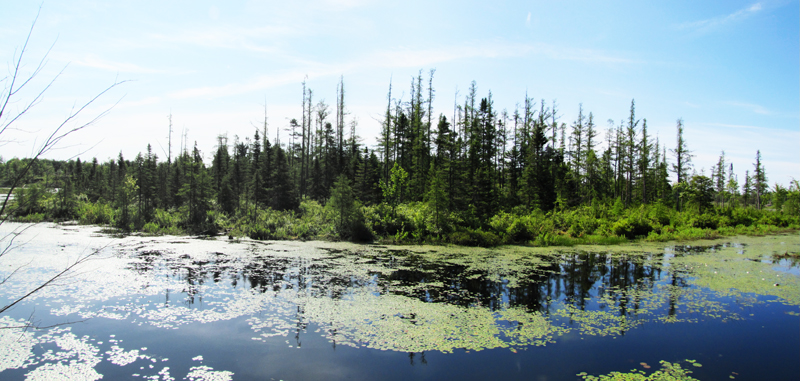
A boreal bird in Frontenac

Spruce/tamarack bog in Frontenac (click to zoom)
Yellow-bellied Flycatcher (Seabrooke Leckie)

Lots of updates to share but no time or energy to write anything at length. However, I couldn’t resist sharing news from this morning of a territorial Yellow-belled Flycatcher (Empidonax flaviventris) , which sang constantly from a good size Black Spruce/Tamarack bog in Frontenac Provincial Park. The water surrounding the bog is quite deep and probably full of monsters so I didn’t venture into the bog itself – though I did seriously consider crafting some sort of crude watercraft for the short passage. This would be the first breeding record for the park and one of only a handful for the entire Kingston region. Yellow-bellied Flycatchers are a true northern breeder, preferring moist boreal forest and peatland for nesting. I’ll have to add this to our ever expanding to-do list for Frontenac Bird Studies!

M.A.P.S Visit 1 – 2011

Eastern Towhee at Rock Ridge (Seabrooke Leckie)

In addition to all the stream hopping, nest searching, colour banding and biothon-ing, we are also well into our third consecutive season of the Monitoring Avian Productivity & Survivorship (MAPS) program. Our three stations have been a wellspring of data and ideas for the FBS program and a fundamental monitoring scheme for measuring the health and viability of local breeding bird populations. We launched the stations in 2009 and were pleased to find high numbers of adults at the sites. However, unusually wet and/or cold conditions in late spring/early summer of that year and again in 2010 appeared to contribute to low productivity (nest success) for two consecutive breeding seasons. This has been backed up by an apparent high nest failure rate detected by our nest searching efforts in both years. We hoped that things would begin to turn around in 2011 but unfortunately our results from the first of seven visits this year indicates record low numbers of adults – not unexpected given the lackluster output of young birds into the population in the preceding two years.

Blue Lakes (BLAK)

We began the season on June 4 at BLAK and found a mostly quiet woodland – far from the exuberant activity of even a year ago. We ended the day having captured just 10 individuals, although four of these were returns from previous years, which gave us some encouragement. For comparison we captured 24 individuals here during visit 1 on June 8, 2010. Numbers were down for most species with Red-eyed Vireo, Ovenbird, Black-throated Blue Warbler and Veery being the most lacking.

Big Poplar down at Net 8, MABO (S.Leckie)

Rock Ridge (RRID)

On the following day, June 5, 2011, we made our way to Rock Ridge in Frontenac Provincial Park. Once again, overall bird activity was considerably lower than in previous years, especially in the forest interior. A total of 10 birds were captured – again with 4 returns. This total is identical to that for visit 1 in 2010 but significantly lower than the 25 recorded in 2009. Black-and-white Warbler, Red-eyed Vireo, Scarlet Tanager and Field Sparrow are the species that seem to have declined here most heavily.

Male Yellow-bellied Sapsucker at BLAK (S.Leckie)

Maplewood Bog (MABO)

Our final stop for round one was to Maplewood Bog (MABO), which tends to be our busiest of the three stations. We captured 26 birds here during visit 1 in 2009, followed by 21 in 2010. After six hours of banding we arrived at, remarkably, yet another tally of 10 individuals!! We banded just four new birds and recaptured six returning individuals from previous years. The woods, once so abundant with thrushes, vireos and tanagers, were very quiet indeed.

Chestnut-side Warbler at BLAK (S.Leckie)

Our data from the MAPS program and our other studies appear to indicate a widespread downward trend in forest bird populations in the FBS study area since 2009. Factors driving populations are highly complex so we won’t be sounding any alarm bells or hitting the panic button just yet. Also, we know that populations are subject to periodic highs and lows in sync with naturally occurring but variable weather phenomena. We expect (and hope) that bird numbers will be gradually restored following breeding seasons with more favourable weather. Speaking of weather, the MAPS program is very well positioned to shed light on effects of climate change on breeding birds at the landscape, regional and even broader scales. It is unfortunate that there are so few MAPS stations in Ontario as it would be instructive to compare regional patterns and trends in vital rates in anticipation of shifting climate “normals”. All of this being said, there is still six more visits to each station in 2011 and a great deal more to learn.

The Red-headeds are here!

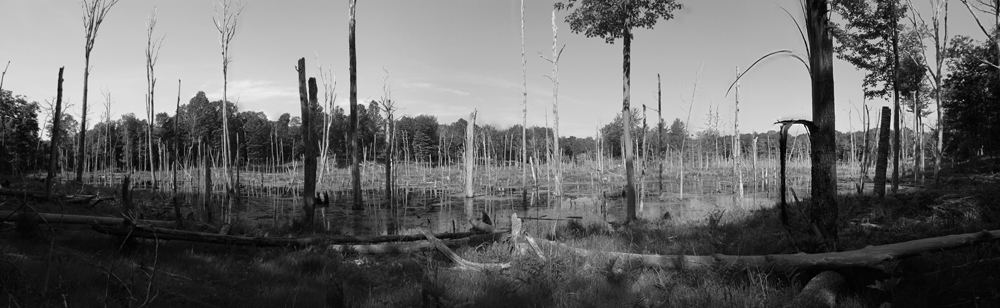
May 30th was probably one of my top 5 most enjoyable days of fieldwork since Frontenac Bird Studies began. The weather was perfect, the biting insects were oddly subdued and I could scarcely walk 100m before needing to georeference some exciting critter. I saw many butterflies, moths, snakes and plants of note but the centerpiece was a wetland that Steve Gillis and I explored during our first biothon in July 2010. Below are two panoramic views of the swamp from the south and east respectively (click to enlarge).


The wetland is fairly large by frontenac standards, about 9 acres in total area. It is distinctive in having a small raised island of live trees (mostly pine) surrounded by a flooded lowland dotted with snags and fallen trees. Surrounding the wetland is mid-successional oak-maple forest with scattered mature trees, an open understorey and with ground cover dominated by grass. The area was absolutely teeming with cavity nesters – Northern Flickers, Hairy Woodpeckers, Yellow-bellied Sapsuckers, Great Crested Flycatchers and White-breasted Nuthatches mostly. Apparently the area is so irresistible to Common Grackles that they were also nesting in cavities 10-15m above the water – an unusual choice for them (1.8% of nests reported to Ontario Nest Records Scheme n=2652).

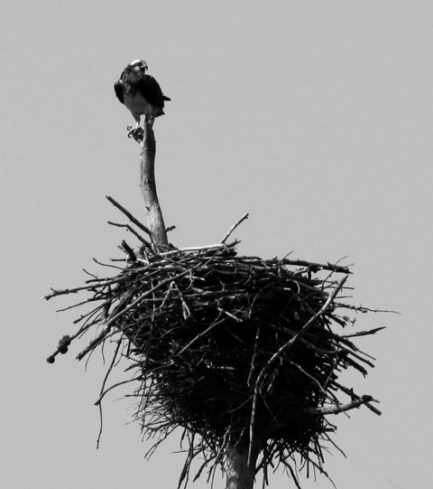
At the far north end of the swamp were two large platform nesting species – Osprey (1 nest) and Great Blue Heron (3 nests). These and the all the cavity dwellers put on quite a show! The bordering woodland was also active with Cerulean Warblers, Red-shouldered Hawks, Yellow-throated Vireos and a single Olive-sided Flycatcher being the most noteworthy. The Olive-sided is the first I’ve seen in the region and probably a migrant, although suitable is available north of the park closer to highway 7. You can hear it singing in the video clip above (quick-three-beers) along with the odd Cerulean Warbler.

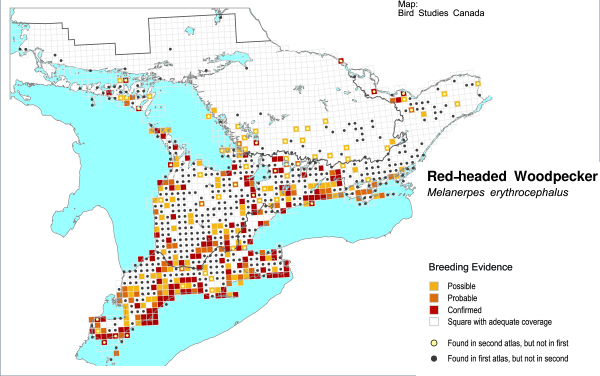
The birding at this site in July of last year was less memorable, probably due to the fact that it was during a mid-afternoon in July. However we did spot a pair of Red-headed Woodpeckers that day (Melanerpes erythrocephalus) – a rapidly declining species (Threatened status) in Ontario. It turns out that the species has been retracting from many parts of its range but heavily in Eastern Ontario. Our observation was the second of only two documented breeding records for Frontenac Provincial Park, although breeding evidence was not officially obtained in 2010. I bookmarked this as a target for 2011 and am pleased to report that it took me less than 30 minutes to confirm an active nest site this past Monday!

Adult Red-headed Woodpecker near cavity
RHWO Nest Site (near top of snag just underneath foliage)

Their active behaviour and brilliant high contrast of their plumage made them easy to track and observe within the open wetland. An adult called repeatedly from the west end of the swamp but rarely approached the nest (the male?). The other adult, presumed to be the female, made frequent trips to a cavity near the top of a 14m tall snag close to the southeast shoreline. The video at the beginning of this post highlights some of the activity at the nest site, which seemed to be exclusively short incubation sessions as no excavation or food carrying were noted. We will return to this site again in the next week or two to check on its progress.

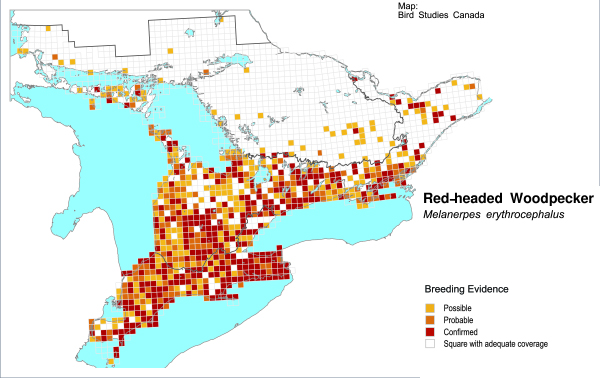
The Red-headed Woodpecker is an extraordinary bird for many reasons. This post is already running long so I’ll have to return to this topic at a later date to highlight its unique ecology and relationship with human settlement. Below are two instructive breeding evidence maps from the Ontario Breeding Bird Atlas, which visualize the widespread decline of this species in Southern Ontario. For further intormation, The Birds of North America account (subscription needed) is essential reading for this species but the Cornell account hits some key points too.

1st Atlas (Source: Atlas of the Breeding Birds of Ontario)
2nd Atlas (Source: Atlas of the Breeding Birds of Ontario)

The Louisiana and the Cerulean

This video was recorded yesterday while revisiting the site where a Louisiana Waterthrush nest was found on May 26, 2010. The stream at this site is flowing with so much vigor that the two waterfalls severely limit the audibility of my playback system. Despite this I was able to locate a territorial male at the south end of the stream complex in a low valley sandwiched between two small ridges. I promptly ended playback as soon as the male responded and watched him for about ten minutes or so as he moved back and forth from the stream to higher perches. At one point he moved higher toward the canopy and was instantly chased off by a bill snapping small passerine, which turned out to be a female Cerulean Warbler (Dendroica cerulea). I followed the female for several minutes and hit an ornithological jackpot of sorts when she flew to a nest located on a horizontal branch of a large Sugar Maple (Acer saccharum), about 15m above the ground.

Cerulean Warblers build their nests high in the upper canopy of deciduous forests that have mature trees, little or no understorey and small gaps or breaks in canopy closure. These characteristics make their nests quite difficult to find and even harder to inspect and monitor! In this case I was able to get a decent view of the nest from either of the two ridges, which put me roughly 15 feet closer to the crown of the large trees growing in the valley. Even with this advantage I still had to zoom to 39x to get a low quality recording. Gotta thank the 749 mosquitoes for all the shakiness. I will definitely be returning to this site (with a tripod!) to monitor both of these important breeders in the next several weeks. Frontenac Provincial Park is one of the most significant protected areas for Canada’s population of Cerulean Warblers now listed as an Endangered species by COSEWIC.

Playback and Bullfrog at the falls

Back to the waterthrush surveys. Things have picked up a bit since my last post but it seems that 2011 will be marked as a down year for breeding Louisiana Waterthrushes in this region. I have not been successful at several reliable sites despite as many as four repeat visits. A review of historical records show some evidence of a downward trend occurring since the first half of the last decade. Despite an apparent population decrease coinciding with the initiation of our study in 2010 it is critical to monitor the sites through the good times and the bad times. Interestingly, the high number of unoccupied sites found this year has only buoyed my interest in the study going forward. Also, the 2011 season is not over yet as surveys at five more sites are yet to be completed and I do have four active sites to keep tabs on.

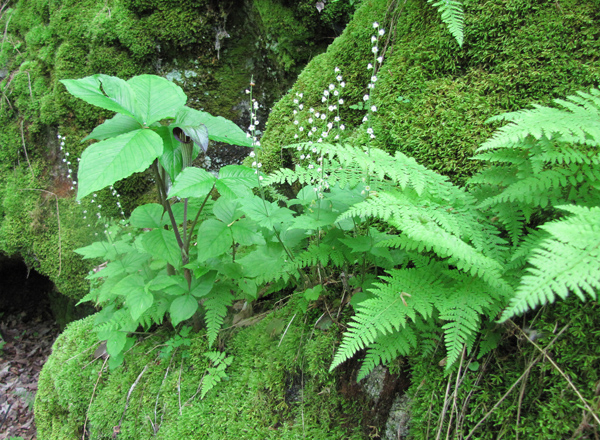
Ferns and Jack-in-the-Pulpit
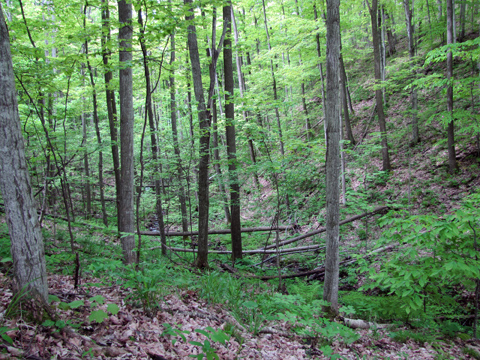
Gorge near Birch Lake
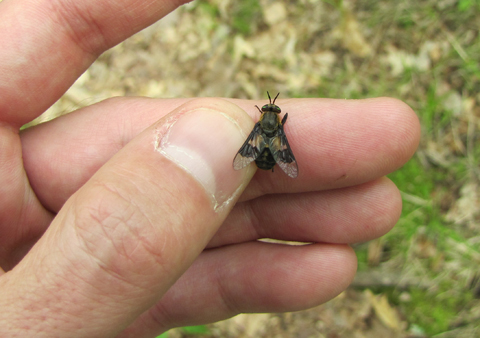
Deer Fly season begins