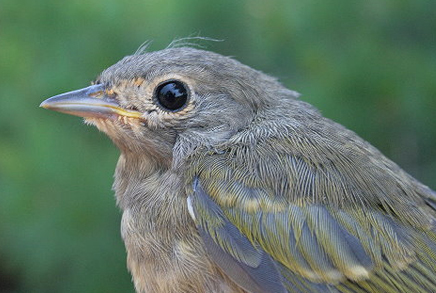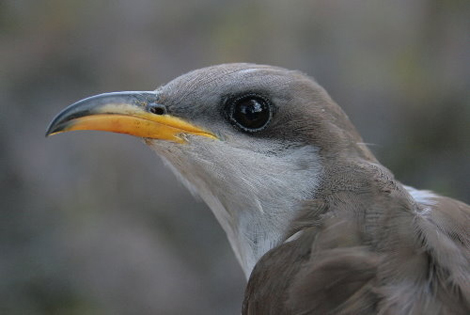
MAPS Visit 5-Rock Ridge

3743243228_608978c481
Yellow-billed Cuckoo (S.Leckie)

Fieldwork for the Frontenac Breeding Birds program is still rolling along with the Monitoring Avian Productivity and Survivorship program. Since our last reports on visit three to each of the sites we have also completed rounds four and five at MABO and RRID. This summary reports on visit five to Rock Ridge (RRID), a site situated in rock barren habitat in Frontenac Provincial Park.

3740984061_7d57a62d73
Sunrise over Big Clear Lake (Leckie)

Our pre-dawn entry to the site featured a spirited concert by Whip-poor-wills and Common Nighthawks and this sunrise on Big Clear Lake captured by Seabrooke Leckie. It was an enjoyable paddle-not too buggy and calm.

IMG_030-Panorama
180 degrees of Rock Ridge goodness (click to enlarge)

I hope I’m not boring everyone with these pan shots from the RRID banding station but it continues to dazzle us with its scale and perspective:) This spot is extremely active first thing in the morning with loons diving and calling below, vultures and osprey soaring just overhead and a dizzying number and variety of birds moving between and along the cliffs. Post-breeding dispersal of adult and young birds is well underway and this is without a doubt the best spot to sit and watch. There were the usual suspects dispersing here on July 20, lots of Yellow-rumped, Pine and Black-and-white Warblers, Field and Chipping Sparrows, Purple Finches, phoebes, sapsuckers and towhees among others. There were also some new faces including a singing male Northern Parula about 50m from the banding station and several Vesper Sparrows, all of which sadly avoided capture.

3742452525_c318b9c9ec
Adult Hermit Thrush (Leckie)

We finally captured a Hermit Thrush at RRID! A male had been singing inside the perimeter of our station since May and had eluded us until visit 5.

3743243306_40395cec89
Hatch-year Hermit Thrush (Leckie)

Its territory must have been neatly tucked inside our station boundaries as two youngsters were captured on this day, indicating that an active nest was present. Oddly, this was the first juvenile thrush we have captured so far this season (not including robins), despite that a much higher number of thrushes occur at MABO. In fact, the overall proportion of youngsters sampled thus far at both stations has been quite low, which may reflect low productivity-perhaps due to cool and wet weather. We still have two visits to MABO and RRID left in 2009 so we will reserve judgment for later.
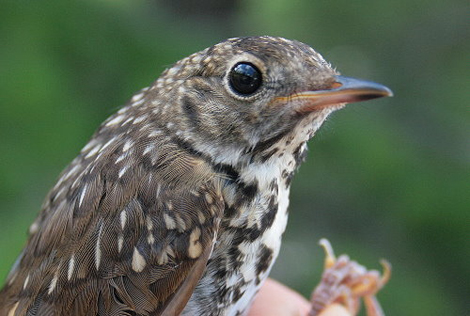
3743243368_bd916b5e60
Brother or sister HY Hermit Thrush (Leckie)

A second young Hermit Thrush captured in the same net on the following net check (All birds were later reunited).

3742452575_03aa3708f4
Hatch-year Black-and-white Warbler (Leckie)

Black-and-white Warblers were equally sampled as three were banded on July 20, which included two young birds and an adult. Together, Hermits and Black-and-whites comprised almost 50% of the birds captured at RRID on this day. Capture totals at RRID have been considerably lower than at MABO thus far. Our point count surveys in the region indicated that the density and diversity of breeding birds in mixed-forest and rock barren habitat is lower than deciduous woodland. Still, the RRID site was partially selected for its potential to sample a large dispersal in late summer, which has yet to happen. We are hopeful that the remaining visits will yield an increased capture rate of birds dispersing from surrounding areas.

3750822471_9db384a4ec
Spoon-leaved Sundew (Leckie)

Seabrooke was itching to check a nearby fen for carnivorous plants and wasn’t disappointed with what she found-plenty of Pitcher Plants and Spoon-leaved Sundews! The RRID site is positively teeming with biodiversity.

IMG_0310
Seabrooke nest checking by canoe (Derbyshire)

There is usually some time between net checks to sit and watch birds from “the balcony” seat at the banding station. During one of these sessions I spotted an Eastern Phoebe entering a small cut in the rock at the water’s edge on the opposite cliff. I suspected a nest was present given their repeat visits to the same spot and the frequency with which adult phoebes were observed catching moths and other insects over the water.
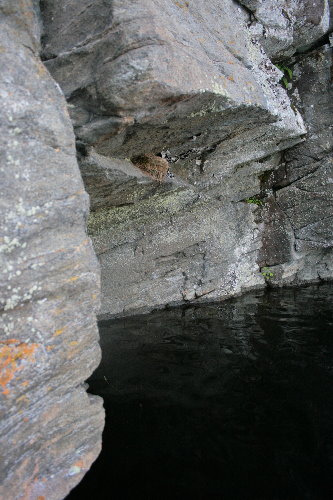
3742451919_e85d4acd2a
Eastern Phoebe nest

I ‘radioed’ to Seabrooke about these observations and she was able to confirm the presence of a nest with three young positioned on a ledge underneath the cut in the rock wall. This is the second nest of an Eastern Phoebe recorded in non-manmade structures this summer. Despite how quiet the banding can be at times, there is never a dull moment at Rock Ridge!

Rock Ridge Results-Visit 5 of 7

New birds banded (15 of 8 species)

American Redstart-1
Black-and-white Warbler-3
Red-eyed Vireo-1
American Robin-4
Yellow-billed Cuckoo-1
Field Sparrow-1
Hermit Thrush-3
Blue Jay-1
Project Whip-poor-will in 2009

h

Project Whip-poor-will, our pilot study to examine protocols suitable for long-term monitoring of Whip-poor-will populations in Ontario, was successfully completed this summer by FBS staff. The Whip-poor-will is the latest bird species added to the COSEWIC list of Species at Risk having been recommended for listing in April 2009. The Whip-poor-will joins the Common Nighthawk as nightjar species with ‘threatened’ status in Canada.

As a group, nightjars are one of the least understood families of birds in North America, which is largely due to their strict crepuscular/nocturnal habits and cryptic nature. Much like bats, nightjars are entirely dependent on flying insects for sustenance-moths in the case of Whip-poor-wills. This species feeds exclusively at dawn and dusk and throughout the night under a bright moon, making short upward flights at flying insects back-lit by bright nighttime skies. While it is troubling that both Common Nighthawk and Whip-poor-will life histories remain “in the dark”, even more troubling is that we know even less about their respective population trends and systematics. This void places these two species at considerable risk for rapid decline. What is clear is an echoed sentiment amongst landowners and the public in the northeast region that Whip-poor-wills no longer fill the night with their distinctive song in places long inhabited by these enchanting birds. So what’s causing these retractions from historical breeding sites? Are birds in fact declining across the board or are declines localized? Are the declines attributable to breeding productivity or adult survivorship? All important questions but the first place to start is to generate scientifically rigorous and annually repeated assessments of populations across as much of the species continental range as possible.

This effort to index the status and patterns of Whip-poor-will populations has already begun in the United Status with the Northeast Nightjar Survey but as yet no parallel initiative has taken root in Canada. The Frontenac Arch, the most environmentally ‘intact’ region in Southern Ontario, remains a stronghold for Whip-poor-will populations in Ontario as reported by the recently updated Breeding Bird Atlas of Ontario. The Southern Shield ecotone in Ontario’s cottage country, which includes northerly sections of the Frontenac Axis landform, clearly represents an area of vital importance to Canadian populations of the Whip-poor-will.

For our part, a total of 35 point count station comprising three distinct routes were conducted in early July, 2009. Counts were conducted on nights when the moon was above the horizon and when greater than 75% of the moon was illuminated. Replicates of count stations with multiple Whip-poor-wills were also performed to assess effects of temperature, cloud cover and wind speed and also to compare dusk to nighttime periods for counting. There were some clear patterns of vocal frequency determined by these factors, which will be useful in designing a protocol to maximize detection in future years.

Over 50 Whip-poor-wills were detected on the surveys with abundance per station ranging from 0 birds (usually in wide open or closed habitats) to 5 birds countersinging in “good habitats”. Distance and compass bearing from station centre were recorded for each encounter. At the busy stations it was quite a challenge to keep track of ‘who was who’ as birds moved around and songs frequently overlapped from various directions and distances. I don’t think I’ve ever been so reliant on cupping my ears to sonar the location of a singing bird as their voice seemed to echo from a very general area unless the bird was within 75 meters. Whip-poor-wills were found in habitats of various types and forms but always with an association of open fields, meadows, outcrops and/or rock barrens.

I spent many evenings/nights with the Whip-poor-wills in July along Canoe Lake Road, Devil Lake Road and McAndrews Road among others-it was a rich experience and I’ve come away with a deep appreciation for this bird and many questions about its ecology and apparent plight. There is something about the moon and the dark and these strange and wonderful birds that made me believe volunteer citizen scientists from across the province would band together to monitor and ultimately protect this threatened species. Hopefully this can get underway for 2010 and beyond….

Nest under construction: Red-eyed Vireo

CLICK HERE to watch this video in High Definition on Vimeo

The above video was captured over a period of four and a half days from June 27-July 1, 2009. A female Red-eyed Vireo began installing the foundation of a nest in a young maple about two meters above the ground on June 27. The process in its entirety was fascinating to observe as the footage revealed subtleties of technique and the use of various materials.

The Red-eyed Vireo (Vireo olivaceus) is one of the most common passerines of eastern forests in North America. A neotropical migrant, “Red-eyes” migrate to South America each autumn where they feed primarily on fruit. During the summer they are dedicated insectivores of mainly deciduous forest stands and fragments. The male Red-eyed Vireo is a vocal standout in the avian world as they hold the record for most songs per day of any bird species on the planet. In June and July the female Red-eyed Vireo builds a pensile or suspended cup nest from an outer fork of a branch-exclusively in deciduous tree species. The subject nest of this writing matches this description very closely. This particular nest was easily accessible for monitoring, providing a convenient window into the meticulous and masterful work of the nest building songbird.

I strongly recommend that you watch the HD version of the video to see the subtle movements and to appreciate the remarkable precision of the bill in manipulating nest material. The video clearly shows how important spiders and their webs are to nest construction for this and many other bird species. The female worked constantly during daylight hours over the course of four days. Review of the footage indicated that she visited the nest for periods of between three seconds to two minutes with an average of four minutes between trips. This rate would mean that just shy of 200 visits to the nest are made each day for a total of ~850 visits to complete a nest in four to five days!

the Nest Files – Eastern Phoebe

IMG_0227
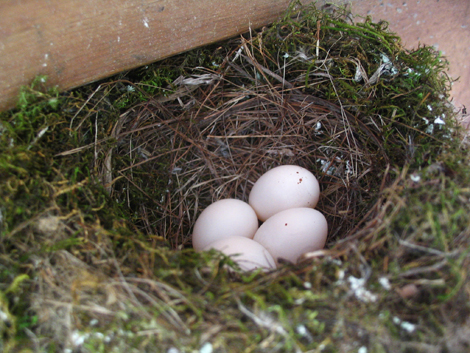
Eastern Phoebe nest contents

Eastern Phoebe (Sayornis phoebe)

Nidiologicals (from Peck and James 1987)

Habitat=deciduous and mixed woodlands; rural areas
Microhabitat=primarily man made structures in open forested habitats but also in natural crevices and ledges
Spring arrival=April
Average nest height=2.1-3m
Nest builder=female
Incubation=female
Average # of broods/season=1-2
Average Egg Date=May 23-June 18
Area sensitive=no
Average clutch size=4-5
Incubation period=14-15 days
Egg colour=white with some of the clutch speckled
Parasitized by cowbirds=yes

phoebe2
Guard duty-male Eastern Phoebe

[This is a pre-scheduled post written with haste on June 30 for publishing on July 3. We are hoping to have internet back up and running by the end of the weekend]

This Eastern Phoebe nest was originally built in a prior year, probably 2008, and was re-established by the adult male (above) and female (below) beginning June 17, 2009. The pair began checking out the dilapidated nest found under an eave on top of a motion-sensor light in mid-June. A day or two later, an adult was seen carrying material to the nest. Eastern Phoebes are remarkably tolerant of human activity around their nests and this particular pair is no exception as dogs, cats, people and various vehicles come and go without any apparent objection to the birds. By June 21, the nest was refurbished with a tidy new wreath of moss, plant fibers and animal hair. Upon checking the nest with a mirror on June 22, two eggs were discovered which became four by June 24. The female has been incubating ever since.

phoebe3
Adult Eastern Phoebe incubating

This species has a variable incubation period, however the average is 14-15 days, which would mean that the eggs should hatch around the end of the first week of July. We will keep an eye on this nest for as long as we can with the hope that we might determine its final outcome.

MAPS Visit 3-Rock Ridge

3668800446_1eb3dbbe3f
Broad-winged Hawk (S.Leckie)

Our third visit to Rock Ridge was a much busier affair than the last when just 9 birds were captured in six hours in mid June. We finished the morning with a total of 28 captures, the highest single-day tally we have had at this site so far. The variety of birds was also very good as fifteen species were handled during visit three. The highlight of the morning’s catch was this superb Broad-winged Hawk, which was in net #6 for little more than a few seconds as I pounced on it before it could get out. Birds of this size are rarely captured in our nets because the mesh is small, 30mm mesh to be exact, which is appropriate for most songbirds but not nearly large enough to hold a bird as big as a buteo for any length of time. This adult Broad-wing was spectacular up close and a rare treat as they are by no means a bird to be expected in a mistnet. The species is a local breeder in mature forests along with its relative the Red-shouldered Hawk.

IMG_0236
Song Sparrow

Song Sparrows are suddenly more plentiful. They are one of the most abundant songbirds in North America, inhabiting a wide array of habitats with a strong preference for open and edge environments. A pair has been nesting just below our banding station atop the cliff at Rock Ridge. Field Sparrow, Eastern Towhee, White-throated Sparrow and Chipping are all much more common than Song Sparrow at the site.

3667996415_d5d24d9734
Adult male Nashville Warbler (S.Leckie)

A pair of male and female Nashville Warblers were captured in a net close to a suspected nest site along the northwestern slope of the MAPS station.

3667996619_61c13dfe7e
Nashville Warbler Fledgling (S.Leckie)

This is likely the reason why they were suddenly captured-fledged young. This is a recently fledged juvenile Nashville Warbler that was captured in the following net round and in the same net as the parents. This youngster was completely oblivious to its circumstance being in the net and handled by a pair of humans. We quickly returned it to its parents after measurements and banding as it is still dependent on its parents for food.

IMG_0262
Bog habitat at net 8 favoured by Nashville Warblers
IMG_0260
Net lane #8
3667995209_7f8265f07a
Baltimore Oriole (S.Leckie)
3668800058_cc3546449d
Broad-winged Hawk (S.Leckie)
3668801916_0332227ef1
Take off (S.Leckie)
3667995583_d3b55b9434
Black-billed Cuckoo (S.Leckie)

Another fabulous visit to Rock Ridge, a member station of our young MAPS network in the FBS study area. Given all that was done in June, it feels as though the breeding season should be wrapping up soon but in fact, we are less than halfway through our season and thus a great deal is yet to come! A summary of results for MAPS visit 3 is provided below.

Rock Ridge Results-Visit 3 of 7

New birds banded (23 of 14 species)

Broad-winged Hawk-1
Nashville Warbler-3
Black-and-white Warbler-4
Yellow-rumped Warbler-1
Black-capped Chickadee-2
Red-breasted Nuthatch-1
Red-eyed Vireo-1
Song Sparrow-2
Baltimore Oriole-2
Rose-breasted Grosbeak-1
Great Crested Flycatcher-1
American Robin-1
Hairy Woodpecker-2
Black-billed Cuckoo-1

Recaptures (5 of 4 species)

Black-capped Chickadee-1
Black-and-white Warbler-1
American Robin-1
Eastern Towhee-2