Habitat=deciduous and mixed woodlands; rural areas Microhabitat=primarily man made structures in open forested habitats but also in natural crevices and ledges Spring arrival=April Average nest height=2.1-3m Nest builder=female Incubation=female Average # of broods/season=1-2 Average Egg Date=May 23-June 18 Area sensitive=no Average clutch size=4-5 Incubation period=14-15 days Egg colour=white with some of the clutch speckled Parasitized by cowbirds=yes
Guard duty-male Eastern Phoebe
[This is a pre-scheduled post written with haste on June 30 for publishing on July 3. We are hoping to have internet back up and running by the end of the weekend]
This Eastern Phoebe nest was originally built in a prior year, probably 2008, and was re-established by the adult male (above) and female (below) beginning June 17, 2009. The pair began checking out the dilapidated nest found under an eave on top of a motion-sensor light in mid-June. A day or two later, an adult was seen carrying material to the nest. Eastern Phoebes are remarkably tolerant of human activity around their nests and this particular pair is no exception as dogs, cats, people and various vehicles come and go without any apparent objection to the birds. By June 21, the nest was refurbished with a tidy new wreath of moss, plant fibers and animal hair. Upon checking the nest with a mirror on June 22, two eggs were discovered which became four by June 24. The female has been incubating ever since.
Adult Eastern Phoebe incubating
This species has a variable incubation period, however the average is 14-15 days, which would mean that the eggs should hatch around the end of the first week of July. We will keep an eye on this nest for as long as we can with the hope that we might determine its final outcome.
Nidiologicals (from Peck and James 1987 and Van Horn et.al 1994)
Habitat=deciduous forests Microhabitat=nest built in sparsely vegetated forest floor with dense leaf litter, often in forest clearings Spring arrival=May Average nest height=ground Nest builder=female Nest building period=5 days Average # of broods/season=1 (rarely 2) Average Egg Date=June 6-June 20 Area sensitive=yes Average clutch size=4-5 Incubation period=12 days Egg colour=white with speckles of gray, brown or hazel forming a wreath at large end Incubation=female Fledgling stage=young leave nest 8-10 days after hatching Parasitized by cowbirds=yes
The Ovenbird is a common species inhabiting both dry and mesic deciduous forest types throughout our study area in the northern Frontenac Arch. Our point counts suggest that they are one of the most abundantly occurring species in contiguous tracts of deciduous and mixed forest, both mature and younger stands, where the understorey is sparsely developed and canopy closure is high. The Ovenbird, a ground specialist, is an area sensitive species, which means that productivity is adversely affected by forest fragmentation. Data from the Breeding Bird Survey and the Ontario Breeding Bird Atlas indicate a significant population decline in southern Ontario where most large tracts of forest have been reduced to isolated smaller fragments unsuitable for reproduction of this species. The Ovenbird winters in southern Florida, Mexico, Central America and the Caribbean islands.
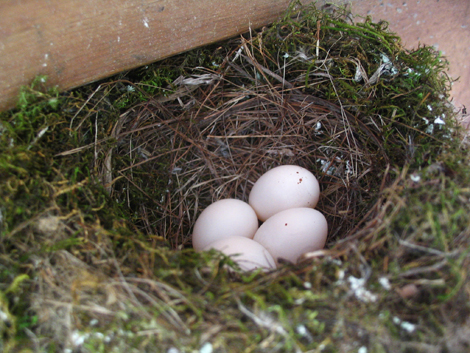
Nest contents
This Ovenbird nest was discovered at our Maplewood Bog MAPS station on June 14, 2009. This species is notoriously cryptic in its habits during the breeding season, often walking slowly along the forest floor to its well concealed nest. The species gets its name for its domed nest that resembles an oven. I was rather exstatic to find this nest as I had spent a good few hours tracking adults in two other territories in nearby Frontenac Park, both of which led me to recently fledged young instead of active nests. The eggs are heavily speckled with reddish-brown marks that are concentrated at the larger end.
The Oven nest
So here is the weird part. The nest was built at some point between our first and second visit to MABO in a 12m long net lane that was cleared in late May! The female will only flush from the nest if your foot comes to within perhaps 10 inches or so of the nest, which is an extreme example of an incubating bird “sitting tight” to avoid exposing the nest to an intruder. It was remarkable that we hadn’t either stepped on the nest or flushed the female earlier that morning as the nest is almost directly in the middle of our foot path for checking the net.
microhabitat
It was only when I took the net down at the end of the day that I sensed that something small and quick had just dashed from the ground near my feet. I then had a quick look around in the thicker ground cover but didn’t find anything resembling a nest. I then turned to a small and rather odd looking clump in the grass underneath a juniper seedling and noted the classic domed shape of an Ovenbird nest and then four eggs! The nest is not unusual in being located in a clearing but it is unusual to be positioned in such an exposed context with direct sun beaming on its roof during late morning and much of the afternoon. There is however, a decent layer of dead leaves, which female Ovenbirds key on for nest site selection.
habitat
This last photo shows the location of the nest within the net lane and the habitat of choice for this particular pair of Ovenbirds. Incidentally, we captured presiding male and female in the net that goes here on the first net check of visit three! They both seem to be doing well as the male sings throughout the morning, no less than 30m from the nest at any time and the female incubates the four eggs despite our comings and goings. We won’t be revisiting MABO until next week, which will give these expecting parents some quality alone time to take care of business.
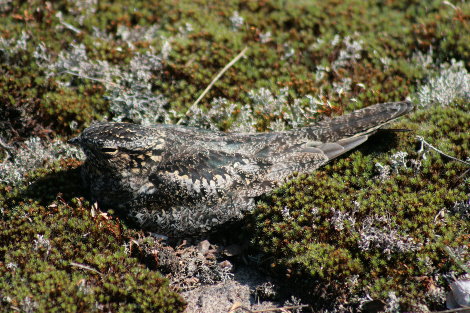
The Common Nighthawk nest first discovered at our Rock Ridge MAPS site is still active. This adult, probably a female, spent the morning of June 16th incubating eggs in the blistering sun and seemed to be catching up on some sleep as well. I called in Seabrooke to sweep by on a net check with her long lens for a photograph and it turned out very nicely as usual. The eggs have been incubated since at least June 2, which means that the chicks should hatch no later than June 21 if they haven’t already. We will be back for our third visit to the site around the middle of next week and will hopefully find two “nighjarlets” at the little rock outcropping. I will also be conducting two point count routes in rock barren habitat next week. Each route will be four kilometres long, which gives me a good opportunity to turn up some more of these fascinating birds.
Whip-poor-wills, waiting for the next full moon to approach, have been quiet of late but we did flush three individuals from Canoe Lake (1 bird) and Perth (2 birds) Rds on our pre-dawn drive to Rock Ridge on the 16th.
Nidiologicals (from Peck and James 1987 and Middleton 1998) Chipping Sparrow (Spizella passerina)
Habitat=open woodlands, parkland and treed fields Spring arrival=April-May Average nest height=0.9-2.4m Nest builder=female Average # of broods/season=2 (rarely 3) Average Egg Date=June 4-June 20 Area sensitive=no Average clutch size=4 Nest building period=~4 days Incubation period=10-11 days Microhabitat=high variable across geographic range; strong preference for conifers. Egg colour=sky blue (rarely white) with irregular streaks, blotches and spots mostly at larger end Incubation=female Parasitized by cowbirds=yes
Nest searching in the FBS study area has been generally productive, although we’ve been forced to reduce the amount of time for dedicated searching due to time constraints in June. I’ve been monitoring about forty nests in the last two weeks and have been pleased with success thus far in finding nests at a good rate when time is available. Yesterday in two hours, I was able to find active nests of Blue Jay, American Robin, Eastern Wood-Pewee, Baltimore Oriole and American Redstart. This post is an in-depth profile of Frontenac nesting species number three (only about 190 to go!).
The Chipping Sparrow is one of North America’s most abundant songbirds, a species that has benefited from the creation of suitable habitat by human settlement and infrastructure from Newfoundland to Alaska through Central America. Unlike most sparrows, the Chipping Sparrow prefers open woodlands and treed edges of waterways and fields. They seem to occur in higher densities in urban settings than undisturbed habitats. I recall my surprise in encountering an abundance of Chipping Sparrows in taiga habitats near the treeline in the Northwest Territories where Chipping Sparrows nested on the ground or slightly elevated in spruce saplings. Here in the Frontenac Arch, “chippers” are abundant in most areas where natural or man-made forest clearings occur. Our point counts are revealing a strong preference for mixed forest sites containing Eastern White Pine and/or juniper.
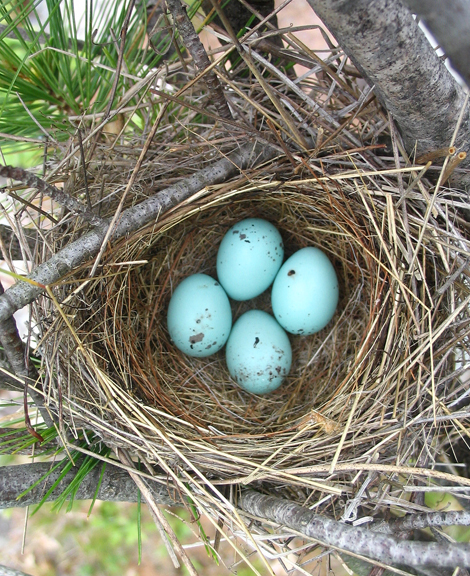
Chipping Sparrow nest contents (Derbyshire)
This Chipping Sparrow nest was discovered in Frontenac Provincial Park in early June within transitional habitat from young deciduous forest to mixed forest/rock barren. I was alerted to the presence of the nest by alarm calling adults. The nest was easily found at the outer end of a low pine bough, not terribly well hidden. The nest itself is a loosely formed cup consisting of dried grass with a more densely formed inner bowl of animal hair and fine plant fibers. The four eggs are a distinctive sky blue with irregular dark markings, mostly at the larger end. It was recently discovered that male Chipping Sparrows copulate with multiple females in neighboring territories (extra-pair copulations).
These last three shots visually describe the nest position and the habitat. It is unusual for a Chipping Sparrow to select such an exposed location for the nest as this particular one is clearly visible from the sides and especially from below. Not surprisingly, the preference of Chipping Sparrows for wooded edges has exposed them to high rates of brood parasitism by Brown-headed Cowbirds. Interestingly, of the forty nests (all species) I have discovered thus far, I have yet to find a single case of parasitism. This is, in part, due to the habitat where nests have been found, interior forest sites where cowbirds are rare. I have begun nest searching in a forest plot adjacent to open habitats and will be interested to observe any divergence in rates of parasitism.
Habitat=Deciduous forest
Area sensitive=yes
Average clutch size=4
Nest building period=6 days
Incubation period=10-14 days
Microhabitat=ground or slightly elevated in shrub/tree
Nest builder=female
Incubation=female
Parasitized by cowbirds=yes
This is the first edition of what will be an ongoing series of nest profiles for breeding bird species of the Frontenac Arch. Searching out and monitoring active nests has always been an important component of ornithology and is also a significant source of data for understanding and tracking changes in demographics and ecology of breeding avifauna all over the world. As part of the Frontenac Breeding Birds program we will be actively searching for nests in select areas to yield valuable information on habitat associations, nest success/failure rates and predation/parasitism rates to name a few. These demographic data combined with vital rate statistics drawn from our three Monitoring Avian Productivity and Survivorship stations will be utilized in concert with standardized population estimates (point counts) to form an integrated approach to avian monitoring.
This Veery nest was discovered on June 6, 2009 at our Maplewood Bog MAPS site. The Veery is one of five members of the Catharus genus of thrushes, which inhabit forests across much of North America. The Veery prefers damp, deciduous forests and tend to favour more successional habitats than the other “spot breasted” thrushes. Nests are built entirely by females in mid-May to early June and are built on or near the ground in 6-10 days (Forbush 1927). This particular nest was found about 8 inches above the ground in the centre of a small juniper in a deciduous woodland clearing. Eggs are laid 4 days after nest completion and the average clutch size is 4 eggs. The female builds the nest alone and incubates the clutch while the male guards the territory until the eggs hatch after 10-14 days after laying. The Brown-headed Cowbird parasitized 19% of nests recorded in Ontario (n=368), making the Veery a sensitive species to habitat fragmentation (Peck and James 1987).
Veery nest site
I was a bit surprised to find this particular nest in such an “open” spot with full sun shining on the nest and the back of the incubating female. Junipers are definitely a key plant for ground nesting birds in this region as the dense evergreen foliage provides an excellent concealer.
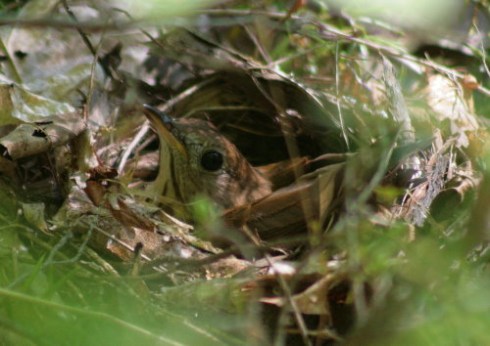
Female Veery Incubating (S.Leckie)
This incubating female sat very tight to the nest for most of the morning and was only flushed when approached to within 1ft. Luckily, Seabrooke, with camera at hand, was nearby and was able to get a couple of shots of the female tending to the clutch. I was very pleased to find our first Veery nest for Frontenac Bird Studies, as the species’ nest is notoriously difficult to find. We will be on the lookout for more and will also look for nests of its relatives-the Hermit and the Wood Thrush in the coming weeks.






 Frontenac Bird Studies