MAPS Visit 1 – Blue Lakes

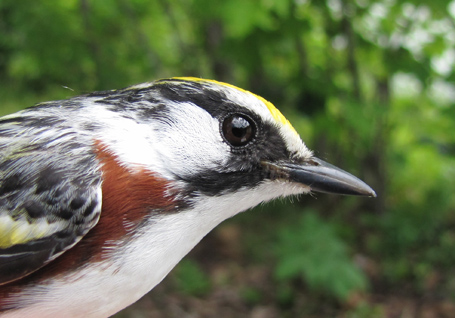
Chestnut-sided Warbler (D.Derbyshire)

Our roster of Monitoring Avian Productivity and Survivorship (MAPS) stations has grown in 2010! Our new site called Blue Lakes is the northernmost of the three and is about nineteen kilometres north of Maplewood Bog. The site fills a key gap for us both spatially and in species coverage. Finding this site was quite an exercise that involved several weeks of map study and reconnaissance. I found lots of other sites that had potential but there was always a negative factor or two with them. Access, terrain, edge conditions and species mix were key considerations that were finally met when the Blue Lakes site was discovered about two weeks ago. A satellite view of the “AXIS” network is included below. Each of the three stations provides coverage of an area up to a four kilometre radius of the station centre, which means that we are now generating productivity statistics for 150 square kilometres of the Frontenac region – very exciting.

FBS MAPS network (Google Earth)
Lake edge at banding station (Leckie)

This is the view from the banding station, which is situated on a scrubby peninsula that bisects a horseshoe-shaped lake full of emergent vegetation, amphibians and a small heronry as well.

Net 9 in mature deciduous (Leckie)

The Blue Lakes is probably the most varied of the three stations in terms of habitat. A circuit of the ten net lanes passes through rocky scrub edge along the shores of small lakes, mature deciduous forest, deciduous swamp thickets, areas of young balsam fir/shrub thicket and grass/lichen outcrops. Also distinct here is the presence of a dense understorey – not represented at our Rock Ridge or Maplewood Bog sites further south.

Net 5 in fir swamp (Leckie)

Balsam Fir occurs throughout the area but is quite dense along a wet draw through mixed age forest with an uneven canopy. The conifers attract species such as Hermit Thrush and Magnolia Warbler, among others. The firs and the odd spruce here and there add a nice northern feel, which becomes more noticeable as you approach Highway 7 from the south. The Blue Lakes site is at the edge of the Boreal Hardwood Transition zone.

rocky clearing (Leckie)

These clearings are our main modes of traversing the site. They provide stable footing and a relatively flat, unobstructed path through the station. Field Sparrow and Sweetfern are dominant species in the rocky clearings where evidence of a rock flipping Black Bear was also found.

Net 1 in edge scrub (Leckie)

This is the important edge habitat that will (hopefully) attract large numbers of dispersing young and adult birds in the latter half of the breeding season. Both of the edge nets on the peninsula performed very well today, which was very pleasing.

Seabrooke banding Yellow-throated Vireo

We banded a Yellow-throated Vireo (YTVI) that was captured in net 1 on first check! This fellow has been singing from the oaks above the net lane for at least two weeks. This is the first capture of a YTVI for the MAPS program. They are a Frontenac Arch specialty of sorts, quite common in deciduous forest with clearings, so it was great to finally band one!
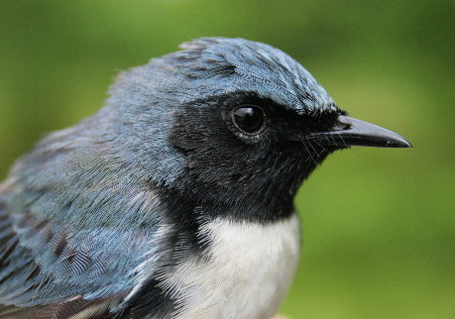
Black-throated Blue Warbler (Seabrooke Leckie)

Black-throated Blue Warblers are a dominant species at Blue Lakes, largely due to the dense undergrowth found in the forests. Seabrooke and I estimated that between 5-7 territorial males are present in the core area of about 8 hectares. It is unclear as to whether these males are mated as no females were observed or captured today. The capture and banding of this second-year male was also a first for our MAPS program. Black-throated Blues are wonderful birds and we can look forward to their buzzy tones for years to come!
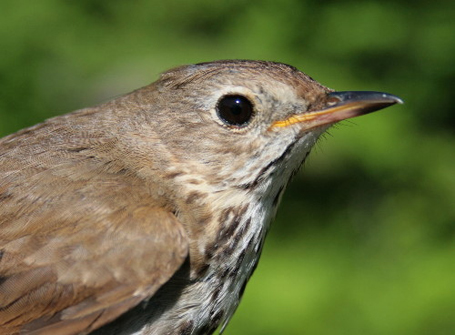
Hermit Thrush (S.Leckie)

The other dominant species at Blue Lakes are Veery and Chestnut-sided Warbler but a very diverse community of breeding birds was evident this morning. Singles of Hermit Thrush, Scarlet Tanager and Warbling Vireo (1st banded by FBS) were banded along with several Common Grackles and a lone Red-winged Blackbird (1st banded by FBS).

Mink Frog (one of many today)

I’ve only just barely scratched the surface of all that was enjoyed and discovered today. Visits to Rock Ridge and Maplewood Bog are imminent and the 3 A.M wake-up calls beckon me to cut this summary a bit short. We will have six more mornings of banding at Blue Lakes this summer and we are looking forward to each of them – a great study site indeed.

Here are the stats…

.

Blue Lakes – Visit 1 of 7

New birds banded (24 of 14 species)

Common Yellowthroat – 1
Veery- 4
Rose-breasted Grosbeak – 3
American Robin – 1
American Redstart – 1
Chestnut-sided Warbler – 3
Black-throated Blue Warbler – 1
Warbling Vireo – 1
Ovenbird – 2
Yellow-throated Vireo – 1
Scarlet Tanager – 1
Hermit Thrush – 1
Red-winged Blackbird – 1
Common Grackle – 3

A tortoiseshell leads the way

Compton Tortoiseshell

Yesterday I enjoyed another foray into the depths of Frontenac Provincial Park. I must have walked a good 4 kilometers or so in search of study sites for our growing MAPS network. I’ve started to learn that satellite and aerial photography is a useful tool but not a valid substitute for ground truthing. Yesterday, I was very lucky to find a good candidate study site by accident. The Compton Tortoiseshell pictured above was very shy and my persistence to ID the thing led me a ways off my intended track. I then noticed some intriguing habitat nearby and found what could be a new MAPS site for FBS!

Serviceberry blossoms

Serviceberry are blooming throughout the park. I am pretty sure this is Allegheny Serviceberry (Amelanchier laevis). They are the most eye catching plants out there right now but will soon fade into the background as their flowers drop and the other trees leaf out. Serviceberry are particularly common at the site found yesterday.

Upland hardwood forest

The site also has rich mature forest growing in steep valleys and upland slopes surrounding a small lake. Neither Rock Ridge (RRID) or Maplewood Bog (MABO) have this habitat, which makes this site particularly attractive. We know from last year’s surveys that Cerulean Warblers and Yellow-throated Vireos inhabit this forest around the lake. The problem with interior, mature forest like this is that the understorey is largely open and devoid of mistnetting opportunities. Fortunately, the mature forest surrounds a sizable area of regenerating woodland with lots of edges.

Thorn scrub

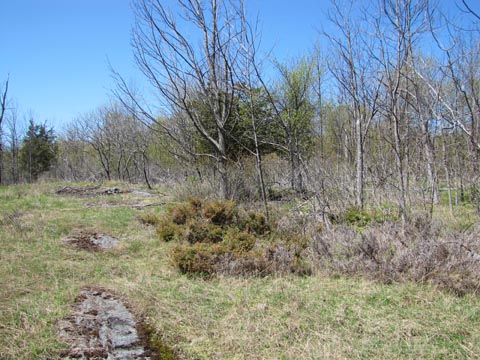
Here is a nice looking edge with thorn scrub, juniper and young trees. The combination of suitable edge habitat with mature forest is unique, which makes this a good candidate site for MAPS. One or two more visits to the area will be needed as I would like to see how it ‘greens’ out. It would also be helpful to learn a bit more about the bird community residing in the site before announcing any grand openings!

Large-flowered Trilliums

Nesting hawks & rare woodland butterflies

Hepatica

The search for new MAPS sites to join our existing Maplewood Bog and Rock Ridge stations has begun. The process is challenging, particularly here in the Frontenac Arch where ‘disturbed’ habitats with pronounced edges can be hard to find. The edges are important as this is where adults and young congregate during post-breeding dispersal, which is key to evaluating annual productivity. The heavily forested Frontenac region also tends to feature open understoreys with little shrub or sapling growth – not suitable for capturing birds using mistnets. Therefore the search feels something akin to looking for a needle in a haystack: a daunting job, to be sure, but not impossible. A needle we shall find!

Trout Lilly

Ontario Parks has been a tremendous supporter of FBS and have made a number of useful site suggestions for a second MAPS station within park boundaries. I will be checking out these various sites and will report on them as they are visited. I searched a good candidate site in a small portion of Frontenac Provincial Park today but unfortunately found nothing suitable for a MAPS site. Despite this I did have an incredible outing with some noteworthy discoveries.

Eastern White Pine

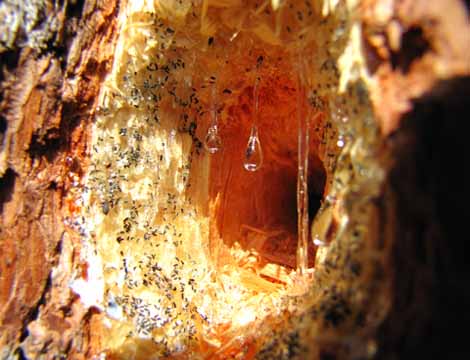
Today’s meander took me through a patch of mixed forest dominated by Eastern White Pine. Ruby-crowned Kinglets, Pine Warblers and Yellow-rumped Warblers were numerous in the canopy while newly arrived Eastern Towhees called from small rock outcrops. I came upon this excavation that was recently created by a Pileated Woodpecker, a common inhabitant of Frontenac Park. The sap was running quite thick and apparently attracted and drowned a considerable number of springtails along with a few other insects.

Woodpecker excavation

I spent an hour or two exploring the margins of many small/medium wetlands for good edge habitat but managed to find nothing of any use to a would-be bird bander. I did, however, find an impressive showing of early spring wildflowers such as Trout Lilly, trillium, hepatica, Bloodroot, Dutchman’s Breeches and Spring Beauties. After snapping a few photos, I decided to head for an area of mature forest en route back to the main road.

Red-shouldered Hawk nest

This is when things got interesting! This Red-shouldered Hawk nest was rather easily discovered in a mature Yellow Birch within a steep valley of mature hardwood forest. The adults were nearby and quite displeased with my presence! This is the first nest found by FBS in 2010, which is consistent in habitat and timing with the first nest of 2009 – a Red-shouldered Hawk nest on Canoe Lake Road. I quickly left the nest site to avoid unnecessary disturbance to the hawks, which seemed to be in the beginning stages of nest renovation.

There is a considerable amount of mature deciduous forest in Frontenac with some century old stands present. These forests are ideal for several species of conservation concern such as Cerulean Warbler and Red-shouldered Hawk. However, the ‘real’ biodiversity in these forests is exhibited by its plant and insect communities.

Woodland stream

With forthcoming Louisiana Waterthrush surveys in mind, I ambled down the bank to check on the water level and flow of this stream that courses through the forest. This past winter was the driest in decades and the lack of spring rainfall has further compounded the dry conditions. The result is very low water levels and weak flow of many streams in the park. I am hoping that we will get some decent rain in the coming weeks as the current picture for breeding Louisianas is bleak. There will be more to follow on our efforts to inventory the park’s streams for Louisiana Waterthrush.

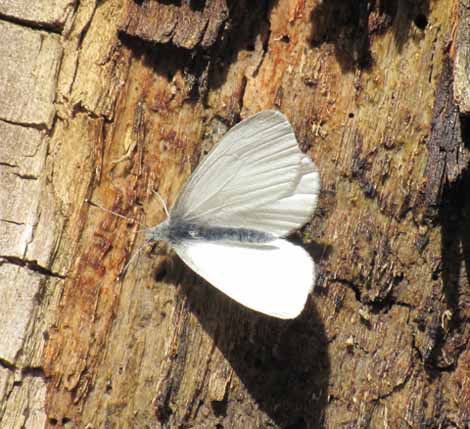
West Virginia White at rest (finally!)

The stream valley was hopping with early spring activity and the most apparent of the beasts were these ghostly-white butterflies, which I suspected might be West Virginia Whites (Pieris virginiensis), a species of Special Concern in Canada. An impressive number of these eye catching butterflies were observed fluttering about near the forest floor. This species is known to occur in Frontenac Park where suitable habitats are found. West Virginia Whites occur in mature moist deciduous forests in isolated pockets of southern and central Ontario. They are known to occur at about 50 sites in the province and were once classified as an Endangered Species (1977). The West Virginia White is one of the earliest butterflies to emerge in spring when the adults seek out emerging toothwort, which their larvae feed on exclusively. I will be watching closely for this species during all of the work in mature forest coming up in May.

West Virginia Whites

Often one finds the most interesting things when looking for something else. The search for new MAPS sites will continue……

MAPS Visit 7-Rock Ridge (RRID)

IMG_0415
Rose-breasted Grosbeak (D.Derbyshire)

It’s always nice to end on a high note. The Rock Ridge MAPS site finally lived up to the potential I thought it possessed for sampling post-breeding dispersal. Waves of birds were observed during our final visit of 2009-to and fro from the rock cliffs, along edges of outcrops and overhead. Tanagers, grosbeaks, warblers, vireos-all the familiar species that breed locally in Frontenac Provincial Park. Eastern Towhee, Chipping and Field Sparrow and Yellow-rumped Warbler seemed to be the most numerous of the species on the move. Most of the birds captured and banded were young birds such as the hatch-year (born summer ’09) male Rose-breasted Grosbeak pictured above.

3804988893_4a1141736b
Yellow-rumped 'myrtle' Warbler (S.Leckie)

We ended up banding four Yellow-rumped Warblers during the morning, a small sample of the overall number that went through.

3805807754_3a1b6abdc8
HY Eastern Phoebe (Leckie)

This hatch-year Eastern Phoebe was the first of the species that we’ve caught this summer and may well be one of the nestlings reared on the opposite cliff face from the banding station. Note the ‘gape’ evident at the corner of this bird’s bill, a temporary vestige of its recent life as a nestling. Also indicative of hatch-year individuals is the presence of distinct buff coloured wing bars (tips of greater, median and lesser wing coverts) as seen on this bird.

IMG_0404
AHY-F Eastern Towhee (Derbyshire)

It is safe to say that I’ve not ever seen so many towhees in one place as during this last visit to RRID in early August! Both young and adults were calling and flitting from everywhere and it is remarkable that only two were captured by day’s end. This is an adult female as indicated by the red-eye colour and brown upperparts (males have black upperparts).

IMG_0412
HY Eastern Towhee (Derbyshire)

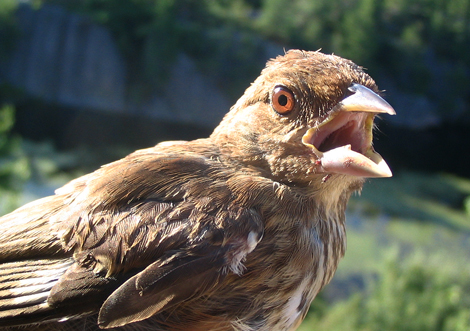
A hatch-year individual for comparision. Note the pale brown iris and streaked underparts indicating juvenile age.

3804988583_41a45196dc
HY White-throated Sparrow (Leckie)

White-throated Sparrows were very common at the site during the first two visits and then slowly moved out until just a single male was heard on visit 6. The hatch-year bird pictured above was the first individual captured since mid-June. We will need more consecutive seasons of experience at RRID to know whether the exodus of adults and dearth of young birds in 2009 was just an anomaly reflective of localized nest failure. Another possible explanation is that the adults present at the site were “unfit” younger males occupying substandard habitats for the species.

IMG_0403
HY Yellow-rumped 'Myrtle' Warbler (Derbyshire)

Yellow-rumped Warblers seemed to have fared better in 2009 as a decent number of young birds were captured at our sites in July/August.

A total of 24 birds were banded during visit 7, the second highest result of the season for the RRID site. Our first summer on the ridge was a very special one. Each of seven treks to the site brought new discoveries and a deeper appreciation for its ecology. The scenery is stark and dramatic, a vivid backdrop to a long list of memorable finds such as the Whip-poor-will and Common Nighthawk nests, an adult Broad-winged Hawk, carnivorous plants and otters to name but a few. I plan to revisit the site in the fall and winter and of course will return in late spring for MAPS season two at RRID.

Rock RidgeVisit 7 of 7

New birds banded (24 of 13 species)

Common Yellowthroat-1
Black-and-white Warbler-2
Black-capped Chickadee-2
Eastern Phoebe-1
Song Sparrow-1
Veery-1
White-throated Sparrow-1
Rose-breasted Grosbeak-1
American Robin-5
Eastern Towhee-2
Yellow-rumped ‘Myrtle’ Warbler-4
Chipping Sparrow-2
Red-eyed Vireo-1

Recaptures (2 of 2 species)

Red-eyed Vireo-1
Chipping Sparrow-1

MAPS Visit 7-Maplewood Bog (MABO)

3790071104_95c000be74
Magnolia Warbler (Seabrooke Leckie)

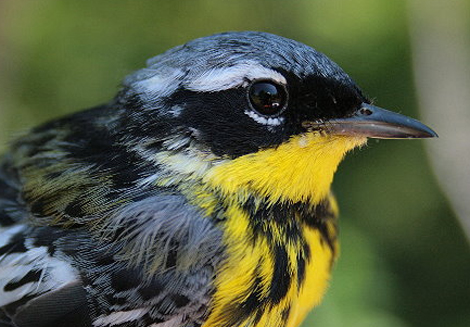
The Frontenac Breeding Birds program is close to completion with just the final visit to the Rock Ridge (RRID) MAPS site remaining for this year’s fieldwork. The Maplewood (MABO) MAPS site now has seven visits neatly squared away as well as the mandatory Habitat Structure Assessment (HSA) required by IBP for each registered station. During the last visit I was pleased to finally observe mixed flocks of dispersing birds moving through the site and even happier to find a higher proportion of young birds in the nets as the previous two visits were lacking in both departments. We also encountered a few species familiar to the general area but not to MABO, which included the boldly plumaged Magnolia Warbler above. Magnolia Warblers are an uncommon breeder in the region but can be locally regular in appropriate habitats (mixed forests with dense evergreen understorey).

3789258417_11b69984b2
Chestnut-sided Warbler (SL)

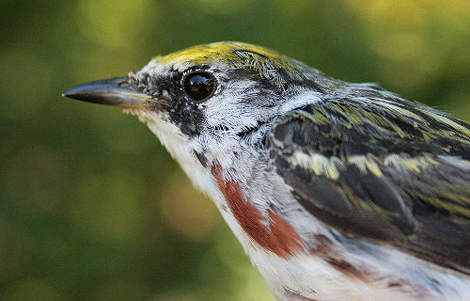
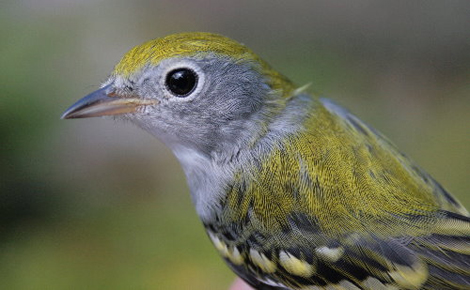
Another new species captured at MABO on visit seven was Chestnut-sided Warbler. This species is a regular breeder in edge/scrub habitats in the Frontenac Arch region. The Hemlock Lake (HELA) MAPS site contained at least one pair and roaming males have been heard and seen at both MABO and RRID throughout the summer but the species wasn’t banded until our last morning at Maplewood.

3790070702_d2c9dc637d
HY Chestnut-sided Warbler (SL)

We banded three in total including two hatch-year birds. Also, in the nick of time, young….

3790070508_3e37f0b892
HY Veery (SL)

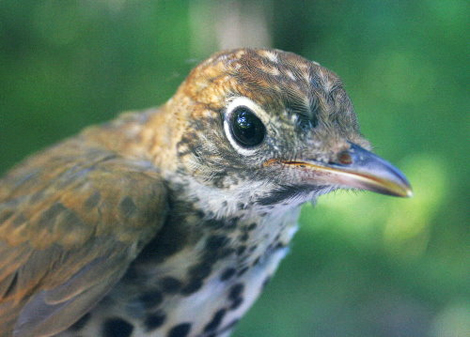
Veery (above) and Wood Thrush (below)! It would have been unfortunate to have an entire season slip by without banding any young of two dominant species at the site.

3789258181_d348629812
HY Wood Thrush (SL)

The final task of the season was to conduct the HSA for the 20 hectare station. The process is fairly time consuming but of paramount importance to the science of the operation. Three base habitats were identified and measured to index dominant species, biodiversity, structure, hydrology and succession for analysis of annual demographic statistics. The HSA will be repeated every five years for the lifetime of the station. It was enjoyable to spend the the time identifying the various species and gaining a richer understanding of the site’s ecology. Sugar Maple (dominant), Red Maple, Red Oak, White Ash, Hop-hornbeam, American Beech, Blue Beech were common in the middle-aged forest while White Oak and Eastern White Pine dominated in the younger section of the northern half. Recorded in smaller quantities were Speckled Alder, Striped Maple, Large-toothed Aspen, Shagbark Hickory, Black Ash and Red Cedar among many others. The trees were relatively straightforward while the ground cover was a little more daunting….

IMG_0363
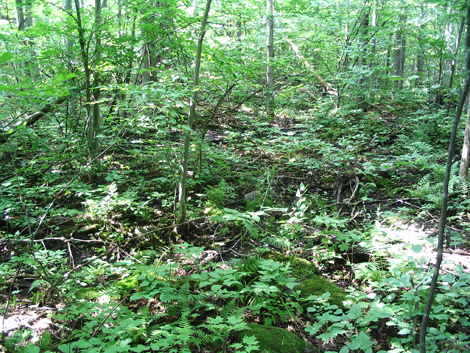
Understorey and ground cover at MABO (D.Derbyshire)

Already looking forward to revisiting MABO in 2010!

Maplewood Bog-Visit 7 of 7

New birds banded (15 of 12 species)

Chestnut-sided Warbler-3
Chipping Sparrow-1
Magnolia Warbler-1
Black-and-white Warbler-1
Ovenbird-1
Northern Waterthrush-1
Red-eyed Vireo-1
Veery-1
Gray Catbird-2
Baltimore Oriole-1
Wood Thrush-1
Hairy Woodpecker-1

Recaptures (4 of 4 species)
Red-eyed Vireo-1
Song Sparrow-1
Gray Catbird-1
Chestnut-sided Warbler-1