Frontenac Bird Studies – The 2011 Season

Undoubtedly, the 2011 edition of our program was our most action-packed and challenging to date

The third consecutive spring/summer field season came to an end with this year’s final session of the Monitoring Avian Productivity & Survivorship (MAPS) program on August 6, 2011. The three years of MAPS data point to a marked reduction in abundance of many landbird species in forest habitats of the region. The pattern is particularly evident at our Maplewood Bog station near Devil Lake, where season capture totals have dropped from 197 individuals in 2009 to just 89 in 2011. The apparent declines are concurrent at all three stations, which are spatially disjunctive and representative of a broad spectrum of landscape conditions. It is likely that the current negative trend will be short-lived and a product of natural population shifts but continued monitoring for at least two more years is needed to strengthen analysis and assess cause and effect.

In 2010 we completed basic inventories of Prairie Warbler and Louisiana Waterthrush populations in the study area, primarily in Frontenac Provincial Park. This year we repeated these exercises and expanded area coverage to begin monitoring year-to-year variation in population size and breeding status. We also began a more in-depth assessment of Prairie Warblers in the area to examine breeding status, survivorship and breeding ecology. These studies were very productive and will be fully explored in the year-end report later this year.

Weather in May was extremely wet, which created exceptionally fertile conditions for black flies and mosquitos. Endlessly attended by the biting swarms, our studies carried us by foot and by canoe over ridges and valleys, to lakes, bogs, barrens and creeks throughout the study area – over 250km in all. Many notable finds were made, which included active nests of Red-headed Woodpecker, Cerulean Warbler, Yellow-billed Cuckoo and Prairie Warbler. Also notable were records of eight at-risk bird species as well as locally significant observations of Yellow-bellied Flycatcher, Five-lined Skink, Sedge Wren, Sandhill Crane and Red-bellied Woodpecker, to name a few.

Our second annual Frontenac Biothon fundraiser was a tremendous success thanks to the generosity of our sponsors and volunteer naturalists. We searched high and low for species during a 24-hour period on June 11-12 in Frontenac Provincial Park. We surpassed our 2010 total of 441 with a final tally of 468. In the end, we raised some important funds for the project, produced an impressive array of records and had a memorable weekend to boot!

Frontenac Bird Studies exists through the support of many individuals and organizations. The Migration Research Foundation thanks the following for their contribution to FBS in 2011!

Funding

The John Hackney Foundation for the Noosphere
Ontario Parks
Frontenac Biothon sponsors

FBS MAPS Assistant

Seabrooke Leckie

Frontenac Biothon

Chris Dunn
Karina Dykstra
Steve Gillis
Seabrooke Leckie
Julia Marko Dunn

Support

Corina Brdar
Ontario Parks

Monique Charette
OMNR

Peter Dawson
Ontario Parks

Audrey Heagy
Bird Studies Canada

Bert Korporaal
Ontario Parks

Chris Robinson
Ontario Parks

Ken Shepherd

Don Sutherland
OMNR, NHIC

Sincerely,

Dan Derbyshire
Project Lead, Frontenac Bird Studies
Migration Research Foundation
M.A.P.S Visits 4 & 5 – 2011

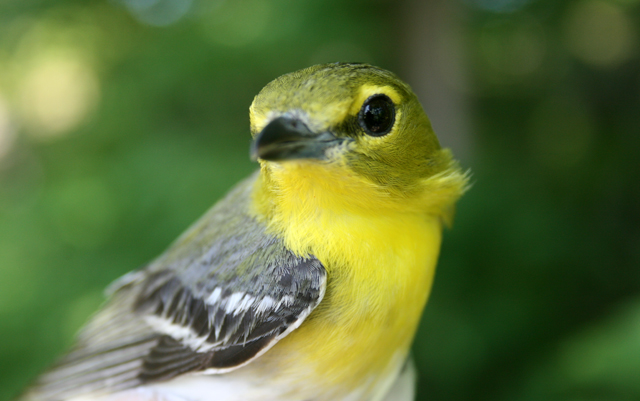
Yellow-throated Vireo (S.Leckie)

The July-early August period of the Monitoring Avian Productivity & Survivorship (MAPS) season is important to our annual assessment of productivity rates. During this time a critical shift occurs from the main nesting period for adults (May-June) and the post-breeding dispersal/pre-migration period (July-August). Some species are still nest building and incubating – mostly late breeders (Cedar Waxwing, American Goldfinch) and those raising second broods or first broods after nest failure. We are able to sample the year’s productivity (nest success) for many species during visits 4-7 when the juvenile or hatch-year birds are first introduced into the population.

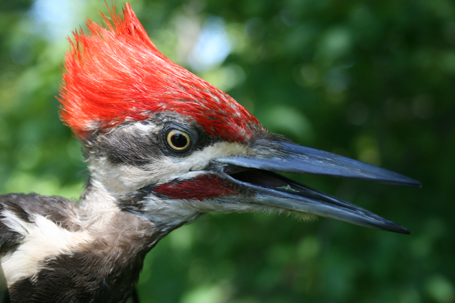
Pileated Woodpecker (S.Leckie)

Blue Lakes (BLAK)

On July 7 we operated BLAK for the fourth session this season. We ended the day with 13 individuals captured, all of which were newly banded. Notable amongst the birds banded were four Ovenbirds, which have been relatively scarce this year, and two adult Yellow-throated Vireos. Only two of the birds captured were young birds, a Rose-breasted Grosbeak and a Hairy Woodpecker.

Visit 5 was completed on a calm, clear mid-July morning. We were a little shocked by how quiet it was as just three birds had been captured until the final net check when a young Black-capped Chickadee was extracted from net 12. The lone highlight of the record slow morning was our second-ever Pileated Woodpecker!

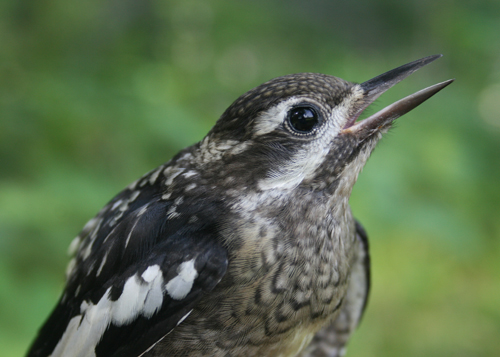
Hatch-year Yellow-bellied Sapsucker (S.Leckie)

Maplewood (MABO)

Activity at MABO has been a little higher than at BLAK, although markedly less so than in previous seasons. We captured 22 birds on July 8, which was followed by a total of just 11 on July 20. We’ve banded a decent number of young birds during the two visits including individuals of Veery, Scarlet Tanager and Yellow-bellied Sapsucker, among others. Since we started in 2009, MABO has produced substantially more recaptures than any other station. So far this year we’ve recaptured 13 at BLAK, 13 at RRID and 34 at MABO.

Red-winged Blackbird (S.Leckie)

Rock Ridge (RRID)

While MABO always seems to perform best of the three stations for adults in June, Rock Ridge typically outshines the others for dispersing adult and young birds in July and early August. A total of 13 birds were sampled on July 9, which was followed by a season-high total of 28 on July 19. This site is located on a high ridge along a peninsula that is bound by a large lake on three sides – attributes that naturally funnel birds on the move. An excellent diversity of species were detected and captured on July 19, which included a respectable number of young birds. Common Grackles, Red-winged Blackbirds and American Robins have been the primary species involved so far but this should changeover to warblers and other small passerines during visits 6 and 7, which are due in the next two weeks.

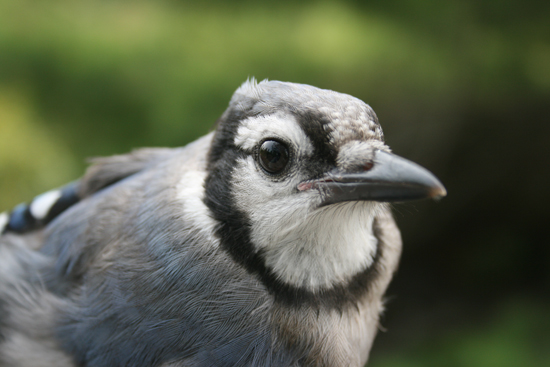
Hatch-year Blue Jay (S.Leckie)

M.A.P.S Visit 3 – 2011

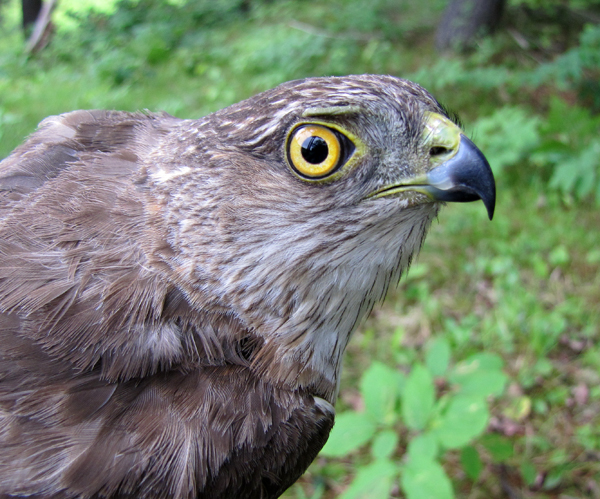
Sharp-shinned Hawk (Derbyshire)

The third round of visits for the 2011 Monitoring Avian Productivity & Survivorship (MAPS) season were completed on June 27 (BLAK), June 29 (MABO) and June 30 (RRID). The weather in June has actually been rather normal and lacking in extended periods of unusual temperatures or precipitation – good for us and good for all the passerines raising young! A total of 17 (9 new, 8 recaptures) birds were captured at MABO during visit 3, the highlight of which was the second-year Sharp-shinned Hawk pictured above – a first for our MAPS efforts to date. Also of note was the recapture of five Veery from previous seasons, including three from our first couple of visits in June 2009.

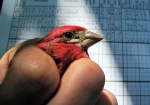
Purple Finch (Seabrooke Leckie)

The BLAK station was the “winner” of Round 3 as 25 birds (20 new, 5 recaptures) were captured here during the visit. All five recaptures were of birds banded earlier in the 2011 season. We banded a nice variety of species, including another male Black-throated Blue Warbler, a Yellow-rumped Warbler and a Hermit Thrush. The highlight though was the male Purple Finch extracted from net 7 around mid-morning – another first for our MAPS program! This species does occur regularly at all three stations but are so strictly attached to the upper canopy that they will always be only rarely captured.

Weather at RRID was calm and clear with pleasant temperatures. A total of 17 birds were sampled by our mistnet array (15 new, 2 recaptures). We recaptured a Field Sparrow that was originally banded on June 20, 2010 as an After second-year male. It’s becoming clear that the return rate of adults is very low at RRID, especially compared to MABO. Habitats and species composition differ greatly between stations, which will certainly present some interesting topics for further study once a few more seasons of data are compiled.

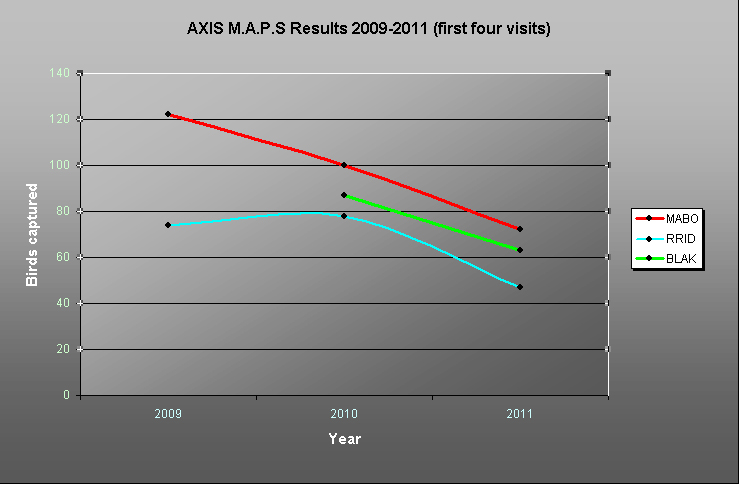
Here is a quick chart that describes an apparent decline of the adult population at all three stations since 2009 (Only 2010-2011 for BLAK). The graph was generated using total captures (newly banded birds and recaptures) for visits 1-4 by year and station. It would be such a tremendous resource if we had more MAPS stations across Ontario to facilitate local and regional comparisons of vital rates. Unfortunately, in marked contrast to the United States, participation in Canada and in Ontario has been very low. The development of a coordinated and standardized effort to monitor breeding bird demographics in the province would be a major asset for biologists to detect and understand forces affecting landbird populations – now more than ever with advancing climate change.

the Nest Files – Prairie Warbler

Adult male Prairie Warbler (D.Derbyshire)

.

Prairie Warbler (Dendroica discolor)

.
Nidiologicals – Peck and James (1987) and Nolan,V.,Jr., E.D.Ketterson, and C.A.Buerkle (1999)

Habitat – Dry, early successional shrubland habitats ranging from pine plantations, dunes, mangroves, barrens, clearcuts and abandoned fields.
Microhabitat – Cup nest usually well concealed in upper crotches of shrub
Spring arrival – Early to mid May (Ontario)
Average nest height – .6m-.9m
Nest builder – Female only
Average # of broods/season – 1-2 (variable with latitude and local conditions)
Average egg laying date – 8 June-19 June (Ontario)
Average clutch size – 3-5 eggs
Incubation period – Average 12 days
Egg colour – White to greenish white with variable brown spots, usually wreathed at larger end.
Incubation – Female only
Brown-headed Cowbird host – Yes

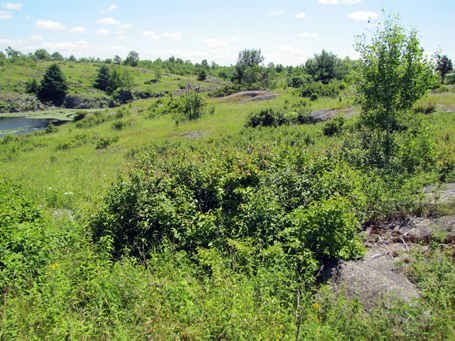
Prairie Warbler habitat (nest site in foreground)

The Prairie Warbler is a rare but regular breeding species in Ontario. It is estimated that about 300 pairs occur annually in the province, although there is some evidence of recent decline due to habitat succession of granitic rock barrens along the edge of the southern shield region. We’ve been surveying and studying Prairies in Frontenac Provincial Park for the last two years and have found a small but apparently healthy population in open barrens with scattered young trees and pockets of dense shrub cover. The above photo was taken within the core breeding area, which is about 20 hectares in size and characterized by low tree cover, exposed rock, dense ground vegetation and thick patches of vibernum sp. and junipers. Most Prairie Warbler territories here are associated with sloped shoreline edges of beaver ponds and lakes, which may be a function of denser shrub growth occurring in lower lying areas.

Shrubs along rocky slope (nest site in foreground)

This photo shows a typical nest site along a rocky slope where Downy Arrowwood (Viburnum rafinesqueanum) proliferates. Four nests have been found so far this summer and all but one were positioned near the top of a viburnum at heights between .7m-1.3m. All four nests have been located along slopes ranging from gentle to sharp and with no apparent preference for aspect.

Prairie Warbler Nest with eggs

Prairie Warbler nests resemble those of the Yellow Warbler (Dendroica petechia), a fairly close relative but less common inhabitant of the rock barrens. Prairie Warblers favour hot and dry environments while Yellow Warblers tend to occupy wetter shrubland habitats with a more flexible tolerance for shade/canopy closure. This nest with four eggs was discovered on June 26 when a female was flushed from a small clump of viburnum. When incubating female Prairie Warblers notoriously sit tight and only flush when very closely approached.

Nest in viburnum

This is a shot of the same nest within the shrub. Prior to nest searching this season I was anticipating that Ground Juniper (Juniperus communis) would be the most common host plant for nests but it seems that the viburnums are more abundant and probably preferred here. They are a stout and sturdy shrub with woody main stems and branches, while the leaf cover provides excellent concealment and weather shielding from all sides. The only non-viburnum nest was located in a lonicera sp. that grew within a large clump of Downy Arrowwood.

Prairie Warbler nest with five young (5-6 days old)

Two of the four nests were found by patiently following adults carrying beakfulls of plump, green caterpillars. One of our colour banded males (nickname “Whitey”) led me to this nest with five young. Thanks are due to Julie Zickefoose for helping Seabrooke and I age these nestlings. These little prairielets were identified as being 5-6 days old and only a few days away from leaving the nest.

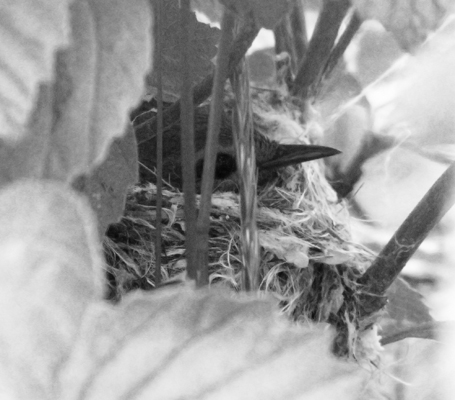
Incubating female

This female was photographed incubating on June 26. When I returned five days later I was disappointed to find that the nest had failed, probably due to predation. Common Grackles, Blue Jays and snakes would be the most likely nest predators in the barrens. I’ve twice found Ribbon Snakes (Thamnophis sauritus) above the ground within shrubs here. On the upside it appeared that the female, or perhaps a different female, was preparing to rebuild within the territory or perhaps even reuse the failed nest. The attached male (also colour banded) was singing vigorously while the female inspected forks of shrubs and called softly. On two occasions she was observed for five-minute periods shaping and touching up the failed nest. Hopefully the second attempt will fair better than the first!