MAPS Visit 3-Rock Ridge

3668800446_1eb3dbbe3f
Broad-winged Hawk (S.Leckie)

Our third visit to Rock Ridge was a much busier affair than the last when just 9 birds were captured in six hours in mid June. We finished the morning with a total of 28 captures, the highest single-day tally we have had at this site so far. The variety of birds was also very good as fifteen species were handled during visit three. The highlight of the morning’s catch was this superb Broad-winged Hawk, which was in net #6 for little more than a few seconds as I pounced on it before it could get out. Birds of this size are rarely captured in our nets because the mesh is small, 30mm mesh to be exact, which is appropriate for most songbirds but not nearly large enough to hold a bird as big as a buteo for any length of time. This adult Broad-wing was spectacular up close and a rare treat as they are by no means a bird to be expected in a mistnet. The species is a local breeder in mature forests along with its relative the Red-shouldered Hawk.

IMG_0236
Song Sparrow

Song Sparrows are suddenly more plentiful. They are one of the most abundant songbirds in North America, inhabiting a wide array of habitats with a strong preference for open and edge environments. A pair has been nesting just below our banding station atop the cliff at Rock Ridge. Field Sparrow, Eastern Towhee, White-throated Sparrow and Chipping are all much more common than Song Sparrow at the site.

3667996415_d5d24d9734
Adult male Nashville Warbler (S.Leckie)

A pair of male and female Nashville Warblers were captured in a net close to a suspected nest site along the northwestern slope of the MAPS station.
3667996619_61c13dfe7e
Nashville Warbler Fledgling (S.Leckie)

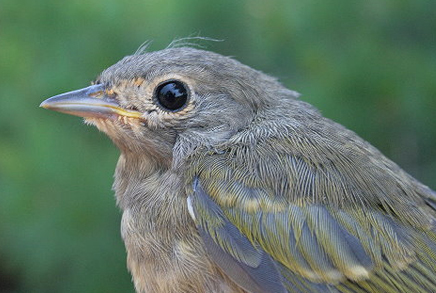
This is likely the reason why they were suddenly captured-fledged young. This is a recently fledged juvenile Nashville Warbler that was captured in the following net round and in the same net as the parents. This youngster was completely oblivious to its circumstance being in the net and handled by a pair of humans. We quickly returned it to its parents after measurements and banding as it is still dependent on its parents for food.

IMG_0262
Bog habitat at net 8 favoured by Nashville Warblers
IMG_0260
Net lane #8
3667995209_7f8265f07a
Baltimore Oriole (S.Leckie)
3668800058_cc3546449d
Broad-winged Hawk (S.Leckie)
3668801916_0332227ef1
Take off (S.Leckie)
3667995583_d3b55b9434
Black-billed Cuckoo (S.Leckie)

Another fabulous visit to Rock Ridge, a member station of our young MAPS network in the FBS study area. Given all that was done in June, it feels as though the breeding season should be wrapping up soon but in fact, we are less than halfway through our season and thus a great deal is yet to come! A summary of results for MAPS visit 3 is provided below.

Rock Ridge Results-Visit 3 of 7

New birds banded (23 of 14 species)

Broad-winged Hawk-1
Nashville Warbler-3
Black-and-white Warbler-4
Yellow-rumped Warbler-1
Black-capped Chickadee-2
Red-breasted Nuthatch-1
Red-eyed Vireo-1
Song Sparrow-2
Baltimore Oriole-2
Rose-breasted Grosbeak-1
Great Crested Flycatcher-1
American Robin-1
Hairy Woodpecker-2
Black-billed Cuckoo-1

Recaptures (5 of 4 species)

Black-capped Chickadee-1
Black-and-white Warbler-1
American Robin-1
Eastern Towhee-2

Surveying the Mixed Forests

IMG_0181
Eastern White Pines

This past week I finished up the remaining point count routes, which included a route through coastal mixed forests along the extreme eastern edge of Frontenac Provincial Park. I accessed the habitat via a lengthy stretch of the Cataraqui Trail. Weather was perfect for surveying and it was fabulous to get and see this area of the park. Dominant species encountered during the morning were Yellow-rumped Warbler, Pine Warbler, Chipping Sparrow, Black-and-white Warbler and Red-eyed Vireo with a few “goodies” mixed in here and there.

IMG_0170
Atop a ridge looking to Buck Lake

The survey route passed through a wide variety of habitats but the main target was mature mixed forest occurring along shorelines of large lakes in the area. Most lakes around here are steep in slope along the perimeter and lined with a high percentage of Eastern White Pine and Eastern White Cedar but I wanted a route that could be accessed relatively easily on foot.

IMG_0166
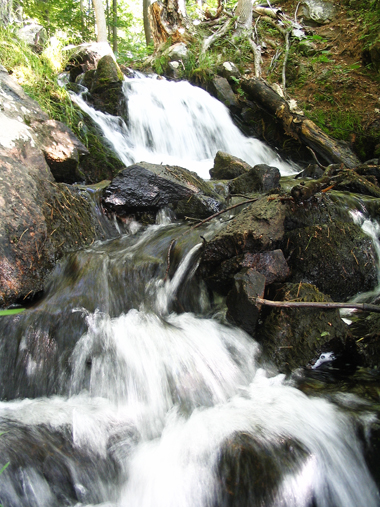
Waterfall near Slide Lake

I was impressed with the high number of clear, gravel bottomed, moving streams in this area of the park. Since early June I’ve been logging locations of suitable stream habitat for breeding Louisiana Waterthrushes with the intention of returning in May, 2009 to inventory populations of this species in Frontenac Park. This particular stream was quite a torrent along its length, ending with a flourishing waterfall as it emptied into South Bay of Buck Lake.

IMG_0173
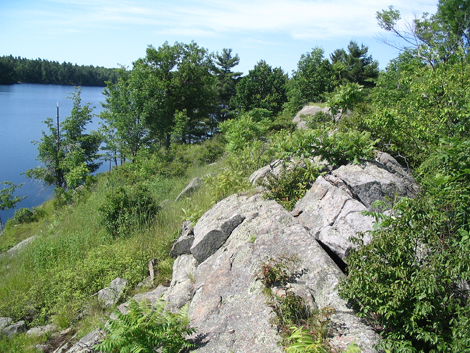
Prairie Warbler habitat

The most significant finding of the morning was of a small colony of Prairie Warblers along the sloped and scrub-bearing banks of Slide Lake!

IMG_0175
Prairie Warbler habitat

This is fairly typical habitat for this rare warbler in Ontario-rocky shorelines of lakes with a large component of successional scrub habitat.

I recorded this video with my ancient Canon A70 point and shoot camera to try and capture some audio of the singing males. A male flew into the small tree directly behind where I sat for a break at the end of the day and sang repeatedly at close range. I wish I’d had my HD camera as this particular male remained very close for about 10-20 minutes.

the Nest Files – Ovenbird

3602403174_0b51997287
Male Ovenbird banded at MABO (early June)

Ovenbird (Seiurus aurocapillus)

Nidiologicals (from Peck and James 1987 and Van Horn et.al 1994)

Habitat=deciduous forests
Microhabitat=nest built in sparsely vegetated forest floor with dense leaf litter, often in forest clearings
Spring arrival=May
Average nest height=ground
Nest builder=female
Nest building period=5 days
Average # of broods/season=1 (rarely 2)
Average Egg Date=June 6-June 20
Area sensitive=yes
Average clutch size=4-5
Incubation period=12 days
Egg colour=white with speckles of gray, brown or hazel forming a wreath at large end
Incubation=female
Fledgling stage=young leave nest 8-10 days after hatching
Parasitized by cowbirds=yes

The Ovenbird is a common species inhabiting both dry and mesic deciduous forest types throughout our study area in the northern Frontenac Arch. Our point counts suggest that they are one of the most abundantly occurring species in contiguous tracts of deciduous and mixed forest, both mature and younger stands, where the understorey is sparsely developed and canopy closure is high. The Ovenbird, a ground specialist, is an area sensitive species, which means that productivity is adversely affected by forest fragmentation. Data from the Breeding Bird Survey and the Ontario Breeding Bird Atlas indicate a significant population decline in southern Ontario where most large tracts of forest have been reduced to isolated smaller fragments unsuitable for reproduction of this species. The Ovenbird winters in southern Florida, Mexico, Central America and the Caribbean islands.

3627388100_e4da6bec70_o
Nest contents

This Ovenbird nest was discovered at our Maplewood Bog MAPS station on June 14, 2009. This species is notoriously cryptic in its habits during the breeding season, often walking slowly along the forest floor to its well concealed nest. The species gets its name for its domed nest that resembles an oven. I was rather exstatic to find this nest as I had spent a good few hours tracking adults in two other territories in nearby Frontenac Park, both of which led me to recently fledged young instead of active nests. The eggs are heavily speckled with reddish-brown marks that are concentrated at the larger end.

IMG_9878
The Oven nest

So here is the weird part. The nest was built at some point between our first and second visit to MABO in a 12m long net lane that was cleared in late May! The female will only flush from the nest if your foot comes to within perhaps 10 inches or so of the nest, which is an extreme example of an incubating bird “sitting tight” to avoid exposing the nest to an intruder. It was remarkable that we hadn’t either stepped on the nest or flushed the female earlier that morning as the nest is almost directly in the middle of our foot path for checking the net.

IMG_9874
microhabitat

It was only when I took the net down at the end of the day that I sensed that something small and quick had just dashed from the ground near my feet. I then had a quick look around in the thicker ground cover but didn’t find anything resembling a nest. I then turned to a small and rather odd looking clump in the grass underneath a juniper seedling and noted the classic domed shape of an Ovenbird nest and then four eggs! The nest is not unusual in being located in a clearing but it is unusual to be positioned in such an exposed context with direct sun beaming on its roof during late morning and much of the afternoon. There is however, a decent layer of dead leaves, which female Ovenbirds key on for nest site selection.

IMG_9875
habitat

This last photo shows the location of the nest within the net lane and the habitat of choice for this particular pair of Ovenbirds. Incidentally, we captured presiding male and female in the net that goes here on the first net check of visit three! They both seem to be doing well as the male sings throughout the morning, no less than 30m from the nest at any time and the female incubates the four eggs despite our comings and goings. We won’t be revisiting MABO until next week, which will give these expecting parents some quality alone time to take care of business.

MAPS Visit 3-Maplewood Bog

IMG_0137
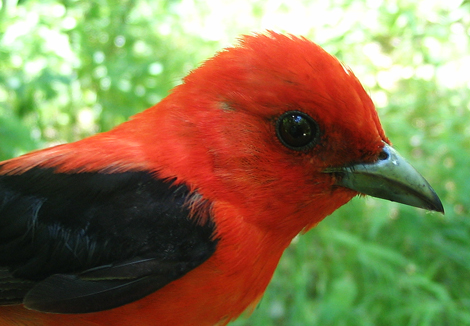
Second-year male Scarlet Tanager

The mid-season “switch” was turned on at MABO this past week. We were plodding along at about 25 birds/morning during the first two visits in early to mid-June. This period of the breeding season is known as the adult “superperiod” when adult males and females tend to nests with eggs or young within defined territories. Capture rates tend to be a little lower at this time as there are few young in the area and just a sample of the adults are mistnetted. Young birds appear in numbers around mid-late June and suddenly the site is alive with adults either dispersing or establishing new territories in different spots. Visit three was a perfect example of this as a total of 45 birds were captured during the morning, which included the first wave of youngsters and many new adults banded including the striking Scarlet Tanager pictured above.

IMG_0123
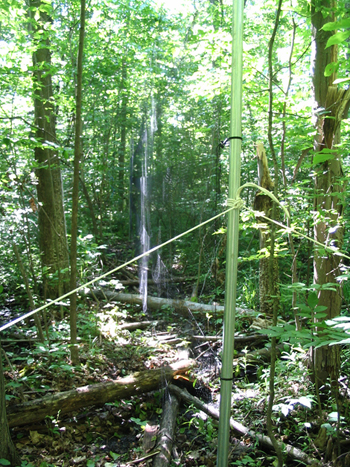
Habitat at Net #9 (aka waterthrush highway)

This is one of the net sites at Maplewood Bog MAPS station, net number nine of ten. Net nine is located in a wet shrubby clearing within mature deciduous forest. This wet area is actually part of a long and narrow band of flooded shrub habitat within the interior of the forest that connects two wetlands. Northern Waterthrushes seem to use this habitat feature as a sort of highway between territories and foraging areas. We have captured and recaptured a high number of individuals in this location. The photo was taken in late morning when light begins to scatter down to the forest floor but this net site is quite shaded for most of the morning.

IMG_0117
Forest floor at MABO

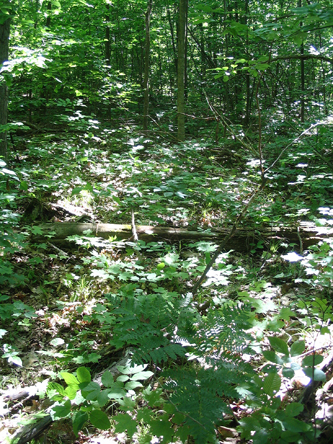
The vegetation on the forest floor indicates an uneven canopy closure where enough light passes down to sustain a fairly dense layer of ferns, tree saplings and other herbaceous plants. This type of deciduous forest is preferred by Wood Thrush, Veery and American Redstart among others. Too dense for Cerulean Warblers however, as the singing males recorded here in late May and early June must have opted to look elsewhere for more mature forest with primarily grass/forb understorey.

IMG_0118
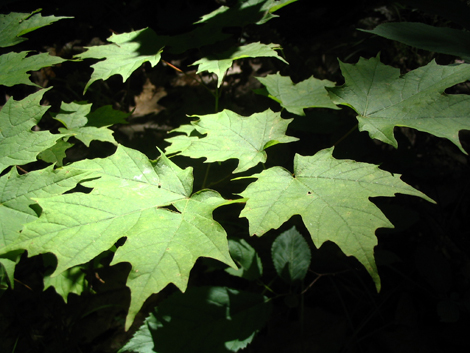
Maple saplings in the understorey
IMG_0088
Female Northern Waterthrush starting to moult

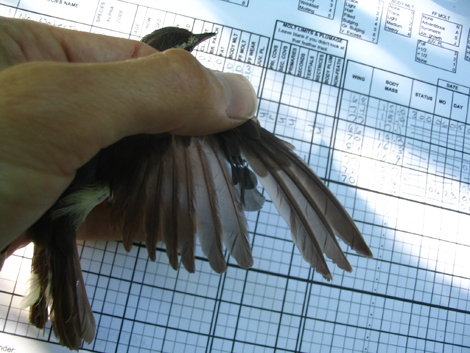
We captured four waterthrushes, including this adult female in the early stages of a complete moult. The new primary feathers are coming through in the center of the wing, which are noticeably darker and crisper than the adjacent primaries and secondaries feathers from 11-12 months ago. This individual was sexed as female based on the appearance of a waning brood patch, indicating that this was likely an early nester somewhere in the area.

IMG_0108
Second-year male American Redstart

We also banded two new redstarts, including this second-year (SY) male that was captured simultaneously with an adult female in net ten. After-second year males have vivid orange and black plumage while the younger males, born last summer, have an unusually delayed plumage maturation for a warbler. SY males are distinguished from the females by the patchy black feathering around the eyes and bill.

IMG_0097
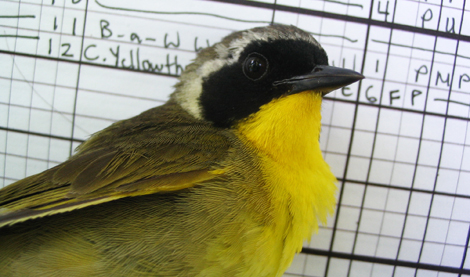
After-second year male Common Yellowthroat

Overall it was a terrific outing and the results certainly give great confidence that the site can yield viable indices of both productivity and survivorship rates for several commonly breeding forest birds of the area. We still have four visits remaining for the MABO site in 2009 as well as a thorough Habitat Structure Assessment of the 20 hectare plot. It is still a bit early to make a final call but I think we can stamp the station with a shiny gold star for its performance thus far. The experience of establishing this and the other two sites will be crucial to setting priorities for expansion of our MAPS network in 2010. Results from visit three to MABO are posted below.

[I should be back to nest profiles and other blog topics tomorrow as I have a ton of content that I want to share with our faithful readers]

Maplewood Bog Results-Visit 3 of 7

New birds banded (36 of 14 species)

American Redstart-2
Black-capped Chickadee-5
Black-and-white Warbler-1
Common Yellowthroat-2
Ovenbird-1
Northern Waterthrush-3
Red-eyed Vireo-1
Veery-4
Song Sparrow-6
Swamp Sparrow-1
Scarlet Tanager-1
Gray Catbird-4
Rose-breasted Grosbeak-1
American Robin-4

Recaptures (9 of 6 species)

Black-capped Chickadee-2
Ovenbird-2
Northern Waterthrush-1
Red-eyed Vireo-1
Veery-2
American Robin-1

On the Road: Frontenac Turtles

IMG_0008

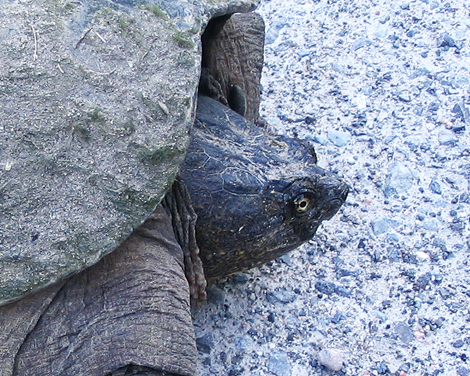
Nesting season for turtles has been in full swing the past two weeks. I’ve probably moved about 15-20 turtles off paved and gravel roads in the area since early June.  Turtles frequently fall victim to collisions with cars as they slowly cross roadways in search of nesting sites. I always prioritize stopping the car and moving them to a safe spot in their intended direction. Female Map Turtles and Snapping Turtles have been observed nesting in the soft gravel at the road edge throughout the FBS study area but these “roadies” are most frequently observed at dusk when one can easily find as many as 5-10 of them on the road in maybe a kilometre or two.

IMG_0010

The Snapping Turtles have a certain air of intimidation about them but can be moved easily without risk of being bitten if you know where to hold them by their shells. I can’t seem to find any decent links to descriptions of this procedure so I will refrain from recommending that these creatures be handled-they do have a powerful bite.  They will often move quickly (for a turtle) if approached from behind so you can often move them out of harm’s way in this manner.