Our pilot year has officially wrapped up with the completion of Frontenac Breeding Birds: Report on the 2009 Field Season. The document summarizes all of our data on breeding bird populations collected from May-August 2009. The results are truly exciting and we are looking forward with great anticipation to what 2010 will bring. The report, in its present form, contains confidential information on Species at Risk but a more streamlined version will be available for wider distribution in early January.
Our attention will now shift to setting priorities for avian research and monitoring in 2010 and beyond. This past year has laid the critical groundwork, providing us the opportunity to refine methodology and also to focus and enhance our efforts going forward. Stay tuned for news and announcements in the coming months!
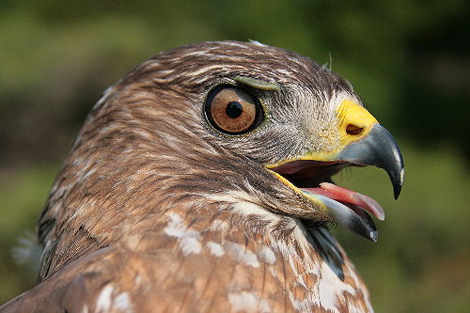
Broad-winged Hawk banded at Rock Ridge MAPS Station (Seabrooke Leckie)
FBS kicks avian research and monitoring into high gear!
Year one of the Frontenac Bird Studies (FBS) program has been a great success! Over 200 surveys of breeding birds were completed in June and July throughout the FBS study area, which encompasses over 15,000 hectares between Sydenham and Westport, Ontario. This substantial effort, which included roughly 42 kilometres of walking in Frontenac Provincial Park, revealed an incredibly rich avian community. Several Species at Risk in the area were encountered including Whip-poor-will, Common Nighthawk, Louisiana Waterthrush, Golden-winged Warbler and a remarkably high number of Cerulean Warblers. We also established a new network of Monitoring Avian Productivity and Survivorship (MAPS) stations to index and monitor critical demographic patterns for breeding landbirds in the Frontenac Arch. Over 300 birds were banded and recaptured during the summer for this program, the most unusual of which was an adult Broad-winged Hawk captured at our Rock Ridge site in June. A nest monitoring effort was also initiated this summer to assist in the collection of demographic statistics for local bird populations. Over 70 nests were carefully monitored in 2009, which included records of Winter Wren, Brown Creeper, Common Nighthawk, Whip-poor-will, Scarlet Tanager, Northern Waterthrush, Osprey and Red-shouldered Hawk, to name a few. And finally, Project Whip-poor-will successfully took flight with over 30 roadside surveys conducted in late June and early July. These nocturnal surveys were timed to coincide with the full moon – peak time for vocalizing Whip-poor-wills. Impressively, over 50 Whip-poor-wills, now classified as a threatened species, were detected during the surveys!
These are just a few of the highlights from our busy summer that further support the Frontenac Arch as a region of significance to bird populations in Ontario and Canada. Frontenac Breeding Birds in 2009, our first year of the project, will serve as an integral foundation for us going forward. The program was made possible by a network of spirited and generous volunteers, collaborators and donors. Staff and directors of the Migration Research Foundation extend a big thanks to the following for their integral support in 2009!
Funding
The John Hackney Foundation for the Noosphere
The McLean Foundation
Volunteers and Sponsors
Andrew Jano
Don Johnston
Friends and family of Gail Woolnough
Ian Sturdee
Jan McDonald
Julia Marko Dunn
Kerry Adams
Larry Menard
Matthew MacGillivray
Pierre Robillard
Sally Wills Seabrooke Leckie (Research Assistant)
Steve Gillis
Wendy Derbyshire
We are already looking forward to 2010, our second year of the Frontenac Breeding Birds project, and encourage everyone to visit our website for more information on FBS programs (www.frontenacbirds.ca), or contact us at fbs@migrationresearch.org.
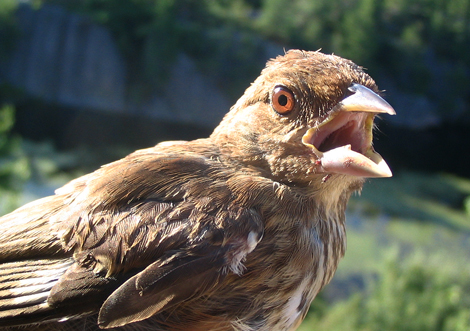
It’s always nice to end on a high note. The Rock Ridge MAPS site finally lived up to the potential I thought it possessed for sampling post-breeding dispersal. Waves of birds were observed during our final visit of 2009-to and fro from the rock cliffs, along edges of outcrops and overhead. Tanagers, grosbeaks, warblers, vireos-all the familiar species that breed locally in Frontenac Provincial Park. Eastern Towhee, Chipping and Field Sparrow and Yellow-rumped Warbler seemed to be the most numerous of the species on the move. Most of the birds captured and banded were young birds such as the hatch-year (born summer ’09) male Rose-breasted Grosbeak pictured above.
Yellow-rumped 'myrtle' Warbler (S.Leckie)
We ended up banding four Yellow-rumped Warblers during the morning, a small sample of the overall number that went through.
HY Eastern Phoebe (Leckie)
This hatch-year Eastern Phoebe was the first of the species that we’ve caught this summer and may well be one of the nestlings reared on the opposite cliff face from the banding station. Note the ‘gape’ evident at the corner of this bird’s bill, a temporary vestige of its recent life as a nestling. Also indicative of hatch-year individuals is the presence of distinct buff coloured wing bars (tips of greater, median and lesser wing coverts) as seen on this bird.
AHY-F Eastern Towhee (Derbyshire)
It is safe to say that I’ve not ever seen so many towhees in one place as during this last visit to RRID in early August! Both young and adults were calling and flitting from everywhere and it is remarkable that only two were captured by day’s end. This is an adult female as indicated by the red-eye colour and brown upperparts (males have black upperparts).
HY Eastern Towhee (Derbyshire)
A hatch-year individual for comparision. Note the pale brown iris and streaked underparts indicating juvenile age.
HY White-throated Sparrow (Leckie)
White-throated Sparrows were very common at the site during the first two visits and then slowly moved out until just a single male was heard on visit 6. The hatch-year bird pictured above was the first individual captured since mid-June. We will need more consecutive seasons of experience at RRID to know whether the exodus of adults and dearth of young birds in 2009 was just an anomaly reflective of localized nest failure. Another possible explanation is that the adults present at the site were “unfit” younger males occupying substandard habitats for the species.
HY Yellow-rumped 'Myrtle' Warbler (Derbyshire)
Yellow-rumped Warblers seemed to have fared better in 2009 as a decent number of young birds were captured at our sites in July/August.
A total of 24 birds were banded during visit 7, the second highest result of the season for the RRID site. Our first summer on the ridge was a very special one. Each of seven treks to the site brought new discoveries and a deeper appreciation for its ecology. The scenery is stark and dramatic, a vivid backdrop to a long list of memorable finds such as the Whip-poor-will and Common Nighthawk nests, an adult Broad-winged Hawk, carnivorous plants and otters to name but a few. I plan to revisit the site in the fall and winter and of course will return in late spring for MAPS season two at RRID.
Rock Ridge–Visit 7 of 7
New birds banded (24 of 13 species)
Common Yellowthroat-1
Black-and-white Warbler-2
Black-capped Chickadee-2
Eastern Phoebe-1
Song Sparrow-1
Veery-1
White-throated Sparrow-1
Rose-breasted Grosbeak-1
American Robin-5
Eastern Towhee-2
Yellow-rumped ‘Myrtle’ Warbler-4
Chipping Sparrow-2
Red-eyed Vireo-1
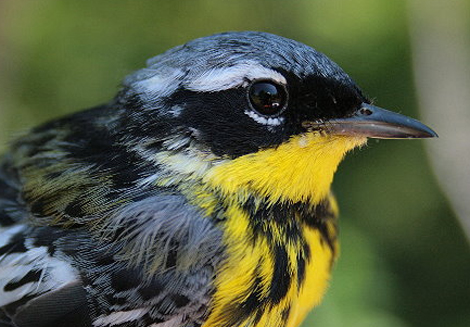
The Frontenac Breeding Birds program is close to completion with just the final visit to the Rock Ridge (RRID) MAPS site remaining for this year’s fieldwork. The Maplewood (MABO) MAPS site now has seven visits neatly squared away as well as the mandatory Habitat Structure Assessment (HSA) required by IBP for each registered station. During the last visit I was pleased to finally observe mixed flocks of dispersing birds moving through the site and even happier to find a higher proportion of young birds in the nets as the previous two visits were lacking in both departments. We also encountered a few species familiar to the general area but not to MABO, which included the boldly plumaged Magnolia Warbler above. Magnolia Warblers are an uncommon breeder in the region but can be locally regular in appropriate habitats (mixed forests with dense evergreen understorey).
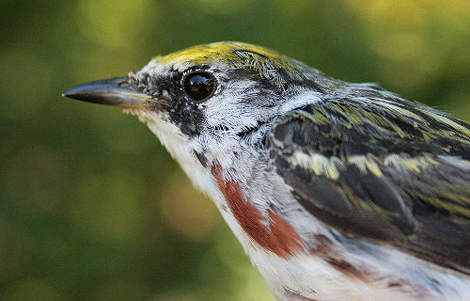
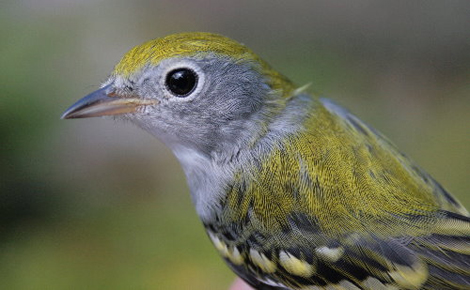
Chestnut-sided Warbler (SL)
Another new species captured at MABO on visit seven was Chestnut-sided Warbler. This species is a regular breeder in edge/scrub habitats in the Frontenac Arch region. The Hemlock Lake (HELA) MAPS site contained at least one pair and roaming males have been heard and seen at both MABO and RRID throughout the summer but the species wasn’t banded until our last morning at Maplewood.
HY Chestnut-sided Warbler (SL)
We banded three in total including two hatch-year birds. Also, in the nick of time, young….
HY Veery (SL)
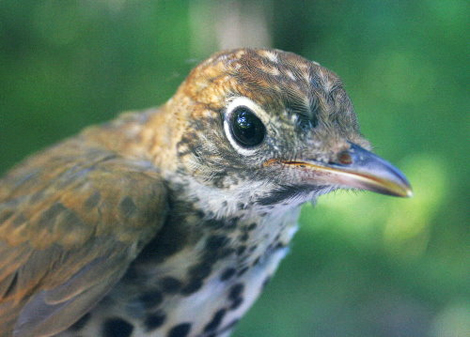
Veery (above) and Wood Thrush (below)! It would have been unfortunate to have an entire season slip by without banding any young of two dominant species at the site.
HY Wood Thrush (SL)
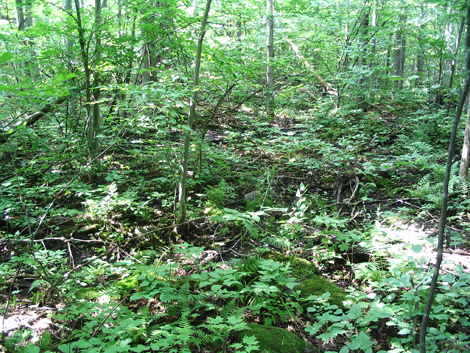
The final task of the season was to conduct the HSA for the 20 hectare station. The process is fairly time consuming but of paramount importance to the science of the operation. Three base habitats were identified and measured to index dominant species, biodiversity, structure, hydrology and succession for analysis of annual demographic statistics. The HSA will be repeated every five years for the lifetime of the station. It was enjoyable to spend the the time identifying the various species and gaining a richer understanding of the site’s ecology. Sugar Maple (dominant), Red Maple, Red Oak, White Ash, Hop-hornbeam, American Beech, Blue Beech were common in the middle-aged forest while White Oak and Eastern White Pine dominated in the younger section of the northern half. Recorded in smaller quantities were Speckled Alder, Striped Maple, Large-toothed Aspen, Shagbark Hickory, Black Ash and Red Cedar among many others. The trees were relatively straightforward while the ground cover was a little more daunting….
Understorey and ground cover at MABO (D.Derbyshire)
Already looking forward to revisiting MABO in 2010!
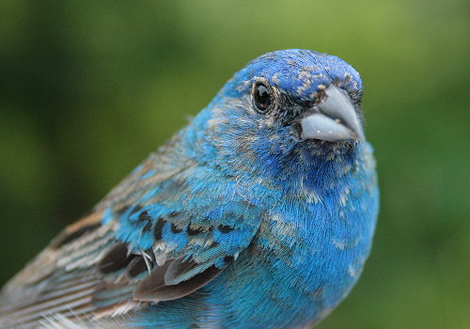
The penultimate visit to MABO in 2009 was completed on July 25. Weather during the morning was more like spring with cool temperatures, thick fog and cloudy skies. A result of 18 new birds banded and 24 total captures was less than we were anticipating given the time of year. We continue to await any substantial movement of young birds at both MAPS stations. We are banding a few young birds here and there but the results so far are indicating low productivity in the area as a whole. Despite a shortage of hatch-year birds, we continue to sample adult birds in high numbers, including the Indigo Bunting pictured above.
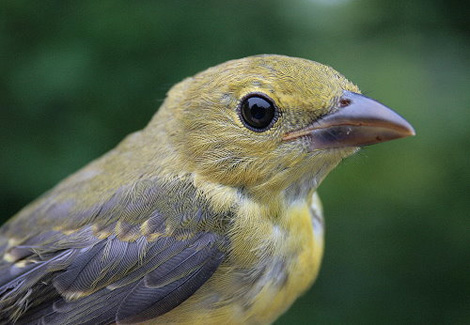
HY Scarlet Tanager (Leckie)
This was the first hatch-year Scarlet Tanager (note the wing bars indicating Juvenal plumage) captured in 2009. We have banded enough Scarlet Tanagers this summer to suggest that both survivorship and productivity indices can be calculated on an annual basis. Veery, Wood Thrush, Black-and-white Warbler, Yellow-billed Cuckoo, Yellow-bellied Sapsucker, Ovenbird and Northern Waterthrush are a few other examples of species sampled in sufficient quantity at MABO and/or RRID to produce vital rate statistics.
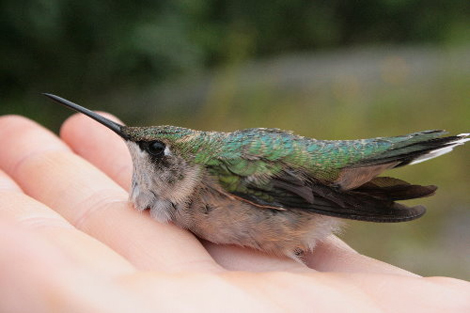
Ruby-throated Hummingbird (Leckie)
A few Ruby-throated Hummingbirds, all females, have slipped into our nets this summer. We release all hummers unbanded as we don’t have the special permits to band this species.
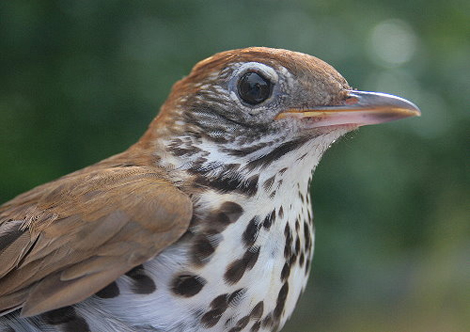
Wood Thrush (Leckie)
Thus far, results for Wood Thrushes and Veerys, abundant breeders at MABO, has been “hit and miss”. We have banded high numbers of adults but have yet to capture a single hatch-year in 2009. Considerably less common at MABO is the Hermit Thrush and yet we banded a juvenile here during visit 6! Naturally, these findings raise many questions that indicate a need for more data. A substantive network of stations across southern Ontario would be powerfully instructive toward an annual assessment of temporal and spatial variation in rates of productivity and long-term factors influencing population change. For the Frontenac Arch, we are committed to expansion of the MAPS program to bolster demographic monitoring in this region and hopefully to serve as a model for other areas in the province.
Maplewood Bog-Visit 6 of 7
New birds banded (18 of 12 species)
American Redstart-1
American Goldfinch-1
Indigo Bunting-1
Red-eyed Vireo-6
Song Sparrow-2
Scarlet Tanager-1
Hermit Thrush-1
White-breasted Nuthatch-1
Yellow-bellied Sapsucker-1
American Robin-1
Wood Thrush-1
Hairy Woodpecker-1
Captured and released unbanded (1 of 1 species)
Ruby-throated Hummingbird-1
Recaptures (5 of 5 species)
American Robin-1
Song Sparrow-1
Common Yellowthroat-1
Black-and-white Warbler-1
White-breasted Nuthatch-1

 Our pilot year has officially wrapped up with the completion of Frontenac Breeding Birds: Report on the 2009 Field Season. The document summarizes all of our data on breeding bird populations collected from May-August 2009. The results are truly exciting and we are looking forward with great anticipation to what 2010 will bring. The report, in its present form, contains confidential information on Species at Risk but a more streamlined version will be available for wider distribution in early January.