
.
Modeled after the Constant Effort Ringing scheme in the United Kingdom, the Monitoring Avian Productivity and Survivorship (MAPS) program was initiated in 1989 to provide long-term demographic data for North American landbirds. Over 1000 MAPS stations have been activated since 1989, contributing heavily to research, land management and conservation strategies at local, regional and continental scales. Unfortunately, only a handful of widely dispersed stations are currently operating in Ontario. Frontenac Bird Studies has operated four stations in the region to date.
MAPS Monitoring Objectives are to provide:
- annual indices of adult population size and post-fledging productivity;
- annual estimates of adult survival rate, adult population size, proportion of residents in the adult population, and recruitment into the adult population.
MAPS Research Objectives are to identify and describe:
- temporal and spatial patterns in the demographic indices and estimates provided by MAPS
- relationships between these temporal and spatial patterns and (1) ecological characteristics of the target species (e.g., migration strategy, nest location), (2) population trends of the target species (e.g., areas or locations with increasing or decreasing trends), (3) station specific and landscape-level habitat characteristics (e.g., total forest cover, mean forest patch size), and (4) spatially-explicit weather data (e.g., mean, min, and max temperature or precipitation, extreme events).
MAPS Management Objectives are to:
- determine the proximate demographic cause(s) of population decline, that is, whether the decline is caused by low productivity or low survivorship.
- to identify and formulate landscape-level management actions and conservation strategies to reverse population declines and maintain stable or increasing populations.
- evaluate, through the adaptive management process, the effectiveness of those management actions and conservation strategies that are actually implemented. In all cases, these management objectives are to be achieved for multiple target species at the appropriate spatial scale.
MAPLEWOOD BOG (MABO) (active 2009-present) – Devil Lake area
.

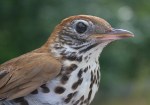
The MABO station was installed on crown land on the north side of Devil Lake Road, north of Frontenac Provincial Park. This crown land parcel is relatively small and surrounded by largely undisturbed private lands. The name Maplewood Bog was chosen for the site because of the predominance of mid-succession Oak-Sugar Maple forest and the presence of multiple bogs. MABO also features smaller components of rock scrub barren habitat and mixed open woodlands. This site was particularly attractive for its lower lying Sugar Maple-Oak forest and preponderance of small/shrubby wetlands. The following species are being sampled in sufficient numbers for annual demographic monitoring (based on 2009-2011 data):
We are cur
- Yellow-bellied Sapsucker, Hairy Woodpecker, Red-eyed Vireo, Black-capped Chickadee, Veery, Wood Thrush, American Robin, Gray Catbird, American Redstart, Ovenbird, Northern Waterthrush, Common Yellowthroat, Scarlet Tanager, Song Sparrow and Rose-breasted Grosbeak.
.
.
.
.
 Frontenac Bird Studies