
(April-August)

The North American Bird Conservation Initiative (NABCI) indicates that relative to other areas of Southern Ontario, the Frontenac Arch has a “high proportion of forest, shrubland and low intensity agricultural habitats” and that diversity of breeding birds is “exceptionally high” (Ontario Partners in Flight 2006).
The Frontenac Arch is an extraordinary region for breeding bird populations in Ontario. The Frontenac Arch forms a junction of five distinct ecoregions: the Mixedwood Plains, St. Lawrence Lowlands, Boreal Shield, Laurentian Mixed Forest and Eastern Broadleaf Forest. The resulting matrix of breeding bird species on the Frontenac Arch is considerably diverse. A total of fifteen bird species classified as Species At Risk occur or have occurred historically on the Frontenac Arch. Of these, Cerulean Warbler, Red-headed Woodpecker, Golden-winged Warbler and Red-shouldered Hawk, among others, occur in the region in nationally significant densities.
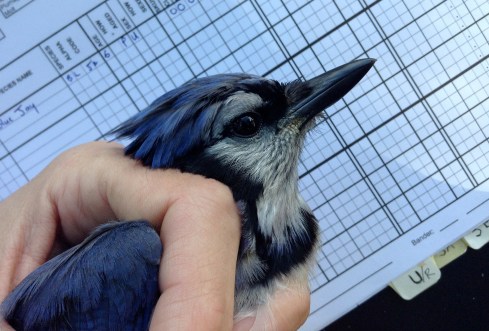
Frontenac Breeding Birds, the flagship program of our FBS project, was designed as an integrated approach to monitoring – an approach that concurrently derives both annual primary demographic statistics and basic population parameters of breeding landbirds. Since 2009, the program has utilized a point count regime throughout a defined study area to systematically assess relative abundance, species richness and distribution through the combined use of roadside and off-road point count surveys. We also produce annual assessments of breeding bird demographics through the installation of the Monitoring Avian Productivity and Survivorship (MAPS) program . The North American Bird Conservation Initiative has identified avian demographics as a primary monitoring objective for “species or study areas of high management concern/interest” in the Ontario region (Ontario Partners in Flight 2006). Data on vital rates such as productivity, survivorship, fidelity and recruitment are critical to the detection and reversal of causal factors in population trends. The first year of field studies alone generated a previously non-existent database on breeding bird demography for this region – a vital platform for long-term monitoring and research.
In addition to these monitoring objectives, FBS also performs more focused assessments and research on at risk species in the region. Since 2009, these species have included: Cerulean Warbler, Louisiana Waterthrush, Prairie Warbler, and Red-headed Woodpecker.
.
.
 Frontenac Bird Studies