the Nest Files – Chestnut-sided Warbler

Adult male Chestnut-sided Warbler (Derbyshire)

.

Chestnut-sided Warbler (Dendroica pensylvanica)

.
Nidiologicals – Peck and James (1987) and Richardson & Brauning (1995)
.
Habitat – Early successional deciduous forest, regenerating clearcuts/fields and woodland edges
Microhabitat – Open cup nest built in crotch of understorey shrub, usually less than 2m from ground.
Spring arrival – Early to late May (Ontario)
Average nest height – .6m
Nest builder – Female only
Average # of broods/season – 1
Average egg laying date – 7 June-17 June (Ontario)
Average clutch size – 4 eggs
Incubation period – Average 11-12 days
Egg colour – White to pale greenish with variable markings concentrated at larger end.
Incubation – Female only
Brown-headed Cowbird host – Yes
.
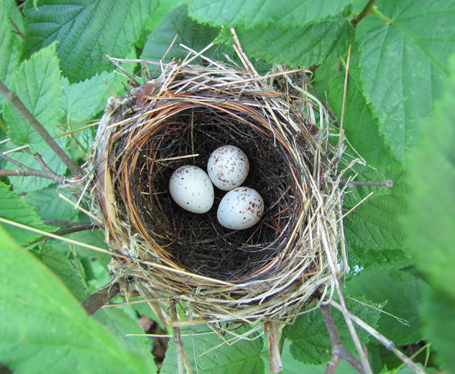
CSWA nest with eggs

The Chestnut-sided Warbler (CSWA) is a fairly common breeder here in Frontenac County and across much of the southern half of Ontario. This species was a North American rarity in the early 19th century before much of the forests were cleared and the young successional habitats became widespread. Populations of Chestnut-sides exploded and now occupy scrubby margins of woodland and overgrown fields from central Saskatchewan to Nova Scotia and south to Georgia along the Appalachian Mountains. In our region they are typically associated with woodland borders of small farms, roadsides, bogs and rock barrens.

This nest was discovered by the observation and tracking of a female carrying nest material on May 28, 2010 at our Blue Lakes MAPS station near Sharbot lake, ON. There are about ten pairs in the immediate area of the station that are occupying scrubby shoreline edges of lakes and ponds. At least part of the site was burned over at some point within the last century or so, which has slowed regeneration and created appropriate conditions for the species. The nest pictured above was less than half complete on May 28 and was finished by June 4 when three eggs were photographed.
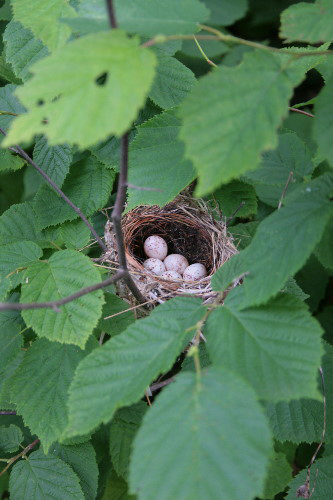
Full clutch (Seabrooke Leckie)

A clutch of five eggs is unusual for this species. This picture was taken on June 8 during our first visit to Blue Lakes. We captured and banded two males and the female responsible for this clutch on that date. The males have an interesting song repertoire and vocal development biology. Two song classes are evident; an Accented Ending (AE) class and an Unaccented Ending (UE) class. The AE song (Please, please, pleased to meetcha) is given on arrival and is primarily used to attract females. The UE song is given later on in the breeding season and seems to be mostly employed for territorial defense and intraspecific aggression. Lab studies have indicated that AE songs are developed with little social interaction while UE songs are learned through direct observation of “tutor” males (Byers and Kroodsma 1992).

Chestnut-sided Warbler nest site

Here is a photograph of the nest site context along the shore of a small unnamed lake. The Chestnut-sided Warblers are nesting in this low, dense shrub layer beneath scattered clumps of young-mid successional oak and maple. Gray Catbird, Warbling Vireo, Yellow Warbler and Indigo Bunting also occupy this habitat type, although the latter is mysteriously absent from the site. We have about five more weeks of fieldwork in 2010 and a lot yet to learn about the “Chestnuts” at Blue Lakes. We are suspecting that the forthcoming post-breeding dispersal will consist of a large dose of young Chestnut-sided Warblers.
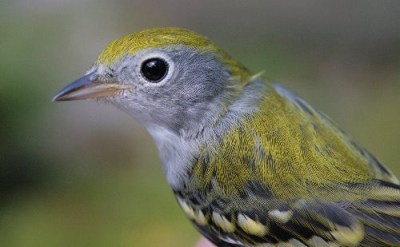
Young CSWA at MABO in 2009 (S.Leckie)

.

MAPS Visit 2 – Blue Lakes & Maplewood

Yellow-bellied Sapsucker

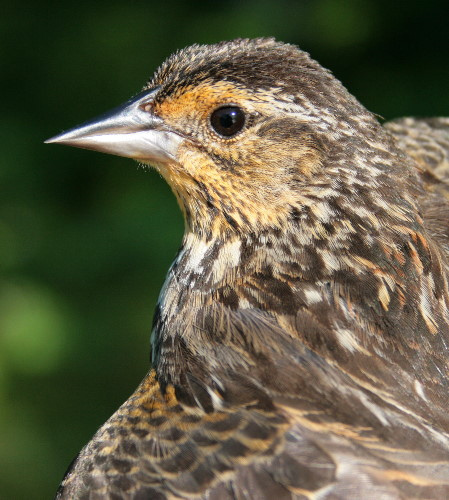
I’ve decided to summarize recent outings to BLAK and MABO in a single post because I’ve fallen behind on a large backlog of other material to touch on soon. Last week we visited the Blue Lakes MAPS site for the second time and had a very good morning. The weather was a highlight in that it wasn’t cloudy or threatening with rain – novel of late. We also captured a nice selection of birds including another Black-throated Blue Warbler (female with brood patch) and five Rose-breasted Grosbeaks, among others. A female Red-winged Blackbird was banded during the morning, which was a first for the FBS MAPS network!

Finally, while driving out at the end of the day we were stopped by the police, who had been lying in wait for us at the end of the road. Apparently, there was some concern that we may have been marijuana growers! That’s another first for FBS….

We will be returning to Blue Lakes by June 29, 2010. Full stats for visit 2 are summarized below the agelaius.

Female Red-winged Blackbird

.

Blue Lakes – Visit 2 of 7

New birds banded (15 of 8 species)

Black-throated Blue Warbler – 1
Ovenbird – 1
Veery – 1
Rose-breasted Grosbeak – 5
Yellow-bellied Sapsucker – 1
Red-winged Blackbird – 1
American Robin – 4
Common Grackle – 1

Recaptures (4 of 2 species)

Black-throated Blue Warbler – 1
Veery – 3

.

Northern Waterthrush (Seabrooke Leckie)

Our first visit to Maplewood Bog in 2010 was a little bit unpleasant due to the wet and ominous weather we endured. We were pleased to give MABO a proper go for visit 2 with clear, warm and dry conditions. The birds were much more active, although Seabrooke and I agree that breeding density seems lower for most species this year. This isn’t too surprising as our 2009 results suggested low productivity for last summer and numbers were way down at most migration monitoring stations this past spring. Visit 2 was all about the Red-eyed Vireo! A total of seven were captured, which included several returns from 2009. We also recaptured two Northern Waterthrushes, which have successfully returned to MABO from their winter haunts in either the Caribbean or Central America.

In all, 28 birds were captured during the six hours of operation. Without question, Maplewood still reigns as the “birdiest” of our MAPS sites….

Full stats for this visit to MABO are provided below Seabrooke’s stunning portrait of a female Eastern Towhee.

Eastern Towhee (Seabrooke Leckie)

.

Maplewood Bog – Visit 2 of 7

New birds banded (17 of 12 species)

Black-capped Chickadee – 1
Ovenbird – 1
Red-eyed Vireo – 2
Song Sparrow – 1
Veery -1
Gray Catbird – 2
Rose-breasted Grosbeak – 1
Wood Thrush – 1
Eastern Towhee – 2
American Robin – 3
Hairy Woodpecker – 1
Blue Jay – 1

Recaptures (11 of 6 species)

Black-capped Chickadee – 1
Red-eyed Vireo – 5
Gray Catbird – 1
Rose-breasted Grosbeak – 1
Blue Jay – 1
Northern Waterthrush – 2

Rock Barrens – Geomorphology, Fire, & Prairie Warblers

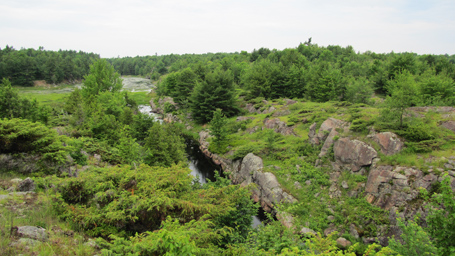
Frontenac Provincial Park lies within the Grenville Province of the Canadian Shield. About 800 million years ago, the Grenville Province was a towering mountain range with peaks as high as the modern day Himalayas. Subsequent periods of erosion, sedimentation, glaciation and more erosion has created the current landscape as we see it today. The rock barrens, in their present myriad of forms and age, cover a significant portion of Frontenac Provincial Park. Geologically, the barrens are described by Christian Barber as a:

“football-shaped body of Diorite that rose up from great depths as a very hot, semifluid pluton.” (Barber 2005)

Three significant forest fires have occurred in the barrens since the mid-19th century. These fires and also the hard bedrock has limited soil generation and plant growth. Both geological and cultural histories have played a role in the creation and maintenance of these open rock barren habitats. The above picture is from the top of a ridge overlooking Slide and Buck Lakes, the most rugged area of the park that stretches from here in the south to our Rock Ridge MAPS site about 6km to the north.

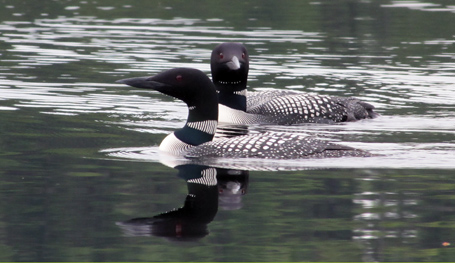
This excursion involved a lot of exercise – over 10km of paddling and about 6km walking. Several pairs of loons would come over quite close to the boat and check me out. Not sure why they do this, maybe the paddling and noise stirs up prey under the surface? I’ll never get tired of seeing Loons.

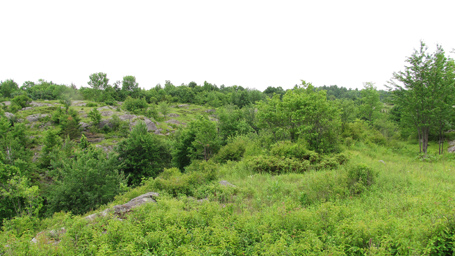
These are the aforementioned rock barrens. The last fire burned this area over around 1930, which demonstrates the remarkably slow rate of succession in the barrens. The few scattered trees are no more than 5 or 6 metres tall. Eastern Towhee, Field Sparrow, Common Nighthawk and Prairie Warbler are attracted to these habitats for its absence of tree/canopy cover, presence of low shrubby growth and/or sparse ground cover.

During the morning I completed a brand new point count route through this area to boost our monitoring coverage of this unique habitat. I was also hoping to find and georeference Prairie Warblers, a recently de-listed Species at Risk that is still quite rare and isolated in Ontario. They occur along a narrow band at the southern edge of the shield – from the Frontenac Arch Biosphere Reserve in the east to the Georgian Bay Biosphere Reserve in the west. Rock barrens can be found throughout the shield but they are most widely distributed and heavily concentrated along this ecotone in central Ontario. This photo shows a small stretch of habitat incised by a wetland that held five Prairie Warblers. The deciduous tree on the right seemed to be a prominent song perch, which three gorgeous males aggressively fought over.

By the end of the day, over a dozen Prairies were located and mapped, which was a terrific reward for such a long day. I have two more “inventory” sessions for Prairies in the area still to come so there should be more of these bright yellow “buzzers” out there. This inventory will set the basic population parameters for potential future research, which would involve a more in-depth look at demographics and habitat preferences. The Prairie is one of a host of species that depends on cyclic disturbance, natural or anthropogenic, to maintain stable and viable populations. It is likely that, without another significant fire, the Prairie Warblers in Frontenac Park will be extirpated as these rock barrens mature. This is definitely a fascinating context for a detailed study…

MAPS Visit 1 – Rock Ridge (2010)

Black-and-white Warbler (S.Leckie)

The final of our first round of MAPS visits was to the Rock Ridge station in Frontenac Provincial Park last week. Rock Ridge is unique in many ways. It is located atop a steep sided gorge, which offers stellar views of the surrounding landscape dominated by Eastern White Pine. The bird community is representative of the coniferous tree cover as well as the scrubby, exposed rock barrens of the area. During our first visit in 2009 we were greeted with a good number and variety of birds – 23 captured of 14 species. Our first morning this year was a much slower affair as just 10 birds were banded in six hours and there were no recaptures of birds banded in 2009. We did band two female Black-and-white Warblers, both of which had heavily vascular brood patches, which suggested they were presently incubating.

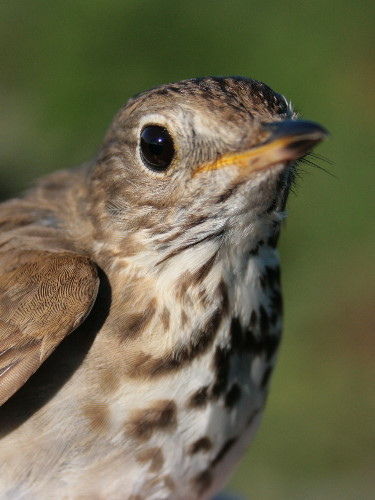
Hermit Thrush (Leckie)

This spring has been an early one and the vegetation is much further advanced than it was last year at this time. Also, many of the species at RRID are earlier migrants from temperate wintering grounds and so it is possible that the timing of our first visit in 2010 coincided with the period when most females are incubating and thus activity/movement is low. We may have encountered this on visit two in 2009 when, once again, only ten birds were captured! This is a good learning experience for us as it now makes sense to sync our first visits in time with the season rather than a specific date.

White-throated Sparrow (Derbyshire)

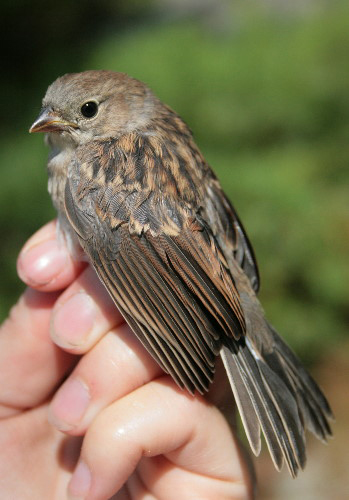
So the morning was unexpectedly quiet but it was even more surprising that no birds banded in 2009 were recaptured; all of the birds shown here represent new captures. Another sign of the advanced spring was the observation and/or capture of recently fledged Field Sparrow, Song Sparrow and Blue Jay. We didn’t start seeing young birds until visit two and three in 2009. Seabrooke got two juv Field Sparrows out of net 5 on one of her fruitful net rounds (see below for a pic).

Juv. Field Sparrow (Leckie)

It is safe to say that I am completely enamored with this place. It is highly diverse, always has the unexpected and is undeniably remarkable. We will be operating the Rock Ridge MAPS station through at least 2013 but hopefully through 2019 – we’ve only just begun…

.

Rock Ridge – Visit 1 of 7

New birds banded (10 of 7 species)
.
Field Sparrow – 2
Black-and-white Warbler – 2
Red-eyed Vireo – 2
Hermit Thrush – 1
White-throated Sparrow – 1
Rose-breasted Grosbeak – 1
Blue Jay – 1

Recaptures (none!)