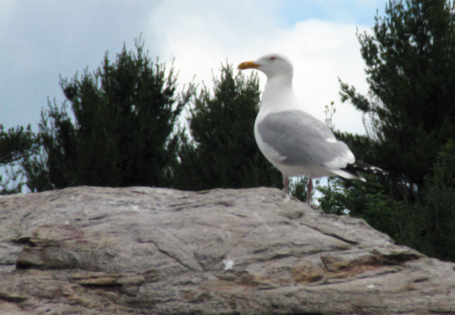
the Nest Files – Herring Gull

Adult Herring Gull (Derbyshire)

.

Herring Gull (Larus argentatus)

.
Nidiologicals – Peck and James (1987) and R.J. Pierotti and T.P. Good (1994)
.
Habitat – Primarily Islands, rock islets, coastal areas and open mainland sites.
Microhabitat – Nest scrape/mound often sheltered from wind by rock, log or vegetation. Usually on ground but sometimes elevated in vegetation or man-made structures.
Spring arrival – Most breeding adults are non-migratory but return to nest sites in March-April
Nest builder – Male and female
Average # of broods/season – 1
Average egg laying date – 26 May-9 June (Ontario)
Average clutch size
– 3 eggs
Incubation period – Average 30 days
Egg description – Large, ovoid with variable base colour ranging from light olive, brownish to greenish with brown to black markings.
Incubation – Male and female

Herring Gull nest with eggs (Derbyshire)

The circumboreal Herring Gull is one of two common breeding gull species in Ontario. The Herring is more numerous from central Ontario north to Hudson Bay while its close relative the Ring-billed Gull is more abundant in the south. By the late 19th century the Herring Gull was nearly driven to extirpation from North America by plumage and egg collectors but their numbers have recovered and have possibly even exceeded precolonial abundance levels (Pierotti et.al. 1994). In Southern Ontario they tend to occur in large colonies with Ring-billed Gulls along the coasts of large lakes. However, this species is more widespread in the Southern Shield region where thousands of inland lakes dotted with rocky islands provide abundant breeding habitat. Smaller colonies or isolated nestings are more typical in the Southern Shield, although the species abundance and ecology appears to be less well known in this region.
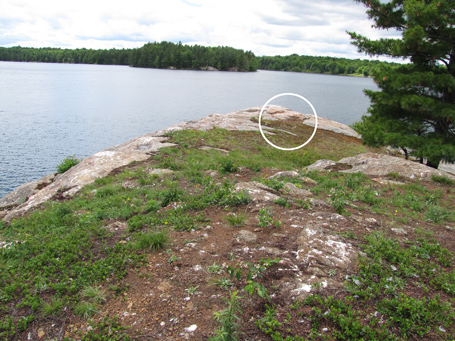
Herring Gull nest site (Derbyshire)

A waterbird breeding colony consisting of Ring-billed Gull (10-12 pairs), Great Blue Heron (2 pairs) and Herring Gull (1 pair) was found on a small island on Big Clear Lake in early June of this year. A followup visit revealed at least 10 active nests of Ring-billed Gull, 2 of which contained young. The Ring-billed nests were fairly tightly spaced along the western slope of the island where low ground vegetation was densest. The Herring Gull nest was isolated from all other nests at the northern edge of the islet abutting some large rocks (note inserted white circle in above photo). The eggs were just beginning to hatch on June 11, 2010.

Nest

This photo, with FBS assistant Seabrooke standing in the background, provides some sense of scale of the large nest mound constructed of mostly pine needles, moss and lichen. Herring Gulls have a reputation as fierce nest defenders, even toward human territory invaders. This particular pair were quite docile and accepting of our intrusion, although we only visited the nest very briefly to snap a few photos and check the contents of the nest. Here you can see the nest tucked up against some rocks, which would have provided protection from the cold north and west winds blowing down the lake.

'Gull' rock on Big Clear (Seabrooke Leckie)

Lastly, here is the rocky islet itself. The islet is little more than 800 square metres in size but it has the sought after expanses of barren rock with low vegetation – ideal for nesting gulls in the Southern Shield. The islet is also attractive to nesting Great Blue Herons. Two active heron nests were found in the crowns of Eastern White Pines and the young are still being fed as of July 2, 2010.

MAPS Visit 3 – Maplewood and Rock Ridge (2010)

Spring Peeper (Pseudacris crucifer)

As we are already into visit 4, I thought I’d better wrap up visit 3 to MABO and RRID in one summary. The visit to Maplewood Bog on June 29 was a unique MAPS experience for me because for the first time I was all by myself! Our first priority is to perform net checks at frequent and regular intervals of no more than 25-30 minutes, which is a challenge without multiple personnel. I was able to do this during visit 3 but felt the fatigue of near constant motion for the six hours of the fieldwork!

The weather was damp and cool with intermittent drizzle, keeping bird activity low and giving me some extra time to race around the net circuit. I was somewhat shocked that I’d processed 27 birds that morning – a not too shabby total considering the conditions. I had no time for photos with the exception of an irresistible Spring Peeper that clung to the stem of a shrub near net 6. As usual, an excellent variety of birds were captured including a female Scarlet Tanager, the first juvenile Wood Thrush of the year and a second-year Veery that was banded as a young bird in August 2009!

Maplewood Bog – Visit 3 of 7

New birds banded (19 of 11 species)
.
American Redstart – 1
Northern Waterthrush – 1
Red-eyed Vireo – 3
Song Sparrow – 2
Wood Thrush – 1
Yellow-bellied Sapsucker – 1
Scarlet Tanager – 1
Gray Catbird – 2
Eastern Towhee – 1
American Robin – 5
Blue Jay – 1

Recaptures (8 of 6 species)
.
Northern Waterthrush – 1
Red-eyed Vireo – 1
Gray Catbird – 1
American Robin – 1
Veery – 2
Wood Thrush – 2

Black-throated Green Warbler (Seabrooke Leckie)

Our first ever Black-throated Green Warbler (Dendroica virens) was banded at Rock Ridge during visit 3 this past week. Black-throated Greens are regular breeders in Frontenac Provincial Park, particularly in areas with mature conifers and dense canopy cover. Overall, things are moving along nicely at this site as young birds are beginning to appear in numbers. Another male White-throated Sparrow was banded (below) while a tan-morph individual was spotted carrying food in an area of juniper scrub at the north edge of the station.

Red-eyed Vireo (Seabrooke Leckie)

Red-eyed Vireos are more commonly heard and captured than seen at Rock Ridge. There are a few pairs occupying young deciduous patches of Sugar Maple-Oak. Growth rates are very slow here so it might be more accurate to describe the forests as ‘low’ instead of young as many of the trees are probably 50-80 years old but appear much younger. Blue-headed Vireos also breed in this conifer dominated eastern edge of the park but we’ve not encountered any so far at Rock Ridge.

White-throated Sparrow (Seabrooke Leckie)

A total of 25 birds were captured during visit 3 – a very good sample of what is present. We captured several young birds including individuals of Eastern Phoebe, Black-capped Chickadee, Field Sparrow, Song Sparrow and American Robin – all early nesting temperate migrants. There has been little sign of productivity so far for any neotropical species at the three stations. The extraordinary amount of rainfall in the month of June may be influential to productivity indices in 2010 – visits 4-7 should be instructive.

Rock Ridge – Visit 3 of 7

New birds banded (17 of 12 species)
.
Black-throated Green Warbler – 1
Common Yellowthroat – 1
Field Sparrow – 2
Black-capped Chickadee – 1
Chipping Sparrow – 1
Eastern Phoebe – 1
Red-eyed Vireo – 1
Song Sparrow – 2
White-throated Sparrow – 1
Hairy Woodpecker – 1
American Robin – 4
Common Grackle – 1

Recaptures (8 of 6 species)
.
Common Yellowthroat – 1
American Robin – 1
Red-eyed Vireo – 1
Chipping Sparrow – 1
Black-capped Chickadee – 2
Eastern Towhee – 1

MAPS Visit 3 – Blue Lakes

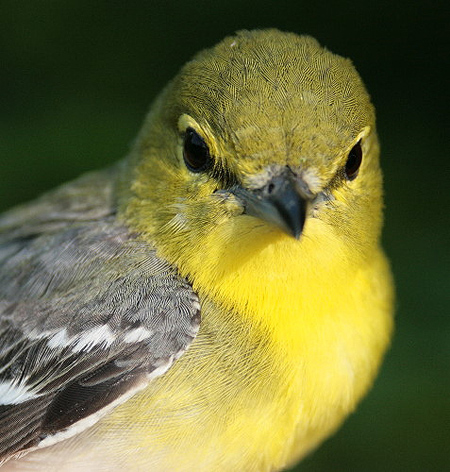
Yellow-throated Vireo (Seabrooke Leckie)

Visit three to Blue Lakes happened late last week. A definite highlight of the day was the capture of three adult Yellow-throated Vireos (2 new and 1 recap) and the discovery of a nest with young in the crown of a large Red Oak near net 1! We’ve banded the male and female tending the nest but also captured a new gravid female (carrying egg) in net 1 around mid-morning. We suspected at least a couple of pairs were in the area but the appearance of a gravid female so close to the nest of another pair seems rather curious. Very cool to have this species around and in numbers too!

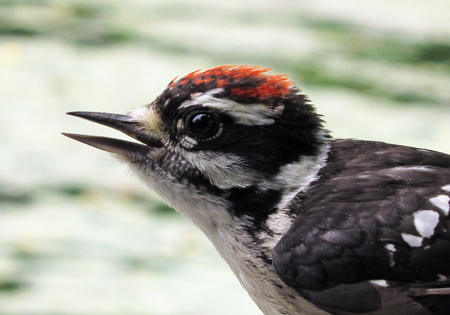
Juv Downy Woodpecker (Derbyshire)

The morning’s work went smoothly and a steady trickle of birds were handled over the six hours. Despite that multiple territories of Black-throated Blue Warblers are present within the station boundaries, we have only managed to band and recapture the one male and female individual. We are starting to wonder if the other singing males are unpaired.

We’ve now completed nine visits to all three stations combined and are not even halfway through the season! The remaining visits to each station will be interesting as adults move or reestablish territories and this season’s crop of young birds begin to disperse. The month of June was extremely wet and it remains to be seen how this has affected nest success for landbirds in Frontenac County and beyond….

Blue Lakes – Visit 3 of 7

New birds banded (18 of 12 species)

.
Field Sparrow – 1
Red-eyed Vireo – 1
Ovenbird – 1
Swamp Sparrow – 1
Yellow-throated Vireo – 2
Veery – 1
Downy Woodpecker – 2
Song Sparrow – 1
Rose-breasted Grosbeak – 3
American Robin – 2
Blue Jay – 1
Common Grackle – 2

Recaptures (6 of 5 species)
.
Black-throated Blue Warbler – 2
Yellow-throated Vireo – 1
Yellow-bellied Sapsucker – 1
Downy Woodpecker – 1
Ovenbird – 1

Update on Frontenac Prairie Warblers

Adult Male Prairie Warbler (Dan Derbyshire)

Our inventory of Prairie Warblers in Frontenac Provincial Park is now complete! Conducting the inventory required lots of hiking over rugged terrain and canoeing – 41 kilometres in all. The Prairies are occupying rock barren habitats in perhaps the most inaccessible part of the 5000 hectare park. I am relieved to report that it was well worth the effort as a surprisingly large number of Prairies were located. Prior to this season I had hopes that about ten pairs would be found in Frontenac but really had no expectations beyond the few pairs that were first encountered at Slide Lake last summer.

Another male (Derbyshire)

The second edition of the Ontario Breeding Bird Atlas provides an excellent summary of the current provincial status of the Prairie Warbler. Incidentally, a bright male Prairie Warbler was chosen as the cover bird for this important work. The authors of the account note that the distribution has remained unchanged since the first atlas conducted in the early 1980’s, although many long standing colonies had been deserted due to habitat succession. Several colonies in the Frontenac region have disappeared including a large population of perhaps 20 pairs that inhabited the west side of Canoe Lake, which hosted birds from 1961-1987. Another historical colony resided at Devil Lake for more than 40 years from 1948-1988 (Weir 2008). The largest population remaining in Ontario occurs in the Georgian Bay region where 270 pairs were located in the 1990’s (Harris 1998). Outside of Georgian Bay, colonies of Prairie Warblers seem to be less concentrated, possibly due to habitat shortage, which could make them more susceptible to extirpation.

Data from the second atlas suggest that away from the Georgian Bay area fewer than 50 pairs occur and the total provincial population is unlikely to exceed 320 breeding pairs. (Cadman et.al. 2007)

Adult female (Derbyshire)

The population in Frontenac Provincial Park, inventoried for the first time this summer, includes a minimum of twenty territorial males! At least four of these males are paired with females. Additional males were likely encountered in two instances involving three males in territorial dispute but it was impossible to exclude potential overlap. The figure of 20 males is a conservative tally of birds with territories delineated by counter singing. I have yet to perform any analysis of habitat availability versus our coverage but strongly suspect that an upper limit of 30 pairs would be a reasonable estimate for the population. At 20-30 pairs It is quite possible that this population may be the largest known active colony outside of the Georgian Bay region.

I spent a lot of time looking for females and managed to find just four over several days of fieldwork in the rock barrens. Females were likely hunkered down on well hidden nests and not moving around much. I did find this female (pictured above) that was much more active. I watched her frequent comings and goings to a patch of dense shrub near an Eastern White Pine. She made half a dozen trips to the patch with beakfulls of “stuff”, either bugs or nest material. I didn’t approach the presumed nest site until the 7th trip when it was clear that food was being carried to the spot (approaching during nest building could have resulted in abandonment). I fully expected to find a nest with young in one of the shrubs but found this instead…..

Fledgling Prairie Warbler (Derbyshire)

This discovery of fledged young confirms successful breeding in Frontenac Provincial Park for this year and provides some indication that the colony is viable and productive! We now have a much better grasp on the current breeding status, habitat association and population density of Prairie Warbler in the park and can now begin setting more specific targets for future years. More to come in 2011….

MAPS Visit 2 – Rock Ridge (2010)

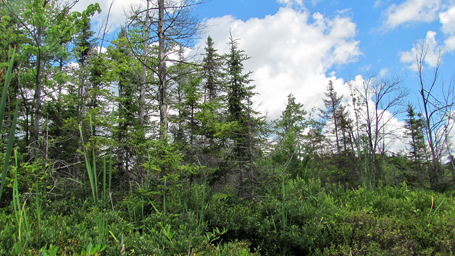
Spruce Bog at RRID

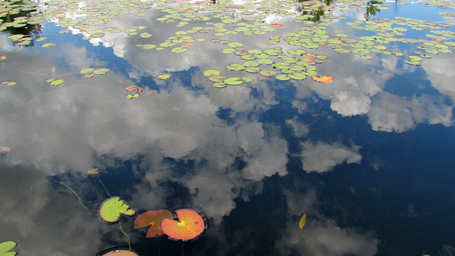
After a quiet first visit on June 11th, the Rock Ridge station returned to form on June 20th as 23 birds were captured during the morning. We thought last summer was unusually wet but this season has been even more drenched with rain seeming to fall consistently on a semi-daily basis. Fortunately, we have completed all of our visits within the intended periods but only by a thin margin and with thanks to a bit of luck. The photos accompanying this update are all landscapes as Seabrooke had a Canon malfunction, which erased all of the avian portraits from the day. This week, on our way in and out of the station, we paddled past this bog/fen habitat with Black Spruce, Tamarack, Sundew and Pitcher Plants. Common Yellowthroat, Wilson’s Snipe, Swamp Sparrow and Red-winged Blackbird are a few of the species nesting within the wetland complex below the steep cliffsides of the site.

The morning started off slow with an eery dawn silence and nothing captured on the first net check. For a second I considered that winter survivorship may have been particularly poor for our resident breeders but this was instantly erased with a net round at 730am when fourteen birds were extracted – nine coming from a single net! We were also pleased to finally recapture some birds banded in 2009, three in all. The full summary of the birds captured is provided below. The list represents a good sample of the breeding birds present at the station with some notable exceptions. Scarlet Tanager, Pine Warbler, Purple Finch and Myrtle Warbler are also common but tend to stick to the high tops of conifers that line both sides of the gorge, making them difficult to catch for banding. These species will move down with fledged young in search for better feeding areas so hopefully we will band a few before the season wraps in early August.

Mixed forest along the ridge

Rock Ridge – Visit 2 of 7

New birds banded (20 of 11 species)
.
Field Sparrow – 2
Black-capped Chickadee – 6
Red-eyed Vireo – 2
Hermit Thrush – 1
White-throated Sparrow – 1
Red-breasted Nuthatch – 1
Common Yellowthroat – 1
Chipping Sparrow – 1
Eastern Towhee – 2
American Robin – 2
Common Grackle – 1

Recaptures (3 of 2 species)
.
Black-and-white Warbler – 1
Black-capped Chickadee – 2