MAPS Visit 1-Rock Ridge (RRID)

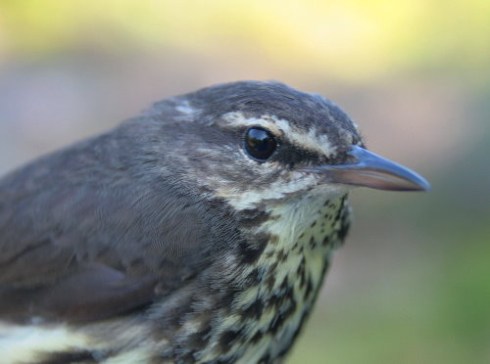
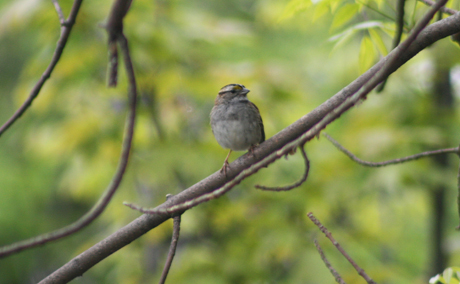
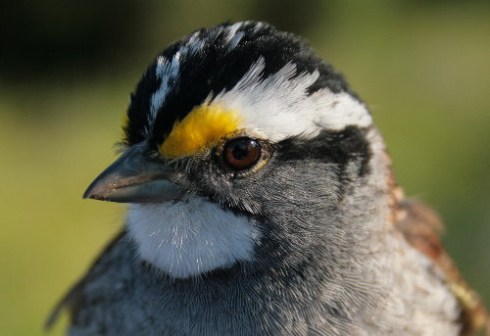
White-throated Sparrow (S.Leckie)

Round one of seven visits to all three MAPS was wrapped up on Saturday, June 6 with our first visit to the Rock Ridge MAPS site in Frontenac Provincial Park. Ontario Parks, particularly the staff at Frontenac, have been of great assistance to FBS getting established. Frontenac Provincial Park, a backcountry wilderness park with over 5000 hectares of incredibly diverse habitats is literally at the core of the Frontenac Breeding Birds program. In addition to the operation of Rock Ridge, we have also started conducting point counts and nest monitoring throughout the park, which will provide a rigorous baseline assessment of breeding bird abundance, species richness, distribution and habitat relationships. A big thanks are due to the following Ontario Parks staff for permitting us to run our project and for assisting in the development of the FBS initiative-Peter Dawson (park superintendant), Bert Korporral, Corina Brdar and Chris Robinson.

Our Rock Ridge Monitoring Avian Productivity and Survivorship (MAPS) site feels, in many ways, like a world apart. The site is as unique as it is beautiful with extensive rock barrens and outcrops that tumble down over steep cliffs into deep clear lakes that shimmer aqua-green in the sun. The steep and rugged cliffs are home to Yellow-rumped Warblers, Pine Warblers, Purple Finches, Northern Rough-winged Swallows and Turkey Vultures to name a few. Frontenac Provincial Park underwent a series of burns about 80 years ago or so. At least one fire that the military had to be called in to put out was started by settlers in a dispute over rights to berry picking territory (blueberries and cranberries)! The human history of Frontenac Provincial Park, while rich and fascinating,  has also played a key role in shaping what is there today. The burns of the 30’s have resulted in a large swath of what is best described as rock barren habitat with stunted and slow growing plant communities. This is a fascinating habitat and a clear favourite of Field Sparrows, Eastern Towhees and a few specialists of the region (more on that later this week).
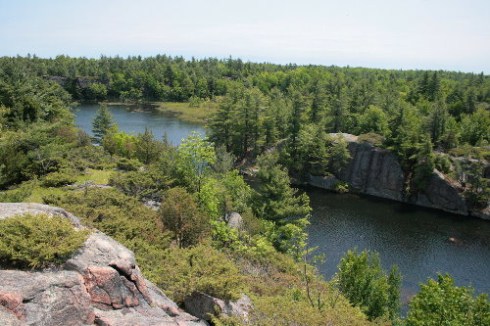
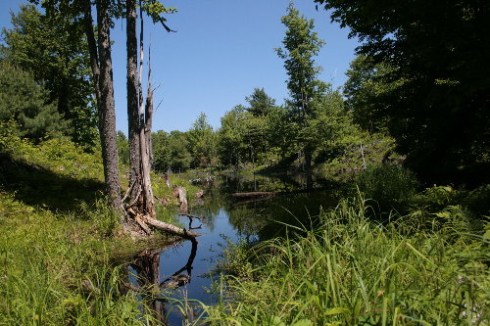
Rock Ridge site (northeast cliffs)

The photo above was taken near the banding station during a brief sunny period on our visit. The view takes us over steep cliffs of conifers across to wetlands that include a small Black Spruce bog. The MAPS site also includes some more mature mixed-forest along the northwestern side. The White-throated Sparrow such as the one pictured above are one of the most abundant species at the station and their distinctive voices filled the air from all directions during our visit.
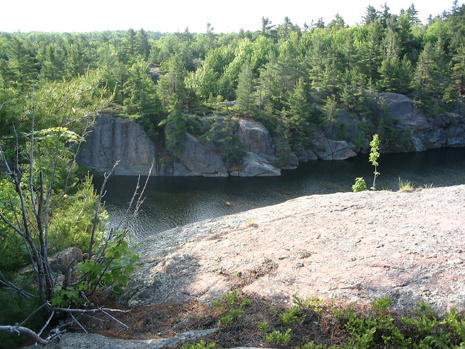
View from the banding station

Access to Rock Ridge is at best an ordeal of mental and physical stamina! Waking up at 3am never gets easy and then to undertake a 30 minute drive followed by a 30 minute portage and 20 minute paddle….you get the picture. However, Rock Ridge is worth it. This is the view from the banding station where all of the captured birds during the six hours of mistnetting are processed (banded, measured, aged, sexed and released). There is just something of the untouched about the place that makes it all worthwhile and the birds are terrific as well. Actually, I had an hour or two of panic when we had caught a promising four birds on the first net check, which was followed by three consecutive rounds of absolutely nothing. Fortunately, a total of fifteen birds were captured during the following three net checks!

Eastern Kingbird (D.Derbyshire)

Speaking of birds, we ended the day having banded a total of 23 birds and 2 repeat captures for a total of 25. The most common of the lot were American Robins (4) followed by Red-eyed Vireo (3) and White-throated Sparrow (3). Nashville Warbler, Yellow-rumped Warbler, Scarlet Tanager and Purple Finch are also quite numerous at the site but all evaded our nets on the first day. There were also a few “singles of things” such as this second-calender year female Eastern Kingbird.

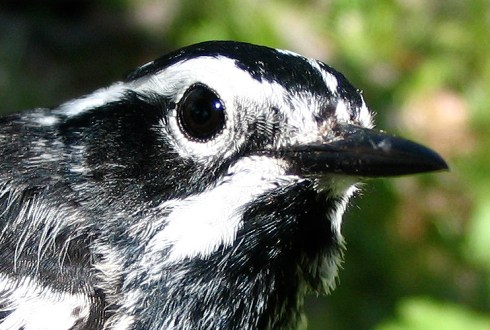
Black-and-white Warbler (Leckie)

Black-and-white Warblers occur in significant numbers at all three MAPS stations. We managed to catch this sharp male from one of our “scrub” nets that is far from appropriate habitat for this species. They tend to be most common along the more maturely wooded slopes but they do seem to occur in some rather open and stunted habitats as well.

Black-billed Cuckoo (Leckie)

Cuckoos, both Black-billed and Yellow-billed are also found at all three MAPS sites. We captured this Black-billed and narrowly missed another in net 10 around late morning (they are a bit on the large side for 30mm mesh nets and tend to flop out when approached). The incredible abundance of forest tent caterpillars this year may produce a bumper crop of juv cuckoos in 2009!

Cedar Waxwing (Leckie)

Cedar Waxwings are late nesters and tend not to get down to business until late June-early July in Ontario. Wheeling flocks of Cedar Waxwings have been observed on a regular basis at our MAPS sites but this is the first of the species that we’ve caught. Seabrooke must have enjoyed the light of Rock Ridge as these bird portraits are particularly strong. Seabrooke has been a huge help to the operation of these MAPS stations as I’m doubtful that this could have been pulled off on my own. Look for her account of Rock Ridge on her marvelous blog later today!

Red-eyed Vireo (Derbyshire)

In the end, our first visit to Rock Ridge was a productive one as we experienced no major incidents in accessing the site and the sample of breeding birds was very strong. I have a feeling that, more so than the other sites, the composition of species in our sample will change most sharply for Rock Ridge as the canopy birds descend and the site funnels a high number of late summer dispersing adults and young. That’s just my hunch…..

Rock Ridge- Visit 1 of 7

Banding Results

Black-capped Chickadee-2
Chipping Sparrow-1
Black-and-white Warbler-1
Red-eyed Vireo-3
White-throated Sparrow-3
Cedar Waxwing-2
Eastern Kingbird-1
Brown-headed Cowbird-1
Eastern Towhee-1
Rose-breasted Grosbeak-1
Black-billed Cuckoo-1
American Robin-4
Hairy Woodpecker-1
Blue Jay-1

Notable Observations

Common Loon
Pied-billed Grebe
Osprey
Common Nighthawk
Ruby-throated Hummingbird
Pileated Woodpecker
Common Raven
Purple Martin
Hermit Thrush
Swamp Sparrow
Indigo Bunting
MAPS Visit 1-Maplewood Bog

Red-eyed Vireo (S.Leckie)

On Friday, June 5 we successfully completed our first session of fieldwork at our Maplewood Bog MAPS station, which is located on crown lands north of Frontenac Provincial Park. Once again I was joined by Seabrooke Leckie, FBS research assistant and director of photography. Seabrooke and I left the station around noon with a very positive impression of MABO for its abundance of breeding birds and rich habitat. Less enjoyable were the Deer Flies, which were rather relentless but we were armed with some defense for their attacks. The site is more easily accessible than Hemlock lake, which was appreciated and is distinctly more deciduous in forest type than the other stations. The first sound we heard after parking the vehicle was that of a Whip-poor-will singing with remarkable gusto from the edge of a nearby bog within the station boundaries.

3602406400_9e6e74a0d3
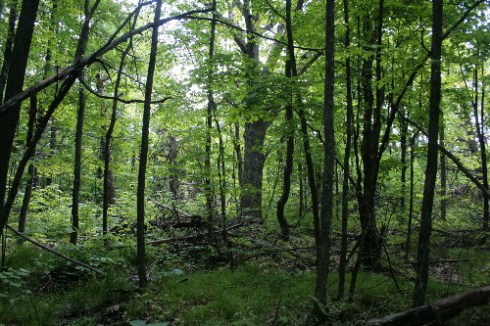
Oak-Maple forest near net #8 (Leckie)

The name Maplewood Bog is our name for the site and was chosen based on this forest structure, which is dominant in the area. The forest consists primarily of maple and oak sp. with lesser quantities of ironwood, american beech, hop-hornbeam, shagbark hickory, basswood and eastern white pine. The forest is of a mixed age with scattered mature growth and an uneven canopy closure, which is well suited to the habitat requirements of Cerulean Warbler. There is at least one Cerulean Warbler, which sang tantalizingly close to net #10 for much of the morning. Red-eyed Vireo, Yellow-throated Vireo and Scarlet Tanager also occupy upper levels of the forest while Veery and Northern Waterthrush are abundant in the understory. An important feature of the site for our research interests is the abundance of natural clearings and wetlands distributed throughout the forest, where birds congregate to bathe and forage and disperse with their young.

3602407168_ce04b86763
Bog wetland near net #3 (Leckie)

The mistnets used to capture the resident breeding birds for banding and study are positioned in a circular fashion around an area of about 7 hectares. The standardized route for checking the nets travels the edges of three bogs containing spongy mats of sphagnum moss. These bogs also feature a dense perimeter of shrubs where American Redstarts and Northern Waterthrushes are nesting. Swamp Sparrow, Wilson’s Snipe, Yellow Warblers and Common Yellowthroats are also found in these habitats.

3601591225_798e0ee3c8
Upland scrub near net #5 (Leckie)

A small section of upland srub with rocky outcroppings occurs in the northwest corner of the site. This area is host to numerous Eastern Towhees, Field Sparrows and Great Crested Flycatchers to name a few. This habitat is found throughout the region on the tops of ridges where the glacial till is particularly lean.

3601592551_a0313cb868
Another bog near net #6 and #7 (Leckie)
3601589873_2024a42896
Eastern Towhee (Leckie)

A total of 26 birds were captured at MABO during visit 1, which was a little busier than Hemlock Lake just two days previous. On any given MAPS visit we are only going to capture a small sample of the breeding bird community, which is why no less than seven visits in a single season are required to portray adult and juvenile “superperiods”. We caught just one Eastern Towhee on this day but there are many more in the area, which we can expect to encounter on subsequent visits. The instantly recognizable “drink your tea” song is a ubiquitous sound at all three of our MAPS stations, making them one of the most common birds at our sites. This is likely a reflection, in part, of the selection of edge habitats as net sites-crucial for measuring productivity rates in late summer.

3601589511_5e17681543
Nashville Warbler (Leckie)

Nashville Warbler is another common species at all of the sites, although they have proven to be difficult to catch so far. We’ve only managed to capture two females (both with brood patches) that happened into our nets on the final round of the first visit to Maplewood Bog. The Nashville Warbler is a common breeder in the Frontenac Arch and Ontario as a whole, favouring more open forests with mixed deciduous and coniferous species.

3601589135_a85b6daf8d
Veery (Leckie)

The downward spiralling song of the Veery, no less distinctive than the song of the towhee, was heard in abundance at MABO during the first couple of hours we were there. The Veery is a regular breeder in deciduous forests with a closed canopy. I was thrilled to stumble upon an active nest of this species at the site and will be posting about that later in the week. We caught two of this species on this day and this particular female seemed happy to take Seabrooke’s offering of a Deer Fly for her trouble.

3602403016_b398d6318f
Northern Waterthrush (Leckie)

No question the bird du jour was Northern Waterthrush as a total of four were banded, all with either well developed brood patches (active breeding female) or cloacal protuberances (active breeding male). An adult was spotted carrying food along the shrubby edge of a small bog, indicating the presence of a nest with young in the area.

3602403174_0b51997287
Ovenbird (Leckie)

Ovenbirds are more often heard than seen and apparently more often heard than caught as well. Mistnets are usually very good at capturing skulky species such as the interior forest dwelling Ovenbird but we only managed to band a single individual during our visit. There were certainly more than just a couple of Ovenbirds in the area so I’m anticipating that we will encounter them more often as the season rolls along.

Maplewood Bog is looking like a very promising site and potentially the busiest of the three stations we are running in 2009. We both remarked how enjoyable it was to take a moment and listen to the Cerulean Warbler, Yellow-throated Vireo and Scarlet Tanager that sang persistently throughout the day within 50m of the banding station-Frontenac birding at its best!

Maplewood Bog-Visit 1 of 7

Banding Results

American Redstart-2
Nashville Warbler-2
Field Sparrow-1
Common Yellowthroat-2
Black-and-white Warbler-1
Black-capped Chickadee-1
Northern Waterthrush-4
Ovenbird-1
Red-eyed Vireo-2
White-breasted Nuthatch-2
Veery-2
Wood Thrush-1
Eastern Towhee-1
Ruby-throated Hummingbird-1 (unbanded)
Rose-breasted Grosbeak-1 (unbanded)

Notable Observations

Whip-poor-will
Wilson’s Snipe
Yellow-throated Vireo
Ruffed Grouse
Common Loon
Yellow-billed Cuckoo
Common Raven
Yellow-rumped Warbler

MAPS Visit 1-Hemlock Lake (HELA)

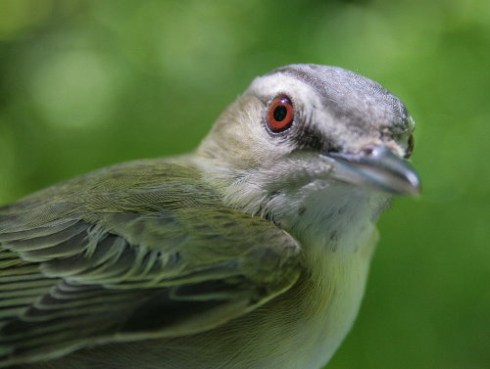
Black-and-white Warbler

The first “official” day of the Frontenac Breeding Birds program began with both great anticipation and the sound of the alarm clock at a shockingly early hour! The first day at a shiny new MAPS station is usually filled with a lot of excitement mixed with a bit of drama and perhaps even a bit of anxiety. Stumbling through the one kilometre long “path” through the thick bush at 430am is then followed by a mad scramble to expeditiously locate net sites and erect the mistnets. This can be a trying experience however things always get easier once this procedure is out of the way. Our first visit of the year was to Hemlock Lake, a gorgeous site of mixed forest and wetlands on crown lands in the FBS study area. The most distinctive characteristic of the HELA station is the proliferation of Eastern Hemlock and the lake itself, which is full of drowned timber and a regenerating shoreline of trees felled by the infamous ice storm of 1998. This shoreline is now regenerating with a host of successional shrubs and saplings, which provides excellent edge habitats for sampling both adult and dispersing juvenile demographics.  Black-and-white Warbler (pictured above) is one of the most abundant species in the area, although just one male was captured this morning.

3594044902_7439639df7
Hemlock Lake at dawn (S.Leckie)

Of the three MAPS stations we are running in 2009, Hemlock Lake is definitely the most rugged and arduous to traverse. There is a great amount of deadfall at the site and a lot of ups and downs over rock outcrops and small ridges and valleys. Wild Roses also provide a dense thorny covering for hidden snags and branches. While each of the twelve runs of the mistnets during the morning is an undertaking, the unique ecology, sights and sounds make it worthwhile and enjoyable.

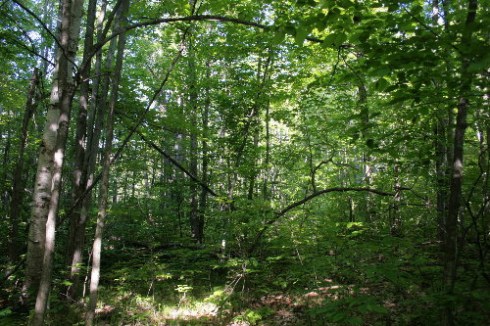
Deciduous forest in northwest corner of HELA
Deciduous forest in northwest corner of HELA (S.Leckie)

The site also has large components of decidous forest at the boundaries of the station where Ovenbirds, Red-eyed Vireos and Scarlet Tanagers are common.

3594046288_4d87142351
Mixed forest habitat (S.Leckie)

Mixed forest is more typical of the banding area, which is dotted by streams and ephemeral ponds. Gray Tree Frog, Winter Wren and Northern Waterthrush, among others, are found in these wetlands at Hemlock Lake. The most exciting find was of a fast moving Five-lined Skink, which thwarted any attempt to acquire a photograph. The Five-lined Skink is Ontario’s only species of lizard and is a designated Species at Risk.

From Royal Ontario Museum

The Five-lined Skink is Ontario’s only species of lizard, and it is split into two series of populations with distinct habitat preferences. The Carolinian populations, which are Endangered Nationally and Special Concern Provincially, occur in Carolinian forest and prefer wooded habitat with sandy soil and ground cover. They use woody debris as shelter and hibernate by burying themselves in the soil. The Great Lakes/St. Lawrence populations, which are Special Concern Provincially and Nationally, occur on the southern part of the Canadian Shield. Preferred habitat is on rocky outcrops in mixed coniferous and deciduous forests, where they can seek refuge from the elements and predators in rock crevices and fissures.


3594043974_c4da7c7128
Yellow-bellied Sapsucker (S.Leckie)

Yellow-bellied Sapsuckers were also common throughout the Hemlock Lake station and are a dominant woodpecker species in forests of this type in the Frontenac Arch region.

3593234753_bd881621f6
Juvenile Brown Creeper (S.Leckie)

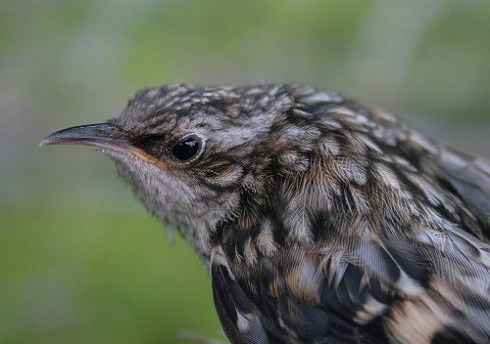
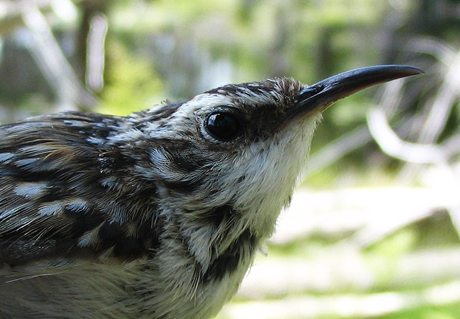
Brown Creepers are abundant at the site, due in part to the abundance of dead and decaying conifers along the shoreline of Hemlock Lake. We are already monitoring an active nest at the site and today captured this juvenile along with its parent (below). The two were released together at the net location where they were captured. All juvenile birds banded are released at locations where they were captured as they are often still dependent on their parents for feeding.

IMG_9562
Adult Brown Creeper

IMG_9574
Winter Wren nest in Eastern Hemlock

Speaking of nests, I discovered a Winter Wren nest at the site last week. The nest is located in a most unusual fashion as Winter Wrens typically build their dome shaped nests low to the ground in mossy stream banks and fallen logs. This particular nest was built on the end of a lateral Eastern Hemlock limb about eight feet off the ground! The photo below is of the entrance hole to the nest. The nest itself looks much like a ball of twigs and moss from below. Male Winter Wrens are known to continuously build nests throughout the summer, even after the female is tending eggs and young in one of his nests from earlier in the season. Males can build as many as twelve nests in a single breeding season! This particular nest is unlined and contains no eggs, which leads me to believe that it is one of these unused building projects. I will continue to check on this nest to note any change in occupancy and will begin my search for the active nest next week.

IMG_9570
close-up of Winter Wren nest

3594046688_3a77d84e50
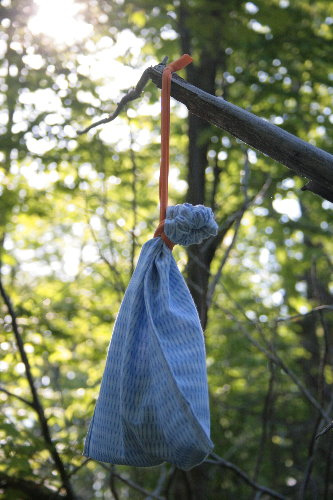
Bird bag (S.Leckie)

A bird waiting for processing at the banding station. A fabulous set of bird bags for Frontenac Bird Studies was expertly prepared and delivered by Wendy Derbyshire (thanks mom!).

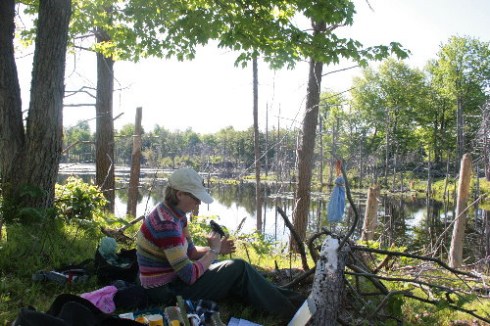
Seabrooke Leckie at the banding station

Research assistant Seabrooke Leckie processing birds at the shore of Hemlock Lake. These MAPS stations are spartan affairs as keeping things light and portable is a top priority! A total of 16 birds were captured during visit one to Hemlock Lake in 2009. Complete results are provided below. Overall, it was a fantastic start to the MAPS component of the Frontenac Breeding Birds and we have twenty more mornings and 251 more net checks at the MAPS stations still to come-a lot to look forward to!

HEMLOCK LAKE-Visit 1 of 7
Banding Results

Brown Creeper-2
Black-and-white Warbler-1
Ovenbird-1
Northern Waterthrush-1
White-breasted Nuthatch-1
Eastern Towhee-1
Rose-breasted Grosbeak-2
Yellow-bellied Sapsucker-2
American Robin-3
Blue Jay-2

Notable Observations

Yellow-billed Cuckoo (bounced out of net 2!)
Barred Owl
Pied-billed Grebe
Chestnut-sided Warblers
Black-throated Green Warblers
Hermit Thrush
Red-shouldered Hawk

Surprise Ceruleans at Maplewood


(Singing Cerulean Warbler-ZHEE ZHEE ZIZIZIZIZI zzzeeet)

Of the three MAPS stations we’re establishing for the Frontenac Breeding Birds project, I’ve definitely had the most difficulty finalizing a layout for the Maplewood Bog station to the north of Frontenac Provincial Park. This particular site seemed to have the most uniformly structured forest and the least number of readily identifiable edges. It was however, the closest thing to pure deciduous forest of the three, which presented our best opportunity to sample species typical of this forest type. My last visit on May 14th, just ten days ago, gave me a bit more confidence that a viable MAPS station could be conducted there but I still had some lingering doubts.

I returned to MABO (station codename) this morning with the hope that I might find some lovely rock outcrops, forest clearings or wetlands that I’d missed on previous visits and also that some new species had arrived since mid-May. Today was my day as I found both! The most notable change since the last visit was the rather sudden appearance of Cerulean Warblers at the site (second only to a mass irruption of Mosquitos!). I hadn’t encountered them previously at MABO but they have been numerous along Canoe Lake Road this spring. In Ron Weir’s latest edition of Birds of the Kingston Region, he makes note of a high count of 25 singing males along Canoe Lake Road on May 15, 1979. Cerulean Warblers seem to have a tendancy to aggregate into colonies, although the reasons for this habit are unclear. Each MAPS station is 20 hectares, inside of which standardized misnetting of breeding birds occurs within an 8 hectare plot. I was delighted to find a total of five singing males within the banding area itself, none of which were audible from the nearby road where the site is accessed. Some of these vocal males may be unmated bachelors but I was able to confirm two pairs and found some evidence of nesting. Ceruleans were located in younger portions of the woodland with an uneven canopy and open understory and seemed to be favouring spots with mature oak sp. protruding through the canopy. The Cerulean Warbler is one of the most heavily declining bird species in North America and is a species of Special Concern in Canada and Ontario.

In addition to the parade of Cerulean Warblers, I also found a great abundance of other deciduous species, the most conspicuous of which were Veery, American Redstart, Red-eyed Vireo and Scarlet Tanager. Other birds of note were Yellow-throated Vireo, Barred Owl, Wilson’s Snipe, Swamp Sparrow, Black-throated Blue Warbler and Magnolia Warbler. The foliage was markedly further along today than my last visit and this was a great help in finalizing the layout of the MAPS station. I didn’t have much time for nest searching but I was very happy to find a Scarlet Tanager nest about 10 feet above the ground at the edge of a blanket bog!

With the layout for MABO now having been properly visualized, we are set to begin site prep next week in advance of our first visit to all three sites in the first week of June. The MAPS work will operate in tandem with an extensive network of on and off-road point count stations throughout the 15,000 hectare study area. An intensive nest-monitoring effort will also commence during the first of June. It will be an eventful and probably very tiring two months of fieldwork but we are in an excellent position to deliver this exciting new initiative. I wonder how many Cerulean Warblers can be found in 15,000 hectares of forest in the northern Frontenac Arch?

Scouting for M.A.P.S- Rock Ridge

viewfromthecliffs

(click on panoramics for higher res images)

This is the final preview in a three part series profiling our network of Monitoring Avian Productivity and Survivorship (MAPS) network in the Frontenac Arch. The panoramic image posted above is from the eastern boundary of our Rock Ridge MAPS site, which is 7 kilometers away from the Hemlock Lake station and 5 kilometers from Maplewood Bog. Rock Ridge is the most remote of the stations, being accessible by portage and a short paddle to the western shoreline of a point jutting into a large deep lake in Frontenac Provincial Park. An alternate route to the site is via a roundabout hike of about an hour, which wasn’t an appealing prospect for seven visits at 4am while lugging equipment!

h

successionalforesth

The site itself is a spectacular mixture of rock barrens, steep cliffs, successional forest/scrub and mature mixed forest. The avian communities are similarly diverse and includes species characteristic of open forest habitats such as Warbling Vireo, Baltimore Oriole, Red-eyed Vireo and Brown Thrasher. Large portions of the site consist of rock barrens with juniper, red cedar and oak-savannah, which host dense populations of Eastern Towhee and Field Sparrow among others. The northern and western slopes are more densely vegetated with mixed-age forest containing pine, cedar and various deciduous tree species. These forested slopes contain large numbers of Black-and-white Warblers, Nashville Warblers and White-throated Sparrows with lesser numbers of Scarlet Tanager, Northern Waterthrush, Yellow-rumped Warbler and Hermit Thrush. Also of interest in the area are black spruce-tamarack bogs, which are probably too small in size for Ruby-crowned Kinglets and other “spruce” specialists of the north. There are larger stands of black spruce in the region, which the extensive point count network will begin to survey in a couple of weeks time.

h

rockbarrensh

Traversing these rock barrens revealed a surprisingly high number of White-throated Sparrows, many of which are well into their first nesting attempts of the year. I didn’t have time to do any formal nest searching but I did GPS several locations of suspected nest sites.

f

IMG_4274

h

Obviously there was more than just interesting birds in the area and I took particular interest in some of the recently sprouted wildflowers. With the help of our assistant Seabrooke Leckie, we were able to identify this attractive plant as Hook-spur Violet.

h

IMG_9509