MAPS Visit 6-Maplewood Bog (MABO)

3767270640_bb59518c07
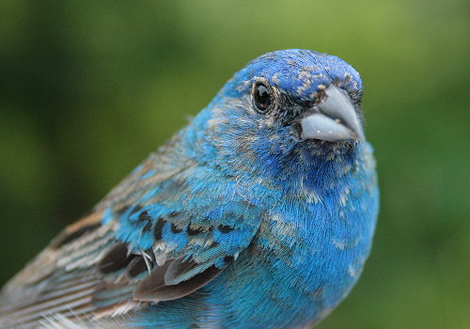
Male Indigo Bunting (Seabrooke Leckie)

The penultimate visit to MABO in 2009 was completed on July 25. Weather during the morning was more like spring with cool temperatures, thick fog and cloudy skies. A result of 18 new birds banded and 24 total captures was less than we were anticipating given the time of year. We continue to await any substantial movement of young birds at both MAPS stations. We are banding a few young birds here and there but the results so far are indicating low productivity in the area as a whole. Despite a shortage of hatch-year birds, we continue to sample adult birds in high numbers, including the Indigo Bunting pictured above.
3767270732_53281c443a
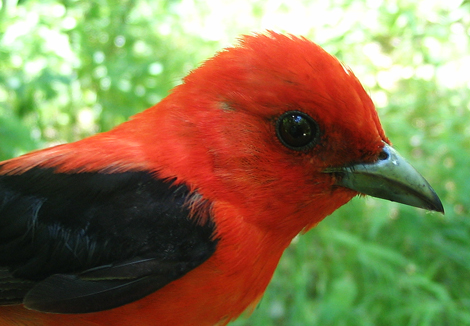
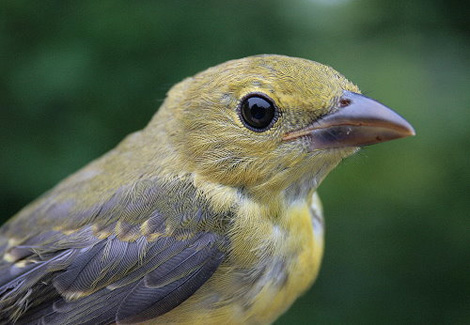
HY Scarlet Tanager (Leckie)

This was the first hatch-year Scarlet Tanager (note the wing bars indicating Juvenal plumage) captured in 2009. We have banded enough Scarlet Tanagers this summer to suggest that both survivorship and productivity indices can be calculated on an annual basis. Veery, Wood Thrush, Black-and-white Warbler, Yellow-billed Cuckoo, Yellow-bellied Sapsucker, Ovenbird and Northern Waterthrush are a few other examples of species sampled in sufficient quantity at MABO and/or RRID to produce vital rate statistics.
3767269662_c541752b7f
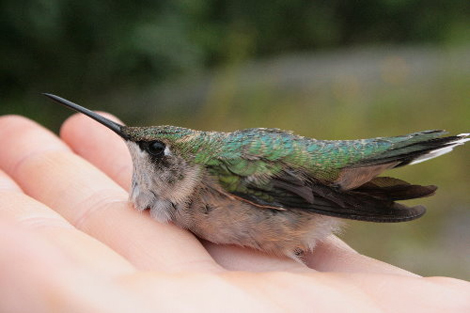
Ruby-throated Hummingbird (Leckie)

A few Ruby-throated Hummingbirds, all females, have slipped into our nets this summer. We release all hummers unbanded as we don’t have the special permits to band this species.
3766472827_570e1cae15
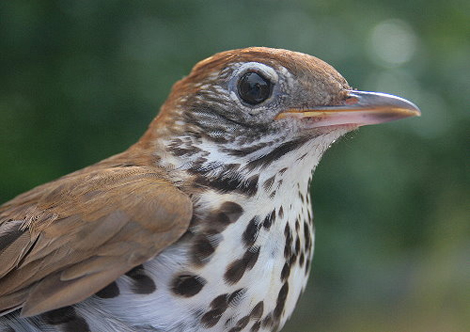
Wood Thrush (Leckie)

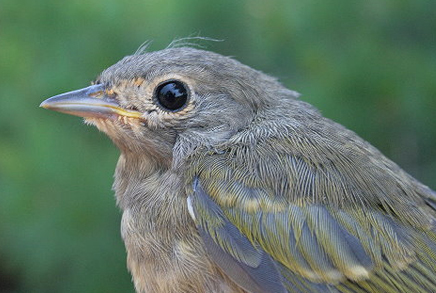
Thus far, results for Wood Thrushes and Veerys, abundant breeders at MABO, has been “hit and miss”. We have banded high numbers of adults but have yet to capture a single hatch-year in 2009. Considerably less common at MABO is the Hermit Thrush and yet we banded a juvenile here during visit 6! Naturally, these findings raise many questions that indicate a need for more data. A substantive network of stations across southern Ontario would be powerfully instructive toward an annual assessment of temporal and spatial variation in rates of productivity and long-term factors influencing population change. For the Frontenac Arch, we are committed to expansion of the MAPS program to bolster demographic monitoring in this region and hopefully to serve as a model for other areas in the province.

Maplewood Bog-Visit 6 of 7

New birds banded (18 of 12 species)

American Redstart-1
American Goldfinch-1
Indigo Bunting-1
Red-eyed Vireo-6
Song Sparrow-2
Scarlet Tanager-1
Hermit Thrush-1
White-breasted Nuthatch-1
Yellow-bellied Sapsucker-1
American Robin-1
Wood Thrush-1
Hairy Woodpecker-1

Captured and released unbanded (1 of 1 species)
Ruby-throated Hummingbird-1

Recaptures (5 of 5 species)
American Robin-1
Song Sparrow-1
Common Yellowthroat-1
Black-and-white Warbler-1
White-breasted Nuthatch-1
MAPS Visit 5-Rock Ridge

3743243228_608978c481
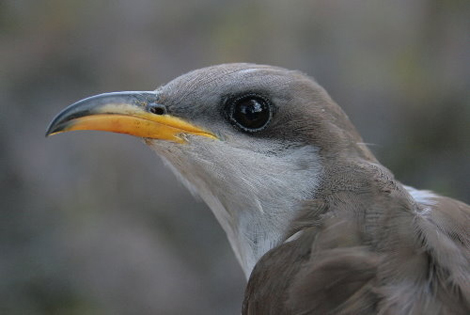
Yellow-billed Cuckoo (S.Leckie)

Fieldwork for the Frontenac Breeding Birds program is still rolling along with the Monitoring Avian Productivity and Survivorship program. Since our last reports on visit three to each of the sites we have also completed rounds four and five at MABO and RRID. This summary reports on visit five to Rock Ridge (RRID), a site situated in rock barren habitat in Frontenac Provincial Park.

3740984061_7d57a62d73
Sunrise over Big Clear Lake (Leckie)

Our pre-dawn entry to the site featured a spirited concert by Whip-poor-wills and Common Nighthawks and this sunrise on Big Clear Lake captured by Seabrooke Leckie. It was an enjoyable paddle-not too buggy and calm.

IMG_030-Panorama
180 degrees of Rock Ridge goodness (click to enlarge)

I hope I’m not boring everyone with these pan shots from the RRID banding station but it continues to dazzle us with its scale and perspective:) This spot is extremely active first thing in the morning with loons diving and calling below, vultures and osprey soaring just overhead and a dizzying number and variety of birds moving between and along the cliffs. Post-breeding dispersal of adult and young birds is well underway and this is without a doubt the best spot to sit and watch. There were the usual suspects dispersing here on July 20, lots of Yellow-rumped, Pine and Black-and-white Warblers, Field and Chipping Sparrows, Purple Finches, phoebes, sapsuckers and towhees among others. There were also some new faces including a singing male Northern Parula about 50m from the banding station and several Vesper Sparrows, all of which sadly avoided capture.

3742452525_c318b9c9ec
Adult Hermit Thrush (Leckie)

We finally captured a Hermit Thrush at RRID! A male had been singing inside the perimeter of our station since May and had eluded us until visit 5.

3743243306_40395cec89
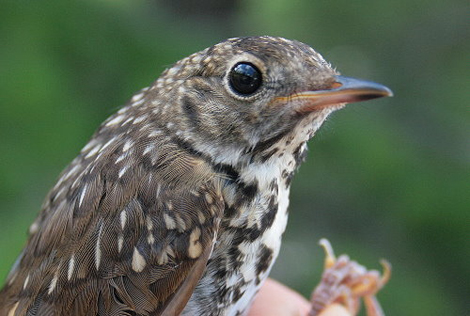
Hatch-year Hermit Thrush (Leckie)

Its territory must have been neatly tucked inside our station boundaries as two youngsters were captured on this day, indicating that an active nest was present. Oddly, this was the first juvenile thrush we have captured so far this season (not including robins), despite that a much higher number of thrushes occur at MABO. In fact, the overall proportion of youngsters sampled thus far at both stations has been quite low, which may reflect low productivity-perhaps due to cool and wet weather. We still have two visits to MABO and RRID left in 2009 so we will reserve judgment for later.

3743243368_bd916b5e60
Brother or sister HY Hermit Thrush (Leckie)

A second young Hermit Thrush captured in the same net on the following net check (All birds were later reunited).

3742452575_03aa3708f4
Hatch-year Black-and-white Warbler (Leckie)

Black-and-white Warblers were equally sampled as three were banded on July 20, which included two young birds and an adult. Together, Hermits and Black-and-whites comprised almost 50% of the birds captured at RRID on this day. Capture totals at RRID have been considerably lower than at MABO thus far. Our point count surveys in the region indicated that the density and diversity of breeding birds in mixed-forest and rock barren habitat is lower than deciduous woodland. Still, the RRID site was partially selected for its potential to sample a large dispersal in late summer, which has yet to happen. We are hopeful that the remaining visits will yield an increased capture rate of birds dispersing from surrounding areas.

3750822471_9db384a4ec
Spoon-leaved Sundew (Leckie)

Seabrooke was itching to check a nearby fen for carnivorous plants and wasn’t disappointed with what she found-plenty of Pitcher Plants and Spoon-leaved Sundews! The RRID site is positively teeming with biodiversity.

IMG_0310
Seabrooke nest checking by canoe (Derbyshire)

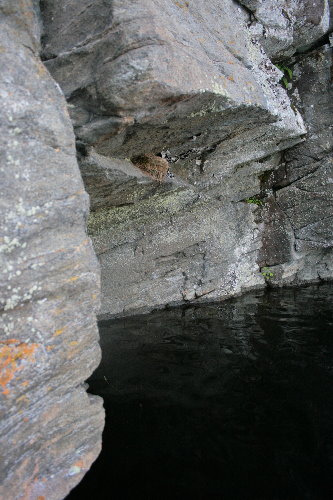
There is usually some time between net checks to sit and watch birds from “the balcony” seat at the banding station. During one of these sessions I spotted an Eastern Phoebe entering a small cut in the rock at the water’s edge on the opposite cliff. I suspected a nest was present given their repeat visits to the same spot and the frequency with which adult phoebes were observed catching moths and other insects over the water.

3742451919_e85d4acd2a
Eastern Phoebe nest

I ‘radioed’ to Seabrooke about these observations and she was able to confirm the presence of a nest with three young positioned on a ledge underneath the cut in the rock wall. This is the second nest of an Eastern Phoebe recorded in non-manmade structures this summer. Despite how quiet the banding can be at times, there is never a dull moment at Rock Ridge!

Rock Ridge Results-Visit 5 of 7

New birds banded (15 of 8 species)

American Redstart-1
Black-and-white Warbler-3
Red-eyed Vireo-1
American Robin-4
Yellow-billed Cuckoo-1
Field Sparrow-1
Hermit Thrush-3
Blue Jay-1

MAPS Visit 3-Rock Ridge

3668800446_1eb3dbbe3f
Broad-winged Hawk (S.Leckie)

Our third visit to Rock Ridge was a much busier affair than the last when just 9 birds were captured in six hours in mid June. We finished the morning with a total of 28 captures, the highest single-day tally we have had at this site so far. The variety of birds was also very good as fifteen species were handled during visit three. The highlight of the morning’s catch was this superb Broad-winged Hawk, which was in net #6 for little more than a few seconds as I pounced on it before it could get out. Birds of this size are rarely captured in our nets because the mesh is small, 30mm mesh to be exact, which is appropriate for most songbirds but not nearly large enough to hold a bird as big as a buteo for any length of time. This adult Broad-wing was spectacular up close and a rare treat as they are by no means a bird to be expected in a mistnet. The species is a local breeder in mature forests along with its relative the Red-shouldered Hawk.

IMG_0236
Song Sparrow

Song Sparrows are suddenly more plentiful. They are one of the most abundant songbirds in North America, inhabiting a wide array of habitats with a strong preference for open and edge environments. A pair has been nesting just below our banding station atop the cliff at Rock Ridge. Field Sparrow, Eastern Towhee, White-throated Sparrow and Chipping are all much more common than Song Sparrow at the site.

3667996415_d5d24d9734
Adult male Nashville Warbler (S.Leckie)

A pair of male and female Nashville Warblers were captured in a net close to a suspected nest site along the northwestern slope of the MAPS station.

3667996619_61c13dfe7e
Nashville Warbler Fledgling (S.Leckie)

This is likely the reason why they were suddenly captured-fledged young. This is a recently fledged juvenile Nashville Warbler that was captured in the following net round and in the same net as the parents. This youngster was completely oblivious to its circumstance being in the net and handled by a pair of humans. We quickly returned it to its parents after measurements and banding as it is still dependent on its parents for food.

IMG_0262
Bog habitat at net 8 favoured by Nashville Warblers
IMG_0260
Net lane #8
3667995209_7f8265f07a
Baltimore Oriole (S.Leckie)
3668800058_cc3546449d
Broad-winged Hawk (S.Leckie)
3668801916_0332227ef1
Take off (S.Leckie)
3667995583_d3b55b9434
Black-billed Cuckoo (S.Leckie)

Another fabulous visit to Rock Ridge, a member station of our young MAPS network in the FBS study area. Given all that was done in June, it feels as though the breeding season should be wrapping up soon but in fact, we are less than halfway through our season and thus a great deal is yet to come! A summary of results for MAPS visit 3 is provided below.

Rock Ridge Results-Visit 3 of 7

New birds banded (23 of 14 species)

Broad-winged Hawk-1
Nashville Warbler-3
Black-and-white Warbler-4
Yellow-rumped Warbler-1
Black-capped Chickadee-2
Red-breasted Nuthatch-1
Red-eyed Vireo-1
Song Sparrow-2
Baltimore Oriole-2
Rose-breasted Grosbeak-1
Great Crested Flycatcher-1
American Robin-1
Hairy Woodpecker-2
Black-billed Cuckoo-1

Recaptures (5 of 4 species)

Black-capped Chickadee-1
Black-and-white Warbler-1
American Robin-1
Eastern Towhee-2

MAPS Visit 3-Maplewood Bog

IMG_0137
Second-year male Scarlet Tanager

The mid-season “switch” was turned on at MABO this past week. We were plodding along at about 25 birds/morning during the first two visits in early to mid-June. This period of the breeding season is known as the adult “superperiod” when adult males and females tend to nests with eggs or young within defined territories. Capture rates tend to be a little lower at this time as there are few young in the area and just a sample of the adults are mistnetted. Young birds appear in numbers around mid-late June and suddenly the site is alive with adults either dispersing or establishing new territories in different spots. Visit three was a perfect example of this as a total of 45 birds were captured during the morning, which included the first wave of youngsters and many new adults banded including the striking Scarlet Tanager pictured above.

IMG_0123
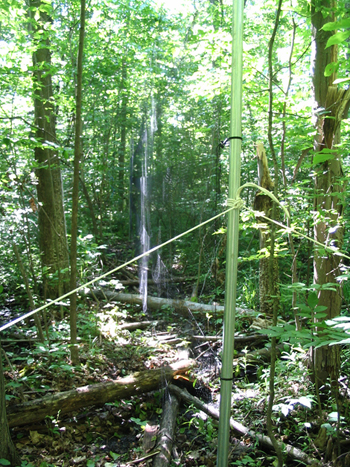
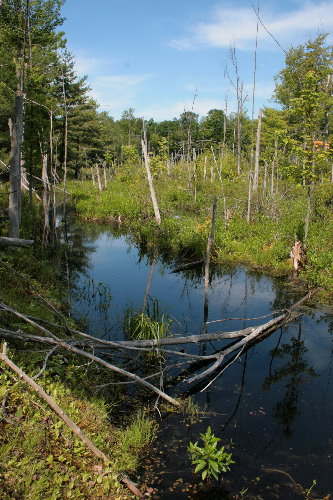
Habitat at Net #9 (aka waterthrush highway)

This is one of the net sites at Maplewood Bog MAPS station, net number nine of ten. Net nine is located in a wet shrubby clearing within mature deciduous forest. This wet area is actually part of a long and narrow band of flooded shrub habitat within the interior of the forest that connects two wetlands. Northern Waterthrushes seem to use this habitat feature as a sort of highway between territories and foraging areas. We have captured and recaptured a high number of individuals in this location. The photo was taken in late morning when light begins to scatter down to the forest floor but this net site is quite shaded for most of the morning.

IMG_0117
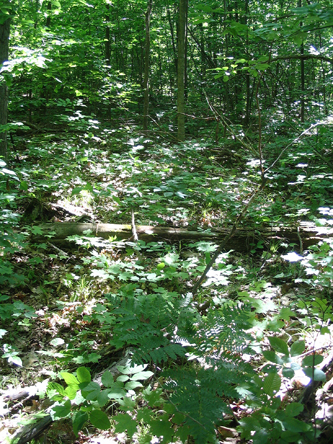
Forest floor at MABO

The vegetation on the forest floor indicates an uneven canopy closure where enough light passes down to sustain a fairly dense layer of ferns, tree saplings and other herbaceous plants. This type of deciduous forest is preferred by Wood Thrush, Veery and American Redstart among others. Too dense for Cerulean Warblers however, as the singing males recorded here in late May and early June must have opted to look elsewhere for more mature forest with primarily grass/forb understorey.

IMG_0118
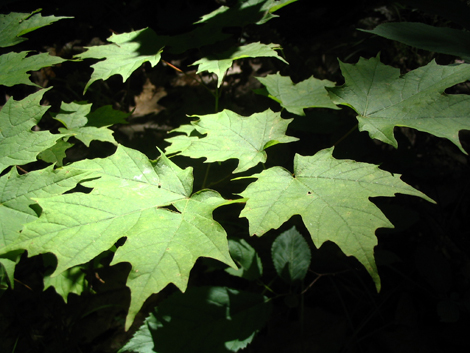
Maple saplings in the understorey
IMG_0088
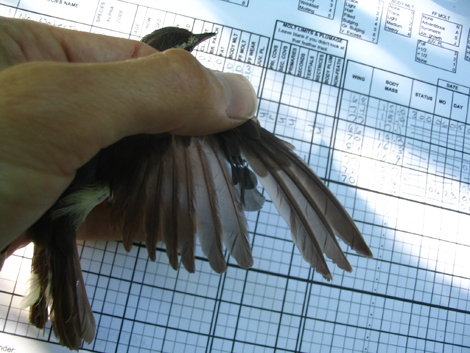
Female Northern Waterthrush starting to moult

We captured four waterthrushes, including this adult female in the early stages of a complete moult. The new primary feathers are coming through in the center of the wing, which are noticeably darker and crisper than the adjacent primaries and secondaries feathers from 11-12 months ago. This individual was sexed as female based on the appearance of a waning brood patch, indicating that this was likely an early nester somewhere in the area.

IMG_0108
Second-year male American Redstart

We also banded two new redstarts, including this second-year (SY) male that was captured simultaneously with an adult female in net ten. After-second year males have vivid orange and black plumage while the younger males, born last summer, have an unusually delayed plumage maturation for a warbler. SY males are distinguished from the females by the patchy black feathering around the eyes and bill.

IMG_0097
After-second year male Common Yellowthroat

Overall it was a terrific outing and the results certainly give great confidence that the site can yield viable indices of both productivity and survivorship rates for several commonly breeding forest birds of the area. We still have four visits remaining for the MABO site in 2009 as well as a thorough Habitat Structure Assessment of the 20 hectare plot. It is still a bit early to make a final call but I think we can stamp the station with a shiny gold star for its performance thus far. The experience of establishing this and the other two sites will be crucial to setting priorities for expansion of our MAPS network in 2010. Results from visit three to MABO are posted below.

[I should be back to nest profiles and other blog topics tomorrow as I have a ton of content that I want to share with our faithful readers]

Maplewood Bog Results-Visit 3 of 7

New birds banded (36 of 14 species)

American Redstart-2
Black-capped Chickadee-5
Black-and-white Warbler-1
Common Yellowthroat-2
Ovenbird-1
Northern Waterthrush-3
Red-eyed Vireo-1
Veery-4
Song Sparrow-6
Swamp Sparrow-1
Scarlet Tanager-1
Gray Catbird-4
Rose-breasted Grosbeak-1
American Robin-4

Recaptures (9 of 6 species)

Black-capped Chickadee-2
Ovenbird-2
Northern Waterthrush-1
Red-eyed Vireo-1
Veery-2
American Robin-1

MAPS Visit 2-Maplewood Bog

Male Yellow-rumped Warbler

This will have to be quick update on our MAPS progress as I will be up at 3am in the morning for the second visit to the Rock Ridge site in Frontenac Park. We visited Maplewood Bog (MABO) for the second time this season on June 14th. The weather was splendid and the fieldwork was even better as a total of twenty birds were captured, of which six were recaptures of birds banded during our first visit on June 6. The forest birds seemed a little quieter than last time but activity picked up as the sun rose and the heavy dew was burned off. Perhaps the most interesting of the captures was a pair of Yellow-rumped Warblers in net 2 at about 6am. There is quite a large contingent of Yellow-rumps breeding in a nearby pine forest but we hadn’t noticed any at the station until these two showed up in the nets. Both the male and female showed evidence of active breeding so they likely have or had a nest nearby.

IMG_9853
Early morning sun at the banding station

This is the location of our banding station for the duration of the morning. This spot is next to a long and narrow clearing next to the main bog. The clearing seems to be a key “highway” of sorts where lots of adult birds congregate. The three nets along the edge of the clearing should be quite productive later in the season when the juveniles and adults move to more open and successional habitats to forage.

3627390418_31fbc6f6c3
The largest bog at Maplewood

This is the largest of several bogs at the site, which all have complete rings or moats of deepish water along the perimeter and thick mats of sphagnum moss. Water Arum and irises have started to bloom along the water’s edge. It would be possible to walk on the moss if you could get past the moat but you would slowly sink and get very wet-very quickly (trust me on that one!). I suppose one could stay dry by skittering along really fast like a Western Grebe in courtship display but there wouldn’t be much point in doing such a thing:). The shrubs and stunted conifers in the middle of the blog always seem to have a large population of nesting birds but they are quite inaccessible to the terrestrial nest searcher/bander.

3626576621_1a562b818f
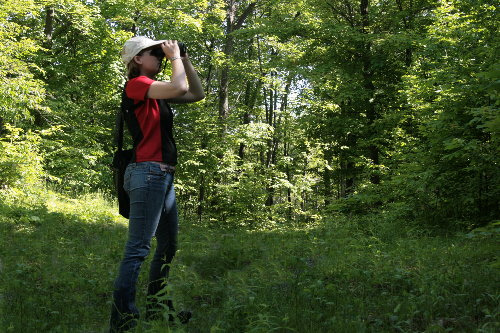
Seabrooke Leckie looking for breeding evidence

In addition to the six hours of mistnetting and banding, we also compile a daily breeding status code for each species recorded at the station. This information helps to weed out the actual breeders from transients and non-breeding residents. Seabrooke and I are often watching for adults carrying food or nest material and also keeping an eye out for recently fledged young.

3627388344_e22e2b2621
Veery nest now with five hungry chicks!

The Veery nest (detailed earlier here) is located in a small juniper near one of our net lanes, which has given us a convenient window into the world of a pair of Veerys raising a family. Our first capture of the morning was of an adult female with a caterpillar intended for one of these gaping maws. We later caught the male with another green caterpillar! It always amazes me how fast the eggs and chicks develop. Just nine days ago this nest contained five eggs and is now full to the brim with five chicks who already have their primaries coming through. Our next visit won’t be for another six to seven days, by which time these chicks will have fledged. These young Veerys, less than a week old, will begin a perilous southbound journey to central and southern Brazil in just a month or two from now.

A summary of results for our visit is provided below. Lights out…

Maplewood Bog- Visit 2 of 7

Banding Results

Yellow-rumped Warbler-2
Black-capped Chickadee-1
Veery-4
Rose-breasted Grosbeak-2
Gray Catbird-2
Yellow-bellied Sapsucker-2
American Robin-1

Recaptures

Ovenbird-1
Northern Waterthrush-2
American Redstart-1
Veery-2

Notable Observations

Chestnut-sided Warbler
Wood Thrush (nest found)
Ovenbird (nest found)
Yellow-billed Cuckoo
Yellow-throated Vireo
Red-shouldered Hawk