MAPS Visit 3 – Blue Lakes

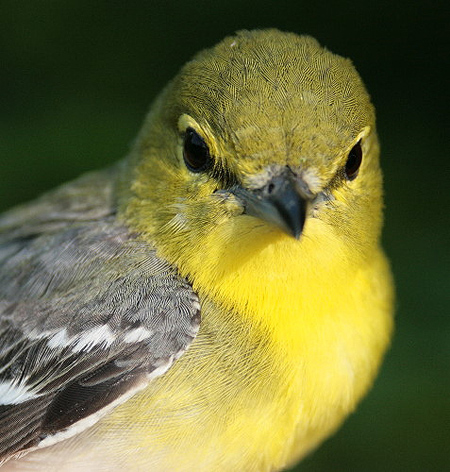
Yellow-throated Vireo (Seabrooke Leckie)

Visit three to Blue Lakes happened late last week. A definite highlight of the day was the capture of three adult Yellow-throated Vireos (2 new and 1 recap) and the discovery of a nest with young in the crown of a large Red Oak near net 1! We’ve banded the male and female tending the nest but also captured a new gravid female (carrying egg) in net 1 around mid-morning. We suspected at least a couple of pairs were in the area but the appearance of a gravid female so close to the nest of another pair seems rather curious. Very cool to have this species around and in numbers too!
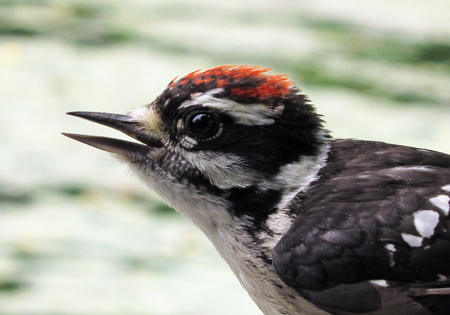
Juv Downy Woodpecker (Derbyshire)

The morning’s work went smoothly and a steady trickle of birds were handled over the six hours. Despite that multiple territories of Black-throated Blue Warblers are present within the station boundaries, we have only managed to band and recapture the one male and female individual. We are starting to wonder if the other singing males are unpaired.

We’ve now completed nine visits to all three stations combined and are not even halfway through the season! The remaining visits to each station will be interesting as adults move or reestablish territories and this season’s crop of young birds begin to disperse. The month of June was extremely wet and it remains to be seen how this has affected nest success for landbirds in Frontenac County and beyond….

Blue Lakes – Visit 3 of 7

New birds banded (18 of 12 species)

.
Field Sparrow – 1
Red-eyed Vireo – 1
Ovenbird – 1
Swamp Sparrow – 1
Yellow-throated Vireo – 2
Veery – 1
Downy Woodpecker – 2
Song Sparrow – 1
Rose-breasted Grosbeak – 3
American Robin – 2
Blue Jay – 1
Common Grackle – 2

Recaptures (6 of 5 species)
.
Black-throated Blue Warbler – 2
Yellow-throated Vireo – 1
Yellow-bellied Sapsucker – 1
Downy Woodpecker – 1
Ovenbird – 1
MAPS Visit 2 – Rock Ridge (2010)

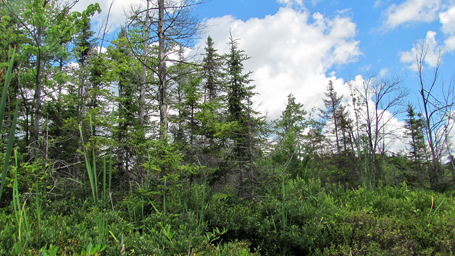
Spruce Bog at RRID

After a quiet first visit on June 11th, the Rock Ridge station returned to form on June 20th as 23 birds were captured during the morning. We thought last summer was unusually wet but this season has been even more drenched with rain seeming to fall consistently on a semi-daily basis. Fortunately, we have completed all of our visits within the intended periods but only by a thin margin and with thanks to a bit of luck. The photos accompanying this update are all landscapes as Seabrooke had a Canon malfunction, which erased all of the avian portraits from the day. This week, on our way in and out of the station, we paddled past this bog/fen habitat with Black Spruce, Tamarack, Sundew and Pitcher Plants. Common Yellowthroat, Wilson’s Snipe, Swamp Sparrow and Red-winged Blackbird are a few of the species nesting within the wetland complex below the steep cliffsides of the site.

The morning started off slow with an eery dawn silence and nothing captured on the first net check. For a second I considered that winter survivorship may have been particularly poor for our resident breeders but this was instantly erased with a net round at 730am when fourteen birds were extracted – nine coming from a single net! We were also pleased to finally recapture some birds banded in 2009, three in all. The full summary of the birds captured is provided below. The list represents a good sample of the breeding birds present at the station with some notable exceptions. Scarlet Tanager, Pine Warbler, Purple Finch and Myrtle Warbler are also common but tend to stick to the high tops of conifers that line both sides of the gorge, making them difficult to catch for banding. These species will move down with fledged young in search for better feeding areas so hopefully we will band a few before the season wraps in early August.

Mixed forest along the ridge

Rock Ridge – Visit 2 of 7

New birds banded (20 of 11 species)
.
Field Sparrow – 2
Black-capped Chickadee – 6
Red-eyed Vireo – 2
Hermit Thrush – 1
White-throated Sparrow – 1
Red-breasted Nuthatch – 1
Common Yellowthroat – 1
Chipping Sparrow – 1
Eastern Towhee – 2
American Robin – 2
Common Grackle – 1

Recaptures (3 of 2 species)
.
Black-and-white Warbler – 1
Black-capped Chickadee – 2

MAPS Visit 2 – Blue Lakes & Maplewood

Yellow-bellied Sapsucker

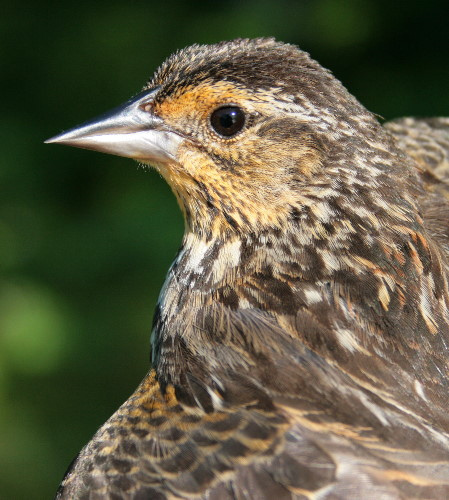
I’ve decided to summarize recent outings to BLAK and MABO in a single post because I’ve fallen behind on a large backlog of other material to touch on soon. Last week we visited the Blue Lakes MAPS site for the second time and had a very good morning. The weather was a highlight in that it wasn’t cloudy or threatening with rain – novel of late. We also captured a nice selection of birds including another Black-throated Blue Warbler (female with brood patch) and five Rose-breasted Grosbeaks, among others. A female Red-winged Blackbird was banded during the morning, which was a first for the FBS MAPS network!

Finally, while driving out at the end of the day we were stopped by the police, who had been lying in wait for us at the end of the road. Apparently, there was some concern that we may have been marijuana growers! That’s another first for FBS….

We will be returning to Blue Lakes by June 29, 2010. Full stats for visit 2 are summarized below the agelaius.

Female Red-winged Blackbird

.

Blue Lakes – Visit 2 of 7

New birds banded (15 of 8 species)

Black-throated Blue Warbler – 1
Ovenbird – 1
Veery – 1
Rose-breasted Grosbeak – 5
Yellow-bellied Sapsucker – 1
Red-winged Blackbird – 1
American Robin – 4
Common Grackle – 1

Recaptures (4 of 2 species)

Black-throated Blue Warbler – 1
Veery – 3

.

Northern Waterthrush (Seabrooke Leckie)

Our first visit to Maplewood Bog in 2010 was a little bit unpleasant due to the wet and ominous weather we endured. We were pleased to give MABO a proper go for visit 2 with clear, warm and dry conditions. The birds were much more active, although Seabrooke and I agree that breeding density seems lower for most species this year. This isn’t too surprising as our 2009 results suggested low productivity for last summer and numbers were way down at most migration monitoring stations this past spring. Visit 2 was all about the Red-eyed Vireo! A total of seven were captured, which included several returns from 2009. We also recaptured two Northern Waterthrushes, which have successfully returned to MABO from their winter haunts in either the Caribbean or Central America.

In all, 28 birds were captured during the six hours of operation. Without question, Maplewood still reigns as the “birdiest” of our MAPS sites….

Full stats for this visit to MABO are provided below Seabrooke’s stunning portrait of a female Eastern Towhee.

Eastern Towhee (Seabrooke Leckie)

.

Maplewood Bog – Visit 2 of 7

New birds banded (17 of 12 species)

Black-capped Chickadee – 1
Ovenbird – 1
Red-eyed Vireo – 2
Song Sparrow – 1
Veery -1
Gray Catbird – 2
Rose-breasted Grosbeak – 1
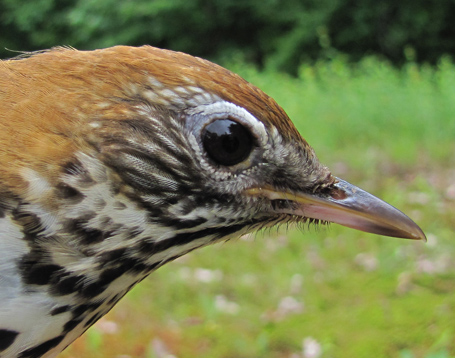
Wood Thrush – 1
Eastern Towhee – 2
American Robin – 3
Hairy Woodpecker – 1
Blue Jay – 1

Recaptures (11 of 6 species)

Black-capped Chickadee – 1
Red-eyed Vireo – 5
Gray Catbird – 1
Rose-breasted Grosbeak – 1
Blue Jay – 1
Northern Waterthrush – 2

MAPS Visit 1 – Rock Ridge (2010)

Black-and-white Warbler (S.Leckie)

The final of our first round of MAPS visits was to the Rock Ridge station in Frontenac Provincial Park last week. Rock Ridge is unique in many ways. It is located atop a steep sided gorge, which offers stellar views of the surrounding landscape dominated by Eastern White Pine. The bird community is representative of the coniferous tree cover as well as the scrubby, exposed rock barrens of the area. During our first visit in 2009 we were greeted with a good number and variety of birds – 23 captured of 14 species. Our first morning this year was a much slower affair as just 10 birds were banded in six hours and there were no recaptures of birds banded in 2009. We did band two female Black-and-white Warblers, both of which had heavily vascular brood patches, which suggested they were presently incubating.

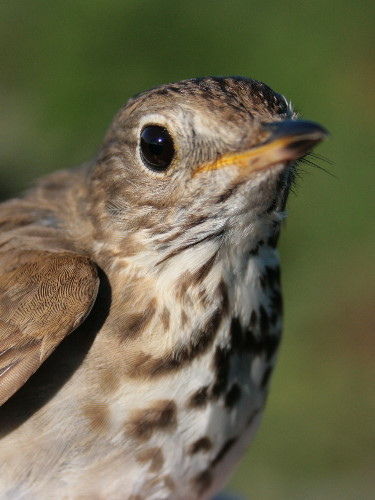
Hermit Thrush (Leckie)

This spring has been an early one and the vegetation is much further advanced than it was last year at this time. Also, many of the species at RRID are earlier migrants from temperate wintering grounds and so it is possible that the timing of our first visit in 2010 coincided with the period when most females are incubating and thus activity/movement is low. We may have encountered this on visit two in 2009 when, once again, only ten birds were captured! This is a good learning experience for us as it now makes sense to sync our first visits in time with the season rather than a specific date.

White-throated Sparrow (Derbyshire)

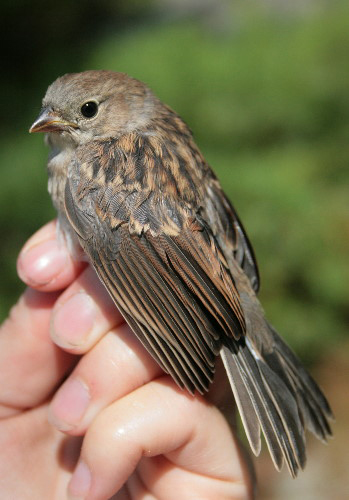
So the morning was unexpectedly quiet but it was even more surprising that no birds banded in 2009 were recaptured; all of the birds shown here represent new captures. Another sign of the advanced spring was the observation and/or capture of recently fledged Field Sparrow, Song Sparrow and Blue Jay. We didn’t start seeing young birds until visit two and three in 2009. Seabrooke got two juv Field Sparrows out of net 5 on one of her fruitful net rounds (see below for a pic).

Juv. Field Sparrow (Leckie)

It is safe to say that I am completely enamored with this place. It is highly diverse, always has the unexpected and is undeniably remarkable. We will be operating the Rock Ridge MAPS station through at least 2013 but hopefully through 2019 – we’ve only just begun…

.

Rock Ridge – Visit 1 of 7

New birds banded (10 of 7 species)
.
Field Sparrow – 2
Black-and-white Warbler – 2
Red-eyed Vireo – 2
Hermit Thrush – 1
White-throated Sparrow – 1
Rose-breasted Grosbeak – 1
Blue Jay – 1

Recaptures (none!)

MAPS Visit 1 – Maplewood Bog (2010)

Wood Thrush recaptured (banded on July 25, 2009)

The inclemency of late has made scheduling our first round of MAPS visits a challenge. Our first morning at Maplewood Bog (MABO) in 2010 began with some trepidation over the forecast of 40% chance of showers. It wasn’t raining when we arrived but the vegetation was dripping wet, which made net setup feel like a 5 a.m swim through the woods and meadows. There were only a few brief periods of drizzle during the morning until the final round when a torrential downpour occurred. We were able to get a full six hours of coverage but the final round was more than a little uncomfortable!

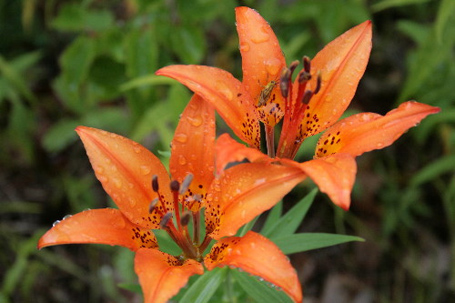
Wood Lily - Lilium philadelphicum (Seabrooke Leckie)

Fortunately, despite the weather, the birds were numerous and active. The highlight of the morning was the recapture of eight birds banded last summer at the site, which included three Veery and two Wood Thrush. These two are dominant species at MABO and both migrate to and from Latin America on an annual basis. The Veerys that we recaptured on this day may winter as far south as the Amazon basin, some 7,000 km south of MABO! This is one of the great marvels and joys of participating in the MAPS program, it vividly connects you to the remarkable life cycles of individual birds and bird communities. For example, we know this Veery (2431-64408) was an ASY male on June 14, 2009 with a wing length of 101mm and a weight of 30.8g. We also knew the age and wear of its feather tracts, breeding condition, its territory location and the onset of its prebasic moult. We re-caught this word traveler on June 10, 2010. He was found in the same net as last year and is likely paired with 2431-64405 – a female that we suspect reared these young with a different male in June, 2009!

Bog in the wet woods (Seabrooke Leckie)

We were too drenched and busy to take many photos of birds during the visit but we did capture a respectable 21 birds of 12 species. Cerulean Warbler and Black-throated Blue Warbler were notables detected but not captured. A full summary of the capture results is presented below.

Maplewood Bog – Visit 1 of 7

New birds banded (13 of 11 species)
.
Common Yellowthroat – 2
Ovenbird – 1
Swamp Sparrow – 2
Rose-breasted Grosbeak – 1
Great Crested Flycatcher – 1
Yellow-bellied Sapsucker – 1
American Robin – 1
Northern Waterthrush- 1
Red-eyed Vireo – 1
Veery – 1
Gray Catbird – 1

Recaptures (8 of 4 species)

Common Yellowthroat – 2
Wood Thrush – 2
Veery – 3
Red-eyed Vireo – 1