the Nest Files – Common Nighthawk

IMG_9621
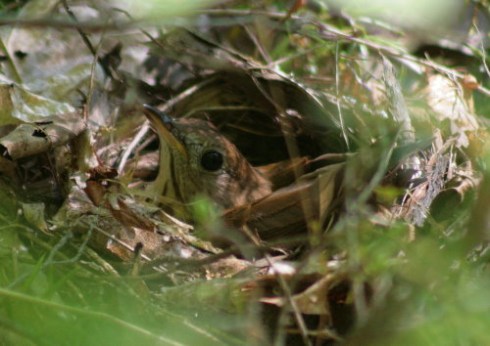
Common Nighthawk nest contents

j

Although arguably the most studied nightjar in North America, the Common Nighthawk remains poorly known (Poulin et.al. 1996).

h

Species Abstract
Common Nighthawk (Chordeiles minor)

Habitat=primarily nests in open habitats such as rock barrens (also gravel roofs in urban areas)
Area sensitive=?
Average clutch size=2
Nest building period=0 (no nest built)
Incubation period=19 days
Microhabitat=on ground on substrates of either rock, sand, gravel, lichens etc.
Egg colour=variable; creamy white to pale olive gray, heavily speckled with greys, browns and blacks.
Nest site selection=female
Incubation=primarily female
Parasitized by cowbirds=no
k

This Common Nighthawk nest was first discovered at our Rock Ridge MAPS site on June 2, 2009. The female was inadvertently flushed from the nest when traversing one of the countless rocky flats at the site. Incidentally, a Whip-poor-will nest was also discovered on this day, less than 1km from the nighthawk nest. There won’t be many days of nest searching where that happens! Both of these species of the nightjar family have been much in the news of late because of their concurrent and precipitous decline in populations. Common Nighthawk was officially designated as a Species at Risk by COSEWIC in 2007 (Threatened) while Whip-poor-will was just recently recommended for listing in April of this year (Threatened). Nightjars are most active at dawn and dusk and are uniquely adapted to a food source of flying insects such as moths. It is suggested that the presence of a tapeta lucidum, a reflective structure of the choroid part of the eye, aids their vision during low light levels (Nicol and Arnott 1974). Relatively little is known about the breeding ecology and population dynamics of these two species, both of which commonly breed in the Frontenac Arch region of Ontario. Project Whip-poor-will will be starting up soon and will be designed to survey all nightjar populations in the FBS study area.

g

The photo of the “nest” above is typical for Common Nighthawks where the eggs, usually two in a full clutch, are laid directly on the ground without any addition of materials or linings. They will sometime excavate a small scrape to contain the clutch but this activity seems to be determined by the habitat in which they choose to nest. The habitat for nesting nighthawks is quite variable, ranging from gravel rooftops in urban locations to a variety of open habitats adjacent to forests. They frequently inhabit rock barrens as in this particular case but will also nest in recently burned or clearcut forests as well as agricultural fields and grasslands throughout the continent.

g


g
This short video clip was recorded of a defensive adult just after it was flushed off the nest. The Birds of North American account for the species describes defensive behaviour by both sexes as follows:

Male does not directly guard the nest (Dexter 1952) but may dive and boom over nest sites (Rust 1947); in addition, male may defend nest by wing-beating and hissing with mouth wide open (Dexter 1952). Female may use injury-feigning behaviour (fly away, then hiss at intruder) when flushed from eggs or young (Tomkins 1942).

j
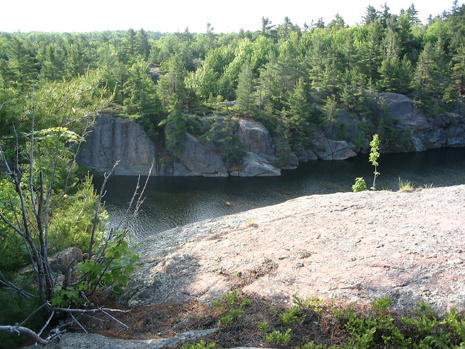
I spent no more than three minutes in the vicinity of the nest as I didn’t want to cause any excess amount of distress to the adult tending the eggs. I have a precise fix on its location and will be able to check on its progress at a distance from now on. The photos below provide a longer perspective on the nest site in terms of habitat. I have flushed several of both Common Nighthawk and Whip-poor-will in the area of our Rock Ridge MAPS station since the initial discovery of this nest but have not yet turned up any additional nest sites. The park has a large amount of suitable habitat for Common Nighthawks, perhaps about 1200 hectares worth, which suggests that the species might be common throughout rock barren areas. I will be traveling through much of the barrens starting next week for point count surveys and hope to encounter more of these fascinating birds.
j

IMG_9616
Nest site on rocky slope
IMG_9628
nesting habitat

Point counting begins in Frontenac Park

IMG_9646

The Point Count is a standard method for gathering data on the relative abundance of breeding birds. This method typically involves a 3, 5 or 10 minute count of all birds detected from a fixed position and is conducted year-after-year from the exact same spot. Annual replicates of point count surveys enable the calculation of population trends and can also infer correlations of temporal changes in relative abundance to specific habitats and many other parameters dictated by survey design. For the Frontenac Breeding Birds project, we will be completing 80 off-road point count stations within Frontenac Provincial Park as well as 120 roadside counts along secondary and tertiary road systems in the study area. This is a big undertaking but will provide a sound baseline assessment of the avian communities in the area. At least for now our point counts will be focused on terrestrial habitats, primarily of the forested kind.

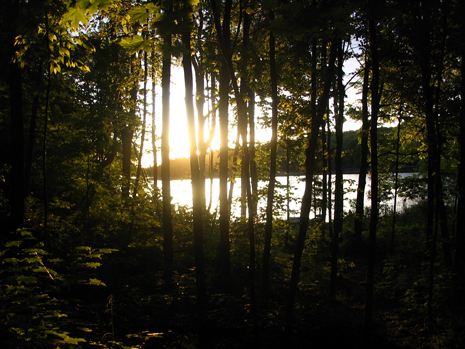
I emerged from the house at dawn on June 8th to begin the first morning of point counts in mature deciduous forest habitat in the park. I heard a Winter Wren singing mightily from the opposite shore of our dock and wondered if I might have a chance to investigate later in the day after the surveys were done. I was about to enter some of the oldest forests in the region and didn’t have any time for dawdling so I carried on to the first station after a short boat trip across Kingsford Lake.

IMG_9653

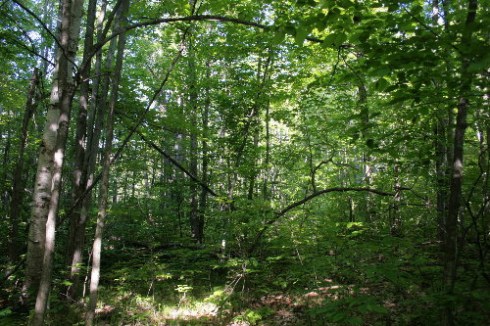
These forests are quite diverse with tree species but the main representatives are Red and White Oak, White Ash and Sugar Maple. The light diffusing through the canopy was quite spectacular and I was pleased to write down a singing male Cerulean Warbler at MH1, the first station of the day! Ceruleans are quintessential canopy dwellers, rarely descending to heights that would afford even a decent glimpse, although they do occur in less mature forests at Queen’s Biological Station.

IMG_9699

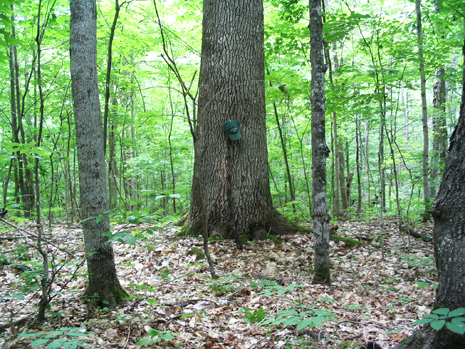
This is one of the grandparent trees in the forest, easily a century old White Ash that pierced through the upper canopy. My jets hat was used to give a better sense of scale of this monster!

IMG_9712

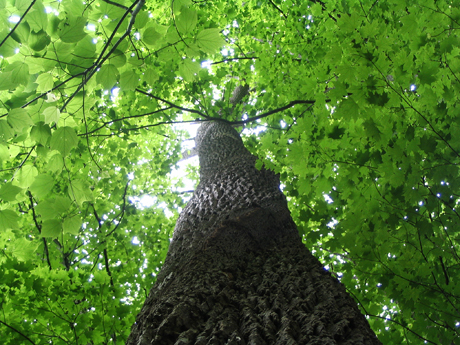
This is a view straight up to the canopy along the trunk of the ash and the Ceruleans like to hang out up near the top somewhere. Fortunately, I’ve been finding that their buzzy songs carry a decent distance through the forest and they are frequent songsters, even well into mid-afternoon.

IMG_9673

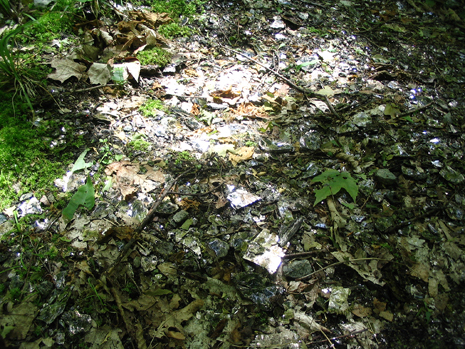
This particular point count route was about 4 kilometres long in total with twelve stations spaced evenly by 330 metres. The route carried me nearly the full length of Kingsford Lake to the north end of the park and Devil Lake. There was much more than just birds to look at during the trip including this abandoned mica mine, which was established in 1844 and terminated in 1949. The mine shaft was fenced off and all that remained of the operation were piles of mica shards and a heap of old equipment and furniture as seen in the photo below.  Mica is abundant in the area, glowing in the soil and exposed rock on sunny days.

IMG_9676

IMG_9685

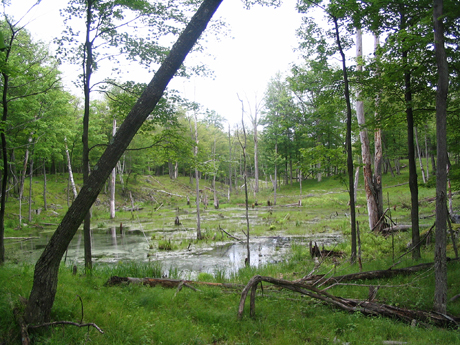
The undulating landscape of ridges and valleys is a hallmark of the Frontenac Arch where the Canadian Shield rears up dramatically at its furthest position south. The valleys often contain ephemeral pools and wetlands, which create ideal growing conditions for these ferns that were over a metre and a half tall. Northern Waterthrushes thrive in these areas of the park.

IMG_9776

Back to the birds. After completing the first route through mature forest on the 8th, today I finished up the first of three routes to be conducted in younger hardwood forest of the park. An obvious highlight of the two survey routes was the abundance of Cerulean Warblers detected. This little wet clearing in a relatively young hardwood stand contained three males that sang from the confines of their respective territories at the edge of the clearing.

IMG_9832

This is a photo of one of my survey forms from this morning, which records no less than three counter-singing Cerulean Warblers! The inner circle has a 50 metre radius and the outer extends from 50-75 metres. This grid is used to keep track of who is where while you are working as it can become quite confusing when there are a lot of birds in your immediate area. The hashmarked lines connecting CERW and SOSP indicate countersinging birds, which helps to confirm that individuals aren’t being double-counted. Birds with small dots were detected in the first three minutes and those with stars and triangles were recorded between 3-5 and 5-10 respectively. There were twelve species within 75 metres at this particular station, including a Yellow-billed Cuckoo (YBCU) and a Scarlet Tanager (SCTA) among the Ceruleans (CERW), American Redstarts (AMRE) and Red-eyed Vireos (REVI). Also present were Northern Flicker (NOFL), American Robin (AMRO), Song Sparrow (SOSP), Great Crested Flycatcher (GCFL), Chipping Sparrow (CHSP) and White-breasted Nuthatch (WBNU).

The first day of point counts finished off nicely with a Louisiana Waterthrush near Crab Lake at the last count and in the last minute! In all a total of 14 Cerulean Warblers were detected along the route through mature deciduous forest. Another 15 were recorded this morning in younger hardwood forests near Birch Lake to the south of Kingsford for a total of 29 singing males in two mornings of point count surveys in Frontenac Provincial Park! The 24 surveys completed so far are at best a slice of what is there and I still have two more routes of twelve counts each in the younger hardwood forests.

IMG_9751

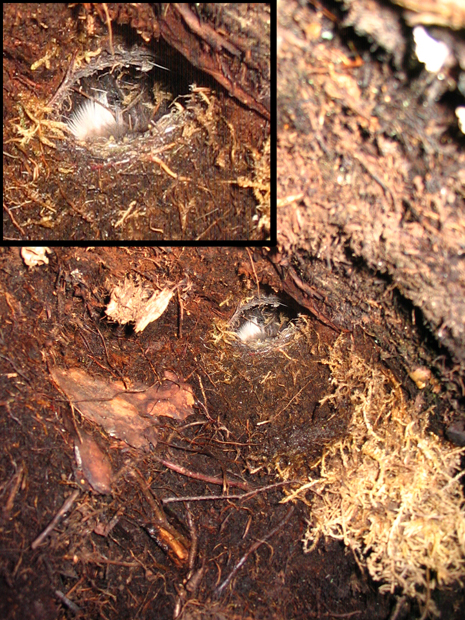
Lastly, after walking back the four kilometres from Crab Lake on Monday, I checked in on that singing Winter Wren I’d heard singing about seven hours before. After about 60 minutes of quietly watching the male and female in their territory, I was able to locate their nest underneath this mossy old stump. It was pitch black under there and I had to basically lie down in the swamp with my flashlight and pocket mirror to find what is effectively a hidden hole in the ceiling of the stump about the size of a two dollar coin! The nest contains three very small chicks and with any luck you will notice the tips of their bills in the photo below.

IMG_9740

MAPS Visit 1-Rock Ridge (RRID)

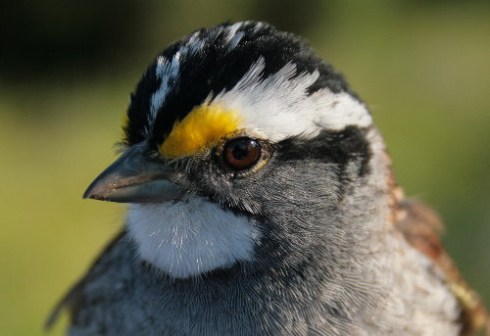
White-throated Sparrow (S.Leckie)

Round one of seven visits to all three MAPS was wrapped up on Saturday, June 6 with our first visit to the Rock Ridge MAPS site in Frontenac Provincial Park. Ontario Parks, particularly the staff at Frontenac, have been of great assistance to FBS getting established. Frontenac Provincial Park, a backcountry wilderness park with over 5000 hectares of incredibly diverse habitats is literally at the core of the Frontenac Breeding Birds program. In addition to the operation of Rock Ridge, we have also started conducting point counts and nest monitoring throughout the park, which will provide a rigorous baseline assessment of breeding bird abundance, species richness, distribution and habitat relationships. A big thanks are due to the following Ontario Parks staff for permitting us to run our project and for assisting in the development of the FBS initiative-Peter Dawson (park superintendant), Bert Korporral, Corina Brdar and Chris Robinson.

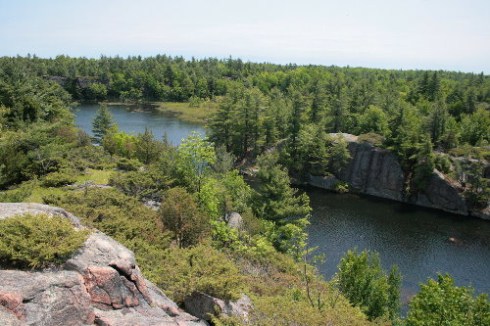
Our Rock Ridge Monitoring Avian Productivity and Survivorship (MAPS) site feels, in many ways, like a world apart. The site is as unique as it is beautiful with extensive rock barrens and outcrops that tumble down over steep cliffs into deep clear lakes that shimmer aqua-green in the sun. The steep and rugged cliffs are home to Yellow-rumped Warblers, Pine Warblers, Purple Finches, Northern Rough-winged Swallows and Turkey Vultures to name a few. Frontenac Provincial Park underwent a series of burns about 80 years ago or so. At least one fire that the military had to be called in to put out was started by settlers in a dispute over rights to berry picking territory (blueberries and cranberries)! The human history of Frontenac Provincial Park, while rich and fascinating,  has also played a key role in shaping what is there today. The burns of the 30’s have resulted in a large swath of what is best described as rock barren habitat with stunted and slow growing plant communities. This is a fascinating habitat and a clear favourite of Field Sparrows, Eastern Towhees and a few specialists of the region (more on that later this week).

Rock Ridge site (northeast cliffs)

The photo above was taken near the banding station during a brief sunny period on our visit. The view takes us over steep cliffs of conifers across to wetlands that include a small Black Spruce bog. The MAPS site also includes some more mature mixed-forest along the northwestern side. The White-throated Sparrow such as the one pictured above are one of the most abundant species at the station and their distinctive voices filled the air from all directions during our visit.

View from the banding station

Access to Rock Ridge is at best an ordeal of mental and physical stamina! Waking up at 3am never gets easy and then to undertake a 30 minute drive followed by a 30 minute portage and 20 minute paddle….you get the picture. However, Rock Ridge is worth it. This is the view from the banding station where all of the captured birds during the six hours of mistnetting are processed (banded, measured, aged, sexed and released). There is just something of the untouched about the place that makes it all worthwhile and the birds are terrific as well. Actually, I had an hour or two of panic when we had caught a promising four birds on the first net check, which was followed by three consecutive rounds of absolutely nothing. Fortunately, a total of fifteen birds were captured during the following three net checks!

Eastern Kingbird (D.Derbyshire)

Speaking of birds, we ended the day having banded a total of 23 birds and 2 repeat captures for a total of 25. The most common of the lot were American Robins (4) followed by Red-eyed Vireo (3) and White-throated Sparrow (3). Nashville Warbler, Yellow-rumped Warbler, Scarlet Tanager and Purple Finch are also quite numerous at the site but all evaded our nets on the first day. There were also a few “singles of things” such as this second-calender year female Eastern Kingbird.

Black-and-white Warbler (Leckie)

Black-and-white Warblers occur in significant numbers at all three MAPS stations. We managed to catch this sharp male from one of our “scrub” nets that is far from appropriate habitat for this species. They tend to be most common along the more maturely wooded slopes but they do seem to occur in some rather open and stunted habitats as well.

Black-billed Cuckoo (Leckie)

Cuckoos, both Black-billed and Yellow-billed are also found at all three MAPS sites. We captured this Black-billed and narrowly missed another in net 10 around late morning (they are a bit on the large side for 30mm mesh nets and tend to flop out when approached). The incredible abundance of forest tent caterpillars this year may produce a bumper crop of juv cuckoos in 2009!

Cedar Waxwing (Leckie)

Cedar Waxwings are late nesters and tend not to get down to business until late June-early July in Ontario. Wheeling flocks of Cedar Waxwings have been observed on a regular basis at our MAPS sites but this is the first of the species that we’ve caught. Seabrooke must have enjoyed the light of Rock Ridge as these bird portraits are particularly strong. Seabrooke has been a huge help to the operation of these MAPS stations as I’m doubtful that this could have been pulled off on my own. Look for her account of Rock Ridge on her marvelous blog later today!

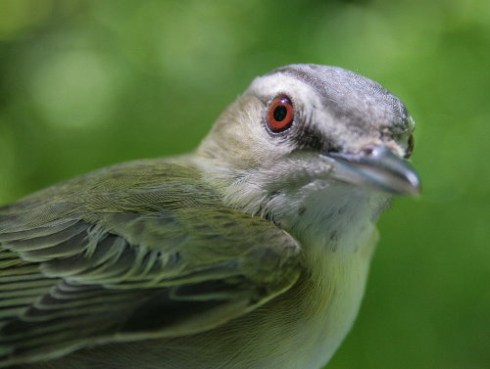
Red-eyed Vireo (Derbyshire)

In the end, our first visit to Rock Ridge was a productive one as we experienced no major incidents in accessing the site and the sample of breeding birds was very strong. I have a feeling that, more so than the other sites, the composition of species in our sample will change most sharply for Rock Ridge as the canopy birds descend and the site funnels a high number of late summer dispersing adults and young. That’s just my hunch…..

Rock Ridge- Visit 1 of 7

Banding Results

Black-capped Chickadee-2
Chipping Sparrow-1
Black-and-white Warbler-1
Red-eyed Vireo-3
White-throated Sparrow-3
Cedar Waxwing-2
Eastern Kingbird-1
Brown-headed Cowbird-1
Eastern Towhee-1
Rose-breasted Grosbeak-1
Black-billed Cuckoo-1
American Robin-4
Hairy Woodpecker-1
Blue Jay-1

Notable Observations

Common Loon
Pied-billed Grebe
Osprey
Common Nighthawk
Ruby-throated Hummingbird
Pileated Woodpecker
Common Raven
Purple Martin
Hermit Thrush
Swamp Sparrow
Indigo Bunting

the Nest Files – Veery

Veery Nest
Veery Nest

Species Abstract
Veery (Catharus fuscescens)

Habitat=Deciduous forest
Area sensitive=yes
Average clutch size=4
Nest building period=6 days
Incubation period=10-14 days
Microhabitat=ground or slightly elevated in shrub/tree
Nest builder=female
Incubation=female
Parasitized by cowbirds=yes

This is the first edition of what will be an ongoing series of nest profiles for breeding bird species of the Frontenac Arch. Searching out and monitoring active nests has always been an important component of ornithology and is also a significant source of data for understanding and tracking changes in demographics and ecology of breeding avifauna all over the world. As part of the Frontenac Breeding Birds program we will be actively searching for nests in select areas to yield valuable information on habitat associations, nest success/failure rates and predation/parasitism rates to name a few. These demographic data combined with vital rate statistics drawn from our three Monitoring Avian Productivity and Survivorship stations will be utilized in concert with standardized population estimates (point counts) to form an integrated approach to avian monitoring.

This Veery nest was discovered on June 6, 2009 at our Maplewood Bog MAPS site. The Veery is one of five members of the Catharus genus of thrushes, which inhabit forests across much of North America. The Veery prefers damp, deciduous forests and tend to favour more successional habitats than the other “spot breasted” thrushes. Nests are built entirely by females in mid-May to early June and are built on or near the ground in 6-10 days (Forbush 1927). This particular nest was found about 8 inches above the ground in the centre of a small juniper in a deciduous woodland clearing. Eggs are laid 4 days after nest completion and the average clutch size is 4 eggs. The female builds the nest alone and incubates the clutch while the male guards the territory until the eggs hatch after 10-14 days after laying. The Brown-headed Cowbird parasitized 19% of nests recorded in Ontario (n=368), making the Veery a sensitive species to habitat fragmentation (Peck and James 1987).

IMG_9585
Veery nest site

I was a bit surprised to find this particular nest in such an “open” spot with full sun shining on the nest and the back of the incubating female. Junipers are definitely a key plant for ground nesting birds in this region as the dense evergreen foliage provides an excellent concealer.

3602404956_faec643147
Female Veery Incubating (S.Leckie)

This incubating female sat very tight to the nest for most of the morning and was only flushed when approached to within 1ft. Luckily, Seabrooke, with camera at hand, was nearby and was able to get a couple of shots of the female tending to the clutch. I was very pleased to find our first Veery nest for Frontenac Bird Studies, as the species’ nest is notoriously difficult to find. We will be on the lookout for more and will also look for nests of its relatives-the Hermit and the Wood Thrush in the coming weeks.

3601590295_3434b00fe8
Veery closeup

MAPS Visit 1-Maplewood Bog

Red-eyed Vireo (S.Leckie)

On Friday, June 5 we successfully completed our first session of fieldwork at our Maplewood Bog MAPS station, which is located on crown lands north of Frontenac Provincial Park. Once again I was joined by Seabrooke Leckie, FBS research assistant and director of photography. Seabrooke and I left the station around noon with a very positive impression of MABO for its abundance of breeding birds and rich habitat. Less enjoyable were the Deer Flies, which were rather relentless but we were armed with some defense for their attacks. The site is more easily accessible than Hemlock lake, which was appreciated and is distinctly more deciduous in forest type than the other stations. The first sound we heard after parking the vehicle was that of a Whip-poor-will singing with remarkable gusto from the edge of a nearby bog within the station boundaries.

3602406400_9e6e74a0d3
Oak-Maple forest near net #8 (Leckie)

The name Maplewood Bog is our name for the site and was chosen based on this forest structure, which is dominant in the area. The forest consists primarily of maple and oak sp. with lesser quantities of ironwood, american beech, hop-hornbeam, shagbark hickory, basswood and eastern white pine. The forest is of a mixed age with scattered mature growth and an uneven canopy closure, which is well suited to the habitat requirements of Cerulean Warbler. There is at least one Cerulean Warbler, which sang tantalizingly close to net #10 for much of the morning. Red-eyed Vireo, Yellow-throated Vireo and Scarlet Tanager also occupy upper levels of the forest while Veery and Northern Waterthrush are abundant in the understory. An important feature of the site for our research interests is the abundance of natural clearings and wetlands distributed throughout the forest, where birds congregate to bathe and forage and disperse with their young.

3602407168_ce04b86763
Bog wetland near net #3 (Leckie)

The mistnets used to capture the resident breeding birds for banding and study are positioned in a circular fashion around an area of about 7 hectares. The standardized route for checking the nets travels the edges of three bogs containing spongy mats of sphagnum moss. These bogs also feature a dense perimeter of shrubs where American Redstarts and Northern Waterthrushes are nesting. Swamp Sparrow, Wilson’s Snipe, Yellow Warblers and Common Yellowthroats are also found in these habitats.

3601591225_798e0ee3c8
Upland scrub near net #5 (Leckie)

A small section of upland srub with rocky outcroppings occurs in the northwest corner of the site. This area is host to numerous Eastern Towhees, Field Sparrows and Great Crested Flycatchers to name a few. This habitat is found throughout the region on the tops of ridges where the glacial till is particularly lean.

3601592551_a0313cb868
Another bog near net #6 and #7 (Leckie)
3601589873_2024a42896
Eastern Towhee (Leckie)

A total of 26 birds were captured at MABO during visit 1, which was a little busier than Hemlock Lake just two days previous. On any given MAPS visit we are only going to capture a small sample of the breeding bird community, which is why no less than seven visits in a single season are required to portray adult and juvenile “superperiods”. We caught just one Eastern Towhee on this day but there are many more in the area, which we can expect to encounter on subsequent visits. The instantly recognizable “drink your tea” song is a ubiquitous sound at all three of our MAPS stations, making them one of the most common birds at our sites. This is likely a reflection, in part, of the selection of edge habitats as net sites-crucial for measuring productivity rates in late summer.

3601589511_5e17681543
Nashville Warbler (Leckie)

Nashville Warbler is another common species at all of the sites, although they have proven to be difficult to catch so far. We’ve only managed to capture two females (both with brood patches) that happened into our nets on the final round of the first visit to Maplewood Bog. The Nashville Warbler is a common breeder in the Frontenac Arch and Ontario as a whole, favouring more open forests with mixed deciduous and coniferous species.

3601589135_a85b6daf8d
Veery (Leckie)

The downward spiralling song of the Veery, no less distinctive than the song of the towhee, was heard in abundance at MABO during the first couple of hours we were there. The Veery is a regular breeder in deciduous forests with a closed canopy. I was thrilled to stumble upon an active nest of this species at the site and will be posting about that later in the week. We caught two of this species on this day and this particular female seemed happy to take Seabrooke’s offering of a Deer Fly for her trouble.

3602403016_b398d6318f
Northern Waterthrush (Leckie)

No question the bird du jour was Northern Waterthrush as a total of four were banded, all with either well developed brood patches (active breeding female) or cloacal protuberances (active breeding male). An adult was spotted carrying food along the shrubby edge of a small bog, indicating the presence of a nest with young in the area.

3602403174_0b51997287
Ovenbird (Leckie)

Ovenbirds are more often heard than seen and apparently more often heard than caught as well. Mistnets are usually very good at capturing skulky species such as the interior forest dwelling Ovenbird but we only managed to band a single individual during our visit. There were certainly more than just a couple of Ovenbirds in the area so I’m anticipating that we will encounter them more often as the season rolls along.

Maplewood Bog is looking like a very promising site and potentially the busiest of the three stations we are running in 2009. We both remarked how enjoyable it was to take a moment and listen to the Cerulean Warbler, Yellow-throated Vireo and Scarlet Tanager that sang persistently throughout the day within 50m of the banding station-Frontenac birding at its best!

Maplewood Bog-Visit 1 of 7

Banding Results

American Redstart-2
Nashville Warbler-2
Field Sparrow-1
Common Yellowthroat-2
Black-and-white Warbler-1
Black-capped Chickadee-1
Northern Waterthrush-4
Ovenbird-1
Red-eyed Vireo-2
White-breasted Nuthatch-2
Veery-2
Wood Thrush-1
Eastern Towhee-1
Ruby-throated Hummingbird-1 (unbanded)
Rose-breasted Grosbeak-1 (unbanded)

Notable Observations

Whip-poor-will
Wilson’s Snipe
Yellow-throated Vireo
Ruffed Grouse
Common Loon
Yellow-billed Cuckoo
Common Raven
Yellow-rumped Warbler