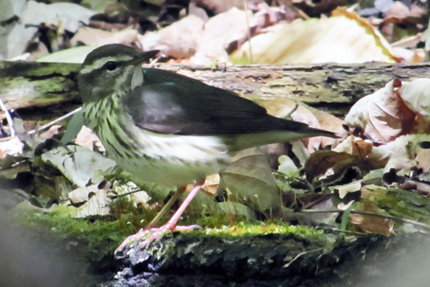
Quick post to share that an early morning search for the nest belonging to this pair of Louisiana Waterthrush was successful! I will be posting a full nest profile sometime this week. Nests of Wood Thrush, Ovenbird, Northern Flicker, Hairy Woodpecker and Black-capped Chickadee were also found – a great day overall.
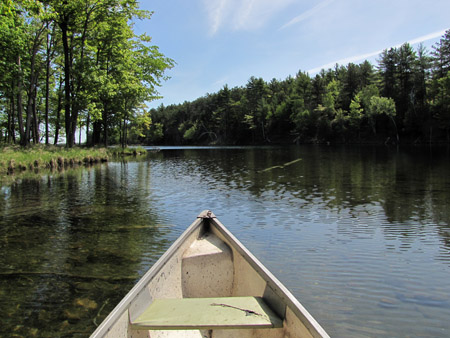
At nearly five kilometres long, Big Salmon Lake is the largest lake within Frontenac Provincial Park boundaries. The lake has over fifteen kilometres of shoreline and has a maximum depth of 42.3 metres. Bisecting the park along a northeast-southwest axis, Big Salmon has long been a gateway to the Frontenac backcountry and a focal point for early mining and logging industries. Geologically, the lake also marks a divide between two distinct zones – granitic gneiss and marble to the northwest and a large dome of diorite in the southeast.
.
.
Yesterday, I ended up paddling the entire length of Big Salmon to reach two remote streams for the ongoing Louisiana Waterthrush inventory. This long oligotrophic lake was absolutely stunning and a joy to travel across. Steep cliff faces with ancient bonsai-like conifers, Cerulean Warblers singing from mature oak-maple canopies and windswept white and red pines on small rocky islands were just a few of the highlights during the trip.
.
Canadian Tiger Swallowtail and Juvenal's Duskywing
.
The sightseeing was a nice diversion but my main priority was to find two streams, which to me were nothing more than tiny blue lines on a map. I’ve visited fifteen streams so far this spring and never really know what I am going to encounter. Some streams are pristine, fast moving waterways in steep sloped ravines while others are completely dry and sun drenched. Regardless of their condition, the purpose of the project is to index as many sites as possible to evaluate current stream conditions, habitat preferences, aid future inventories, and to model population parameters of Louisiana Waterthrushes in the area.
.
.
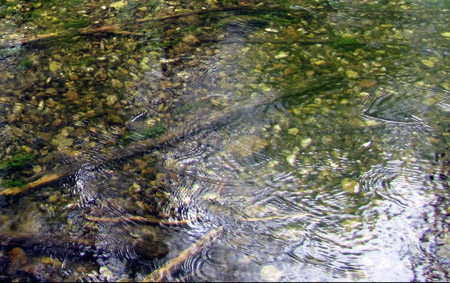
This particular stream was an absolute gem and ‘ticked all the boxes’ for Louisianas in terms of aquatic characteristics as well as slope, canopy closure and presence of suitable nest sites. The meandering stream was teeming with life. My survey of its length revealed a considerable forage base for waterthrushes and very high biodiversity with one glaring exception – no Louisiana Waterthrushes! There was no response to playback following an unsuccessful ground search for the species. This was surprising at first but a broader scan of the site indicated that the mature forest shading the stream was a relatively small patch bordered by younger growth and even small rock barrens. Louisiana Waterthrushes are area sensitive and therefore need large contiguous tracts of mature forest to breed, which would make this site unattractive. Forest succession might make this site suitable for LOWA in the not so distant future.
.
.
The stream itself has been around for quite awhile, evidenced by the erosive passage of water over and through the rocks of the stream. The rectangular finger-shaped rock on the right in the photo above has water passing through it and looks oddly man-made. I’ve uploaded a short video clip of this interesting feature below.
.
.Green Frog
.
Last but not least, a Green Frog (Rana clamitans), one of the many inhabitants of the stream. This fellow was sitting in the middle of the watercourse, faced upstream. Maybe this frog is just chillin’ but I think this might be an excellent way to catch some lunch – let the stream bring it right to you.
.
I am starting to run out of accessible waterthrush sites but still have a few more left to visit before the whirlwind of our other breeding bird work begins in early June. I will miss these shady ravines….
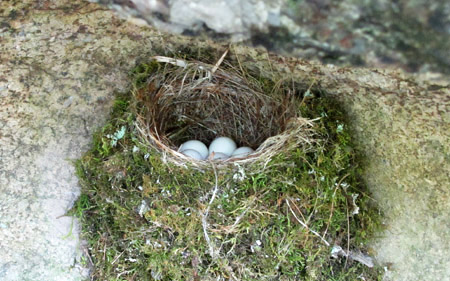
The Eastern Phoebe (Sayornis phoebe) is a common inhabitant of Southern Ontario. The 2nd edition of the Ontario Breeding Bird Atlas shows that peak abundance in the province aligns with the southern edge of the Canadian Shield. In these areas, the high forest coverage and availability of nest sites (e.g. cottages, bridges and other man-made structures) likely contribute to higher densities (Cadman et.al. 2007). It has been suggested that the species underwent a marked range expansion and population increase in unison with early development and human settlement, which greatly increased the availability of suitable nest sites (Weeks, H.P., Jr. 1994). Phoebes attach their nests directly to a vertically sloped surface, which provides overhead protection from the elements, in much the same manner as Barn Swallows (Hirundo rustica). Man-made structures such as bridges, culverts and eaves of buildings are just a few of many ‘unnatural’ features suitable for the species. What does this suggest for precolonial status of the Eastern Phoebe in Ontario? The nest pictured above was found last week and its location illustrates this question.
.
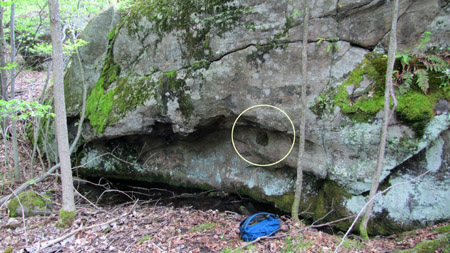
Nest site
.
The Eastern Phoebe has been a resident of Ontario’s woodlands since long before axe-wielding Europeans arrived. This particular nest was attached directly to a vertical rock wall below a cut in the rock. These rock formations occur throughout the FBS study area – in forest interiors, dry rock barrens and edges of lakes and ponds. It is plausible that the high numbers detected along the southern edge of the shield are also attributable to the proliferation of these naturally occurring nest sites. Click here for more info on nesting Eastern Phoebes in the Frontenac Arch.
.
It was a chilly start to this morning’s fieldwork but it turned into a great day on all fronts. Birds were more abundant and diverse today with many firsts of the year including Black-throated Blue Warbler, Broad-winged Hawk (two separate adults carrying food!), Solitary Sandpipers and a whopping great tally of 14 Cerulean Warblers. Yellow-throated Vireos and American Redstarts were also quite numerous.
I was thrilled to find a Northern Waterthrush in the midst of nest building along a creek near Birch Lake but the real star of the show today was the discovery of an actively nesting pair of Louisiana Waterthrushes. The pair were located in a deeply incised ravine in mature forest. I hung around for a bit to observe them and suspect that a nest containing eggs is likely to be found above the steep bank of a waterfall at the site. I didn’t have time to look for the nest but will return to the site at a later date for a checkup. To my knowledge this is a newly documented breeding location for the species.
The media file below includes pictures and a short recording of the male LOWA taken at the site this morning. Something went wonky with the image quality during conversion at Vimeo but the sound is accurate. The Louisiana Waterthrush (Seiurus motacilla) has a distinctive song, much softer, sweeter and melodic than the louder and more guttural warble of its cousin – the Northern Waterthrush (Seiurus noveboracensis).
In Canada, the Louisiana Waterthrush (Seirus motacilla) has a small range limited to southern Ontario and Quebec. The population is small, estimated at <200 pairs, and restricted to mature forested ravines with clear, gravel-bottomed streams and/or woodland swamps. Louisianas are considered “area sensitive”. According to a Maryland study (Robbins 1979) a minimum of 100 contiguous hectares of mature habitat is needed for successful breeding (McCracken 2006). In Ontario, the Louisiana Waterthrush is a rare but regular breeder in southwestern Ontario. Smaller numbers also occur in deeply incised valleys of the Frontenac Arch where mature forest is present.
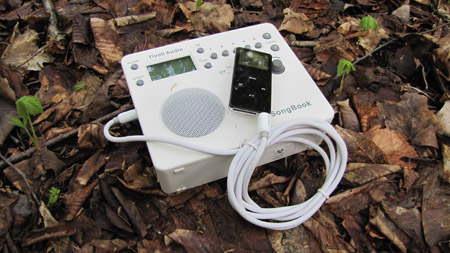
Playback equipment
The Frontenac Arch sits at the northern limit of the continental breeding range for Louisiana Waterthrush. Here, annual occupancy and productivity of breeding sites are probably influenced by weather cycles and periodic expansion/contraction of the source population further south, possibly upstate New York. It is suggested that north wandering immigrants cause a “rescue effect” for the Canadian population. There is also evidence of the species expanding its range northward, likely in response to maturing second growth forest cover. Climate change, beavers and water quality are also important influences on the status of the species in the Frontenac Arch.
We have started an inventory of Louisianas in Frontenac Provincial Park and in accessible habitats immediately surrounding the park. Louisianas will breed in woodland swamps and along clean creeks and streams, both of which occur in abundance in these areas. Potential nest sites have been identified from several sources and will be surveyed in May 2010 to determine occupancy and breeding status. This information will improve our knowledge of the local population’s size, demography and habitat preferences. The work will also enable monitoring through comparative analysis in future years.