The Frontenac Arch
.
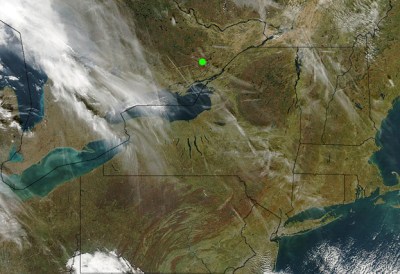
FBS study area (NASA image)
.
The Frontenac Arch is an ancient span of Precambrian bedrock that connects the Canadian Shield of central and northern Ontario to the Adirondack and Appalachian regions to the south. Over a billion years old, the Frontenac Arch is considered the formative “backbone” of Eastern North America. This southerly extension of the shield was formerly part of a towering mountain range. The Frontenac Arch as seen today was shaped by glacial retreat and millennia of erosion, which has resulted in the distinctive topography of ridges and valleys with shallow soils. As an ecotone between converging ecoregions, the Frontenac Arch is believed to have the highest biodiversity in Eastern Canada and an extensive list of Species At Risk. The landform is also an important habitat corridor for the migration and dispersal of wildlife. The Frontenac Arch Biosphere Reserve was established in 2002, in recognition of the region’s significance to cultural and biological heritage.
.
FBS Study Area
.

Mixed habitat near Slide Lake, Frontenac Provincial Park
.
A study area of over 15,000 hectares, located roughly between the towns of Sydenham and Westport, Ontario, has been selected as the most appropriate site for Frontenac Bird Studies. This area, in the northern section of the Frontenac Arch, is at the heart of the transition from the Mixedwood Plains to the Boreal Shield. The North American Bird Conservation Initiative (NABCI) notes that this transition has the “highest average forest cover of any part of ON BCR 13”, a region comprising most of Southern Ontario. The proposed study area includes Frontenac Provincial Park at its centre, a designated threshold-wilderness park of over 5000 hectares. Though the majority of the study area is owned privately, the area does include several Crown Land parcels and some other protected land holdings in addition to Frontenac Provincial Park.
.

Mature deciduous forests, Frontenac Provincial Park
.
Habitats in the region are highly varied, however primary types consist of deciduous, mixed-deciduous woodland and wetlands, followed by lesser quantities of successional shrubland and low-intensity agricultural habitats. The undulating terrain of valleys and ridges supports alternating wet/dry and acidic/calcareous conditions respectively. Data on average age of forest stands is not yet available, however forests of 70+ years are not uncommon while some greater than 100 years can be found.
.

Bog near Clearwater Lake, Frontenac Provincial Park


