
f
[ Note that Louisiana Waterthrush (formerly Seiurus motacilla) was recently moved to the new genus Parkesia with Northern Waterthrush, which leaves Ovenbird as the only remaining Seiurus species ]
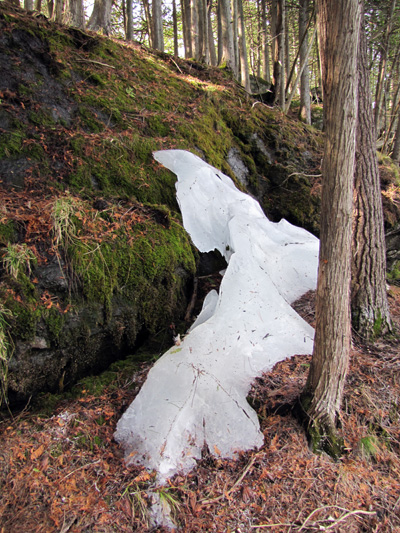
There has been lots of noteworthy observations in recent days but the most significant development continues to be the late arrival of spring and apparent scarcity of Louisiana Waterthrushes in the study area. The mass of ice pictured below was found yesterday near Little Salmon Lake, Frontenac Prov. Park – a late spring indeed. I’ve now surveyed 23 streams and creeks in and around Frontenac Provincial Park with only a few sightings of the target species to show for it. As the above video shows the sites are in excellent condition owing to high precipitation in late winter and early spring. Water levels and flow are higher than a year ago and insect forage is abundant (particularly the black flies!). Click here for a larger version of the clip.

The Louisiana Waterthrush has a very limited range in Canada. Breeding occurs primarily in Southern Ontario where remnants of mature deciduous and mixed forest remain. Looking at the map above, the small green dot at the east end of Lake Ontario indicates a cluster of breeding sites corresponding to mature woodlands of the Frontenac Arch and Thousand Islands. There is evidence that this species is expanding northward probably in response to maturing and regenerating forest cover since the logging boom of the 1800s. The population in the Frontenac Arch is essentially the northernmost outpost for this species in North America and somewhat disjunctive from the core range. It has been suggested that Ontario’s population is dependent upon immigration from the source population further south and could therefore be subject to more variable rates of fidelity and productivity. Perhaps 2011 will be a down year for our north-wandering pioneers? We still have a few weeks of surveys to complete and will have a much better handle on the situation by early June – I have a good feeling that results will improve.
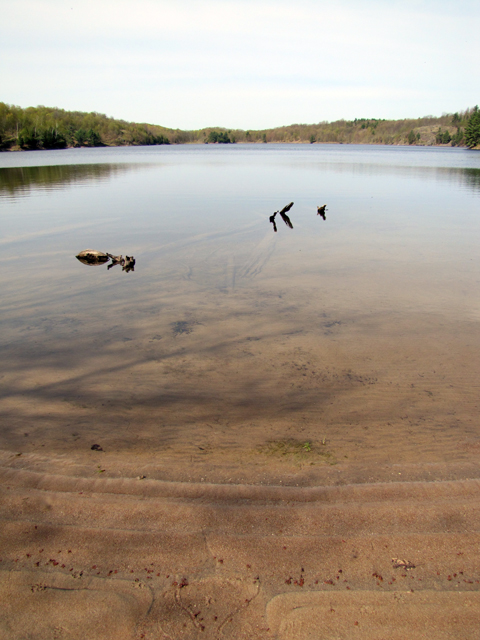
The Louisiana Waterthrush recon work took me to a network of streams flowing to and from Little Salmon Lake in the park’s interior. There are some very promising sites in the area but the relatively young age of the forest is probably not suitable for the species at the present time. Regardless of whether the birds are there or not the effort is still worthwhile to describe and index potential breeding locations for the future. This was my first foray into this area, which made for an interesting day. Sandy beaches like the one pictured above are very scarce in the park.
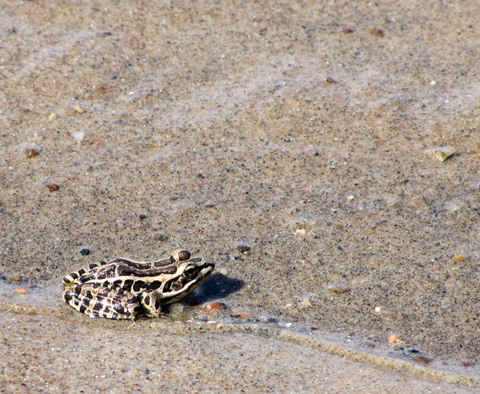
The only sunbather I found was this Pickerel Frog (Rana palustris) – a nice find. While not exactly rare they are uncommon compared to their close relative, the very similar and more numerous Northern Leopard Frog (Rana pipiens). Pickerel Frogs are always brown in coloration and have squared spots aligned into two neat rows down their backs. The Northern Leopard Frog is usually green, although sometimes brown too, but have circular, more randomly distributed dark markings.


 Frontenac Bird Studies