


.
.

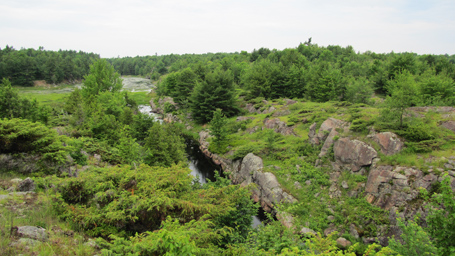
Frontenac Provincial Park lies within the Grenville Province of the Canadian Shield. About 800 million years ago, the Grenville Province was a towering mountain range with peaks as high as the modern day Himalayas. Subsequent periods of erosion, sedimentation, glaciation and more erosion has created the current landscape as we see it today. The rock barrens, in their present myriad of forms and age, cover a significant portion of Frontenac Provincial Park. Geologically, the barrens are described by Christian Barber as a:
“football-shaped body of Diorite that rose up from great depths as a very hot, semifluid pluton.” (Barber 2005)
Three significant forest fires have occurred in the barrens since the mid-19th century. These fires and also the hard bedrock has limited soil generation and plant growth. Both geological and cultural histories have played a role in the creation and maintenance of these open rock barren habitats. The above picture is from the top of a ridge overlooking Slide and Buck Lakes, the most rugged area of the park that stretches from here in the south to our Rock Ridge MAPS site about 6km to the north.
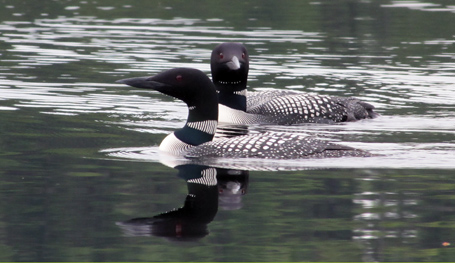
This excursion involved a lot of exercise – over 10km of paddling and about 6km walking. Several pairs of loons would come over quite close to the boat and check me out. Not sure why they do this, maybe the paddling and noise stirs up prey under the surface? I’ll never get tired of seeing Loons.

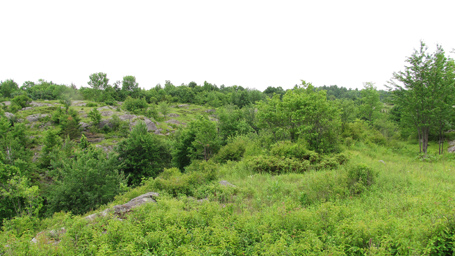
These are the aforementioned rock barrens. The last fire burned this area over around 1930, which demonstrates the remarkably slow rate of succession in the barrens. The few scattered trees are no more than 5 or 6 metres tall. Eastern Towhee, Field Sparrow, Common Nighthawk and Prairie Warbler are attracted to these habitats for its absence of tree/canopy cover, presence of low shrubby growth and/or sparse ground cover.

During the morning I completed a brand new point count route through this area to boost our monitoring coverage of this unique habitat. I was also hoping to find and georeference Prairie Warblers, a recently de-listed Species at Risk that is still quite rare and isolated in Ontario. They occur along a narrow band at the southern edge of the shield – from the Frontenac Arch Biosphere Reserve in the east to the Georgian Bay Biosphere Reserve in the west. Rock barrens can be found throughout the shield but they are most widely distributed and heavily concentrated along this ecotone in central Ontario. This photo shows a small stretch of habitat incised by a wetland that held five Prairie Warblers. The deciduous tree on the right seemed to be a prominent song perch, which three gorgeous males aggressively fought over.
By the end of the day, over a dozen Prairies were located and mapped, which was a terrific reward for such a long day. I have two more “inventory” sessions for Prairies in the area still to come so there should be more of these bright yellow “buzzers” out there. This inventory will set the basic population parameters for potential future research, which would involve a more in-depth look at demographics and habitat preferences. The Prairie is one of a host of species that depends on cyclic disturbance, natural or anthropogenic, to maintain stable and viable populations. It is likely that, without another significant fire, the Prairie Warblers in Frontenac Park will be extirpated as these rock barrens mature. This is definitely a fascinating context for a detailed study…

The final of our first round of MAPS visits was to the Rock Ridge station in Frontenac Provincial Park last week. Rock Ridge is unique in many ways. It is located atop a steep sided gorge, which offers stellar views of the surrounding landscape dominated by Eastern White Pine. The bird community is representative of the coniferous tree cover as well as the scrubby, exposed rock barrens of the area. During our first visit in 2009 we were greeted with a good number and variety of birds – 23 captured of 14 species. Our first morning this year was a much slower affair as just 10 birds were banded in six hours and there were no recaptures of birds banded in 2009. We did band two female Black-and-white Warblers, both of which had heavily vascular brood patches, which suggested they were presently incubating.
This spring has been an early one and the vegetation is much further advanced than it was last year at this time. Also, many of the species at RRID are earlier migrants from temperate wintering grounds and so it is possible that the timing of our first visit in 2010 coincided with the period when most females are incubating and thus activity/movement is low. We may have encountered this on visit two in 2009 when, once again, only ten birds were captured! This is a good learning experience for us as it now makes sense to sync our first visits in time with the season rather than a specific date.

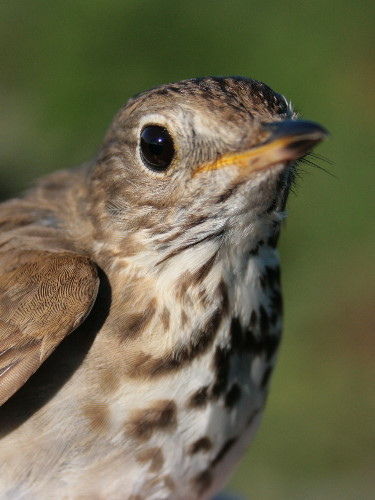
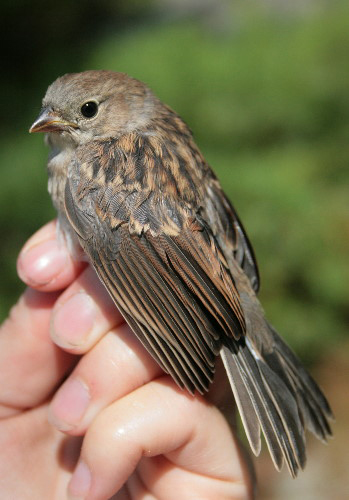
So the morning was unexpectedly quiet but it was even more surprising that no birds banded in 2009 were recaptured; all of the birds shown here represent new captures. Another sign of the advanced spring was the observation and/or capture of recently fledged Field Sparrow, Song Sparrow and Blue Jay. We didn’t start seeing young birds until visit two and three in 2009. Seabrooke got two juv Field Sparrows out of net 5 on one of her fruitful net rounds (see below for a pic).
It is safe to say that I am completely enamored with this place. It is highly diverse, always has the unexpected and is undeniably remarkable. We will be operating the Rock Ridge MAPS station through at least 2013 but hopefully through 2019 – we’ve only just begun…
.
New birds banded (10 of 7 species)
.
Field Sparrow – 2
Black-and-white Warbler – 2
Red-eyed Vireo – 2
Hermit Thrush – 1
White-throated Sparrow – 1
Rose-breasted Grosbeak – 1
Blue Jay – 1
Recaptures (none!)
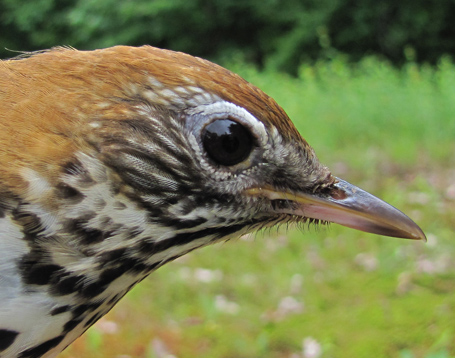
The inclemency of late has made scheduling our first round of MAPS visits a challenge. Our first morning at Maplewood Bog (MABO) in 2010 began with some trepidation over the forecast of 40% chance of showers. It wasn’t raining when we arrived but the vegetation was dripping wet, which made net setup feel like a 5 a.m swim through the woods and meadows. There were only a few brief periods of drizzle during the morning until the final round when a torrential downpour occurred. We were able to get a full six hours of coverage but the final round was more than a little uncomfortable!
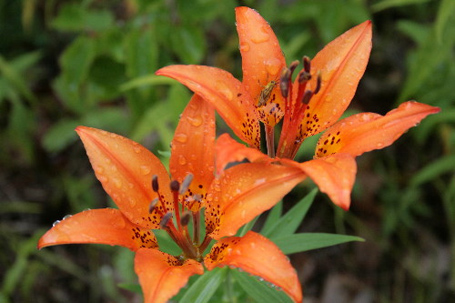
Fortunately, despite the weather, the birds were numerous and active. The highlight of the morning was the recapture of eight birds banded last summer at the site, which included three Veery and two Wood Thrush. These two are dominant species at MABO and both migrate to and from Latin America on an annual basis. The Veerys that we recaptured on this day may winter as far south as the Amazon basin, some 7,000 km south of MABO! This is one of the great marvels and joys of participating in the MAPS program, it vividly connects you to the remarkable life cycles of individual birds and bird communities. For example, we know this Veery (2431-64408) was an ASY male on June 14, 2009 with a wing length of 101mm and a weight of 30.8g. We also knew the age and wear of its feather tracts, breeding condition, its territory location and the onset of its prebasic moult. We re-caught this word traveler on June 10, 2010. He was found in the same net as last year and is likely paired with 2431-64405 – a female that we suspect reared these young with a different male in June, 2009!

We were too drenched and busy to take many photos of birds during the visit but we did capture a respectable 21 birds of 12 species. Cerulean Warbler and Black-throated Blue Warbler were notables detected but not captured. A full summary of the capture results is presented below.
New birds banded (13 of 11 species)
.
Common Yellowthroat – 2
Ovenbird – 1
Swamp Sparrow – 2
Rose-breasted Grosbeak – 1
Great Crested Flycatcher – 1
Yellow-bellied Sapsucker – 1
American Robin – 1
Northern Waterthrush- 1
Red-eyed Vireo – 1
Veery – 1
Gray Catbird – 1
Recaptures (8 of 4 species)
Common Yellowthroat – 2
Wood Thrush – 2
Veery – 3
Red-eyed Vireo – 1
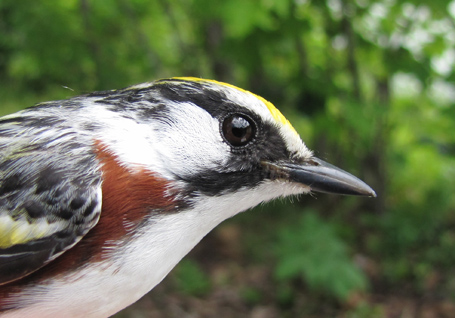
Our roster of Monitoring Avian Productivity and Survivorship (MAPS) stations has grown in 2010! Our new site called Blue Lakes is the northernmost of the three and is about nineteen kilometres north of Maplewood Bog. The site fills a key gap for us both spatially and in species coverage. Finding this site was quite an exercise that involved several weeks of map study and reconnaissance. I found lots of other sites that had potential but there was always a negative factor or two with them. Access, terrain, edge conditions and species mix were key considerations that were finally met when the Blue Lakes site was discovered about two weeks ago. A satellite view of the “AXIS” network is included below. Each of the three stations provides coverage of an area up to a four kilometre radius of the station centre, which means that we are now generating productivity statistics for 150 square kilometres of the Frontenac region – very exciting.


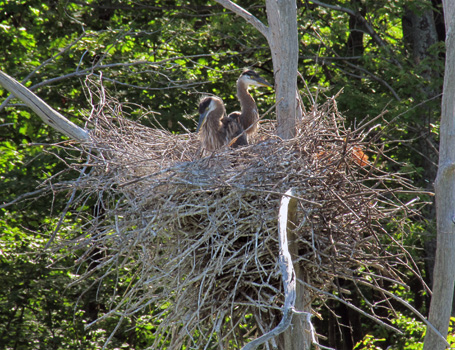
This is the view from the banding station, which is situated on a scrubby peninsula that bisects a horseshoe-shaped lake full of emergent vegetation, amphibians and a small heronry as well.

The Blue Lakes is probably the most varied of the three stations in terms of habitat. A circuit of the ten net lanes passes through rocky scrub edge along the shores of small lakes, mature deciduous forest, deciduous swamp thickets, areas of young balsam fir/shrub thicket and grass/lichen outcrops. Also distinct here is the presence of a dense understorey – not represented at our Rock Ridge or Maplewood Bog sites further south.

Balsam Fir occurs throughout the area but is quite dense along a wet draw through mixed age forest with an uneven canopy. The conifers attract species such as Hermit Thrush and Magnolia Warbler, among others. The firs and the odd spruce here and there add a nice northern feel, which becomes more noticeable as you approach Highway 7 from the south. The Blue Lakes site is at the edge of the Boreal Hardwood Transition zone.

These clearings are our main modes of traversing the site. They provide stable footing and a relatively flat, unobstructed path through the station. Field Sparrow and Sweetfern are dominant species in the rocky clearings where evidence of a rock flipping Black Bear was also found.

This is the important edge habitat that will (hopefully) attract large numbers of dispersing young and adult birds in the latter half of the breeding season. Both of the edge nets on the peninsula performed very well today, which was very pleasing.

 We banded a Yellow-throated Vireo (YTVI) that was captured in net 1 on first check! This fellow has been singing from the oaks above the net lane for at least two weeks. This is the first capture of a YTVI for the MAPS program. They are a Frontenac Arch specialty of sorts, quite common in deciduous forest with clearings, so it was great to finally band one!
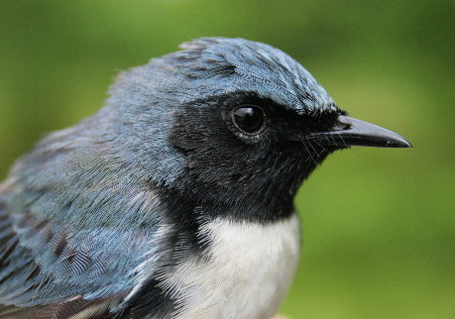
Black-throated Blue Warblers are a dominant species at Blue Lakes, largely due to the dense undergrowth found in the forests. Seabrooke and I estimated that between 5-7 territorial males are present in the core area of about 8 hectares. It is unclear as to whether these males are mated as no females were observed or captured today. The capture and banding of this second-year male was also a first for our MAPS program. Black-throated Blues are wonderful birds and we can look forward to their buzzy tones for years to come!
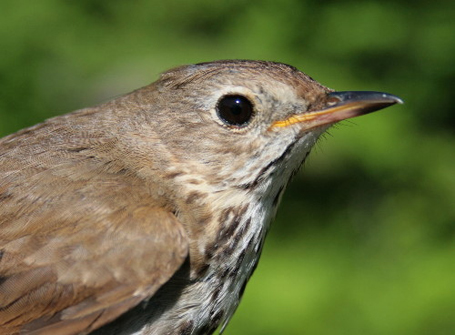
The other dominant species at Blue Lakes are Veery and Chestnut-sided Warbler but a very diverse community of breeding birds was evident this morning. Singles of Hermit Thrush, Scarlet Tanager and Warbling Vireo (1st banded by FBS) were banded along with several Common Grackles and a lone Red-winged Blackbird (1st banded by FBS).

I’ve only just barely scratched the surface of all that was enjoyed and discovered today. Visits to Rock Ridge and Maplewood Bog are imminent and the 3 A.M wake-up calls beckon me to cut this summary a bit short. We will have six more mornings of banding at Blue Lakes this summer and we are looking forward to each of them – a great study site indeed.
Here are the stats…
.
New birds banded (24 of 14 species)
Common Yellowthroat – 1
Veery- 4
Rose-breasted Grosbeak – 3
American Robin – 1
American Redstart – 1
Chestnut-sided Warbler – 3
Black-throated Blue Warbler – 1
Warbling Vireo – 1
Ovenbird – 2
Yellow-throated Vireo – 1
Scarlet Tanager – 1
Hermit Thrush – 1
Red-winged Blackbird – 1
Common Grackle – 3
 Frontenac Bird Studies