
Very busy with fieldwork lately but here’s a preview of a post that will be going up in the next day or two ; )
Very busy with fieldwork lately but here’s a preview of a post that will be going up in the next day or two ; )

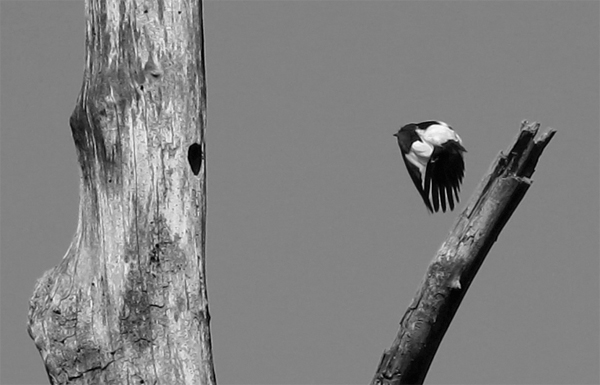
Frontenac Bird Studies is a program of Migration Research Foundation – a non-profit organization dedicated to avian research and monitoring. Since its inception the FBS program has been successfully delivered through the annual support of environmental grant makers and private donors. The Frontenac Biothon was created as an event that would raise important funds for our work and make a beneficial contribution to science and conservation at the same time. Our inaugural biothon in 2010 was a great success as our three teams of nature nuts recorded 441 species, which included a pair of Red-headed Woodpeckers – a threatened species and only the second breeding record for Frontenac Provincial Park!

This year our teams will have their sights on the 500 species barrier when we take to the woods and lakes on June 11-12, 2011. Our biologists will be identifying all plants, mammals, birds, amphibians, reptiles and insects encountered but will have a specific focus on rare species and designated Species at Risk. The Frontenac Arch is such a biodiverse region that we are guaranteed to have some exciting finds to share after the event!
.
.
While our biothon teams have all the fun battling bugs, swamps and steep terrain – it’s the sponsors that make the event happen! Frontenac Bird Studies is a program of the Migration Research Foundation – a registered charitable organization in the U.S and Canada. All sponsors receive a tax-creditable receipt for donations over $10. You can sponsor the Frontenac Biothon by mail (see below for details) or online through Paypal. 100% of donations will go directly to support FBS programs.
.
Seabrooke Leckie & Dan Derbyshire

.
Julia Marko Dunn & Chris Dunn
.
Steve Gillis & Karina Dykstra
.
You can also sponsor the biothon by cheque through regular mail. Please complete the cheque to Migration Research Foundation. Simply include the name of the biothon participant you wish to sponsor on the memo line of the cheque and send the envelope to our address below.
.Frontenac Bird Studies
2386 Bathurst 5th Concession
RR7, Perth, ON.
K7H 3C9
This video was recorded yesterday while revisiting the site where a Louisiana Waterthrush nest was found on May 26, 2010. The stream at this site is flowing with so much vigor that the two waterfalls severely limit the audibility of my playback system. Despite this I was able to locate a territorial male at the south end of the stream complex in a low valley sandwiched between two small ridges. I promptly ended playback as soon as the male responded and watched him for about ten minutes or so as he moved back and forth from the stream to higher perches. At one point he moved higher toward the canopy and was instantly chased off by a bill snapping small passerine, which turned out to be a female Cerulean Warbler (Dendroica cerulea). I followed the female for several minutes and hit an ornithological jackpot of sorts when she flew to a nest located on a horizontal branch of a large Sugar Maple (Acer saccharum), about 15m above the ground.
Cerulean Warblers build their nests high in the upper canopy of deciduous forests that have mature trees, little or no understorey and small gaps or breaks in canopy closure. These characteristics make their nests quite difficult to find and even harder to inspect and monitor! In this case I was able to get a decent view of the nest from either of the two ridges, which put me roughly 15 feet closer to the crown of the large trees growing in the valley. Even with this advantage I still had to zoom to 39x to get a low quality recording. Gotta thank the 749 mosquitoes for all the shakiness. I will definitely be returning to this site (with a tripod!) to monitor both of these important breeders in the next several weeks. Frontenac Provincial Park is one of the most significant protected areas for Canada’s population of Cerulean Warblers now listed as an Endangered species by COSEWIC.

Back to the waterthrush surveys. Things have picked up a bit since my last post but it seems that 2011 will be marked as a down year for breeding Louisiana Waterthrushes in this region. I have not been successful at several reliable sites despite as many as four repeat visits. A review of historical records show some evidence of a downward trend occurring since the first half of the last decade. Despite an apparent population decrease coinciding with the initiation of our study in 2010 it is critical to monitor the sites through the good times and the bad times. Interestingly, the high number of unoccupied sites found this year has only buoyed my interest in the study going forward. Also, the 2011 season is not over yet as surveys at five more sites are yet to be completed and I do have four active sites to keep tabs on.
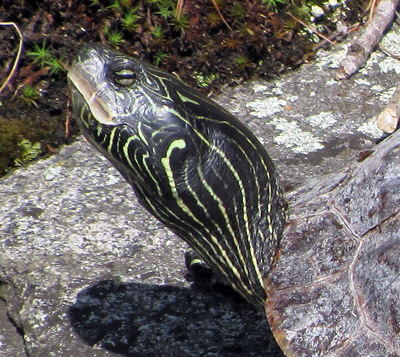
The Northern Map Turtle (Graptemys geographica) is a common inhabitant of medium to large lakes in Frontenac Provincial Park and is listed as a species of Special Concern by the Committee on the Status of Endangered Wildlife in Canada (COSEWIC). The Frontenac Arch region is also home to significant populations of Blanding’s Turtle (Emydoidea blandingii) and the Eastern Musk Turtle (Sternotherus odoratus), both of which are listed as Threatened species by COSEWIC.
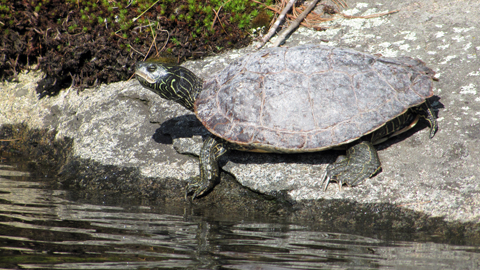
The map turtles are easily the most frequently encountered turtle species during our fieldwork, followed by Blanding’s, Snapping and Painted. Unfortunately I have yet to encounter the Eastern Musk or “Stinkpot” Turtle in the park, which isn’t that surprising given their small size and strictly aquatic habits. Hopefully I’ll luck into one this summer. Click here for a very interesting account of this unique species by researchers at the Queen’s University Biological Station of nearby Opinicon Lake (~20km northeast of FPP office).

In this post from early June of last year I wrote about three recently fledged Common Ravens that were found near Clearwater Lake. This is a small but deep oligotrophic lake that is probably best known for its population of Brook Trout. I regularly pass through this area at this time of year and usually notice the clamorous activity of ravens along the lake edge. The noise reminded me to check the cliff for active nests when I passed by last week. It didn’t take long to spot the nest immediately above some rock covered in white wash. The following photos show an adult brooding and three youngsters waiting for food. Unfortunately the photos were taken from a distance of about 100m, which made them pretty grainy but the idea of leaning over the cliff for a better closeup just didn’t appeal. Common Ravens are regular breeders in the area however this particular record was the first for us since we began in 2009 – very cool!


 Frontenac Bird Studies