MAPS Visit 3 – Blue Lakes

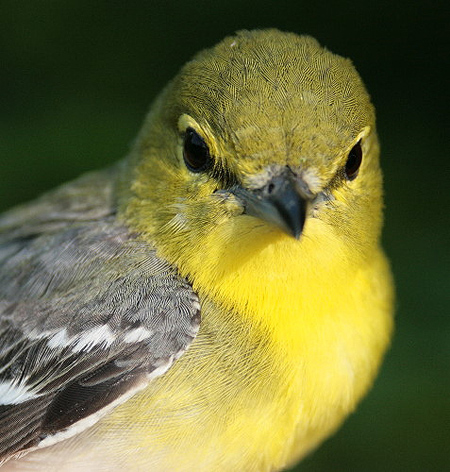
Yellow-throated Vireo (Seabrooke Leckie)

Visit three to Blue Lakes happened late last week. A definite highlight of the day was the capture of three adult Yellow-throated Vireos (2 new and 1 recap) and the discovery of a nest with young in the crown of a large Red Oak near net 1! We’ve banded the male and female tending the nest but also captured a new gravid female (carrying egg) in net 1 around mid-morning. We suspected at least a couple of pairs were in the area but the appearance of a gravid female so close to the nest of another pair seems rather curious. Very cool to have this species around and in numbers too!
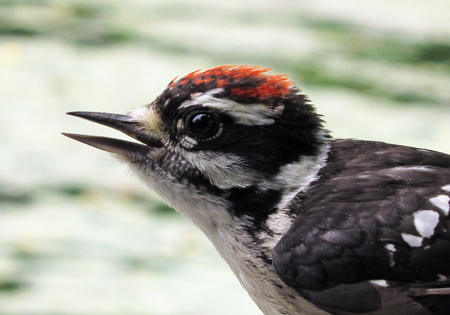
Juv Downy Woodpecker (Derbyshire)

The morning’s work went smoothly and a steady trickle of birds were handled over the six hours. Despite that multiple territories of Black-throated Blue Warblers are present within the station boundaries, we have only managed to band and recapture the one male and female individual. We are starting to wonder if the other singing males are unpaired.

We’ve now completed nine visits to all three stations combined and are not even halfway through the season! The remaining visits to each station will be interesting as adults move or reestablish territories and this season’s crop of young birds begin to disperse. The month of June was extremely wet and it remains to be seen how this has affected nest success for landbirds in Frontenac County and beyond….

Blue Lakes – Visit 3 of 7

New birds banded (18 of 12 species)

.
Field Sparrow – 1
Red-eyed Vireo – 1
Ovenbird – 1
Swamp Sparrow – 1
Yellow-throated Vireo – 2
Veery – 1
Downy Woodpecker – 2
Song Sparrow – 1
Rose-breasted Grosbeak – 3
American Robin – 2
Blue Jay – 1
Common Grackle – 2

Recaptures (6 of 5 species)
.
Black-throated Blue Warbler – 2
Yellow-throated Vireo – 1
Yellow-bellied Sapsucker – 1
Downy Woodpecker – 1
Ovenbird – 1

Update on Frontenac Prairie Warblers

Adult Male Prairie Warbler (Dan Derbyshire)

Our inventory of Prairie Warblers in Frontenac Provincial Park is now complete! Conducting the inventory required lots of hiking over rugged terrain and canoeing – 41 kilometres in all. The Prairies are occupying rock barren habitats in perhaps the most inaccessible part of the 5000 hectare park. I am relieved to report that it was well worth the effort as a surprisingly large number of Prairies were located. Prior to this season I had hopes that about ten pairs would be found in Frontenac but really had no expectations beyond the few pairs that were first encountered at Slide Lake last summer.

Another male (Derbyshire)

The second edition of the Ontario Breeding Bird Atlas provides an excellent summary of the current provincial status of the Prairie Warbler. Incidentally, a bright male Prairie Warbler was chosen as the cover bird for this important work. The authors of the account note that the distribution has remained unchanged since the first atlas conducted in the early 1980’s, although many long standing colonies had been deserted due to habitat succession. Several colonies in the Frontenac region have disappeared including a large population of perhaps 20 pairs that inhabited the west side of Canoe Lake, which hosted birds from 1961-1987. Another historical colony resided at Devil Lake for more than 40 years from 1948-1988 (Weir 2008). The largest population remaining in Ontario occurs in the Georgian Bay region where 270 pairs were located in the 1990’s (Harris 1998). Outside of Georgian Bay, colonies of Prairie Warblers seem to be less concentrated, possibly due to habitat shortage, which could make them more susceptible to extirpation.

Data from the second atlas suggest that away from the Georgian Bay area fewer than 50 pairs occur and the total provincial population is unlikely to exceed 320 breeding pairs. (Cadman et.al. 2007)

Adult female (Derbyshire)

The population in Frontenac Provincial Park, inventoried for the first time this summer, includes a minimum of twenty territorial males! At least four of these males are paired with females. Additional males were likely encountered in two instances involving three males in territorial dispute but it was impossible to exclude potential overlap. The figure of 20 males is a conservative tally of birds with territories delineated by counter singing. I have yet to perform any analysis of habitat availability versus our coverage but strongly suspect that an upper limit of 30 pairs would be a reasonable estimate for the population. At 20-30 pairs It is quite possible that this population may be the largest known active colony outside of the Georgian Bay region.

I spent a lot of time looking for females and managed to find just four over several days of fieldwork in the rock barrens. Females were likely hunkered down on well hidden nests and not moving around much. I did find this female (pictured above) that was much more active. I watched her frequent comings and goings to a patch of dense shrub near an Eastern White Pine. She made half a dozen trips to the patch with beakfulls of “stuff”, either bugs or nest material. I didn’t approach the presumed nest site until the 7th trip when it was clear that food was being carried to the spot (approaching during nest building could have resulted in abandonment). I fully expected to find a nest with young in one of the shrubs but found this instead…..

Fledgling Prairie Warbler (Derbyshire)

This discovery of fledged young confirms successful breeding in Frontenac Provincial Park for this year and provides some indication that the colony is viable and productive! We now have a much better grasp on the current breeding status, habitat association and population density of Prairie Warbler in the park and can now begin setting more specific targets for future years. More to come in 2011….

MAPS Visit 2 – Rock Ridge (2010)

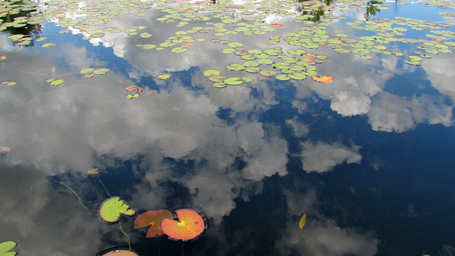
Spruce Bog at RRID

After a quiet first visit on June 11th, the Rock Ridge station returned to form on June 20th as 23 birds were captured during the morning. We thought last summer was unusually wet but this season has been even more drenched with rain seeming to fall consistently on a semi-daily basis. Fortunately, we have completed all of our visits within the intended periods but only by a thin margin and with thanks to a bit of luck. The photos accompanying this update are all landscapes as Seabrooke had a Canon malfunction, which erased all of the avian portraits from the day. This week, on our way in and out of the station, we paddled past this bog/fen habitat with Black Spruce, Tamarack, Sundew and Pitcher Plants. Common Yellowthroat, Wilson’s Snipe, Swamp Sparrow and Red-winged Blackbird are a few of the species nesting within the wetland complex below the steep cliffsides of the site.

The morning started off slow with an eery dawn silence and nothing captured on the first net check. For a second I considered that winter survivorship may have been particularly poor for our resident breeders but this was instantly erased with a net round at 730am when fourteen birds were extracted – nine coming from a single net! We were also pleased to finally recapture some birds banded in 2009, three in all. The full summary of the birds captured is provided below. The list represents a good sample of the breeding birds present at the station with some notable exceptions. Scarlet Tanager, Pine Warbler, Purple Finch and Myrtle Warbler are also common but tend to stick to the high tops of conifers that line both sides of the gorge, making them difficult to catch for banding. These species will move down with fledged young in search for better feeding areas so hopefully we will band a few before the season wraps in early August.

Mixed forest along the ridge

Rock Ridge – Visit 2 of 7

New birds banded (20 of 11 species)
.
Field Sparrow – 2
Black-capped Chickadee – 6
Red-eyed Vireo – 2
Hermit Thrush – 1
White-throated Sparrow – 1
Red-breasted Nuthatch – 1
Common Yellowthroat – 1
Chipping Sparrow – 1
Eastern Towhee – 2
American Robin – 2
Common Grackle – 1

Recaptures (3 of 2 species)
.
Black-and-white Warbler – 1
Black-capped Chickadee – 2

the Nest Files – Chestnut-sided Warbler

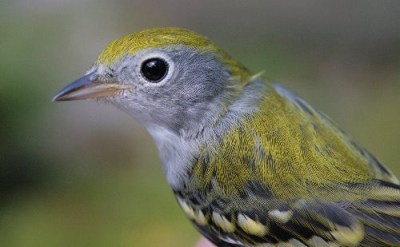
Adult male Chestnut-sided Warbler (Derbyshire)

.

Chestnut-sided Warbler (Dendroica pensylvanica)

.
Nidiologicals – Peck and James (1987) and Richardson & Brauning (1995)
.
Habitat – Early successional deciduous forest, regenerating clearcuts/fields and woodland edges
Microhabitat – Open cup nest built in crotch of understorey shrub, usually less than 2m from ground.
Spring arrival – Early to late May (Ontario)
Average nest height – .6m
Nest builder – Female only
Average # of broods/season – 1
Average egg laying date – 7 June-17 June (Ontario)
Average clutch size – 4 eggs
Incubation period – Average 11-12 days
Egg colour – White to pale greenish with variable markings concentrated at larger end.
Incubation – Female only
Brown-headed Cowbird host – Yes
.

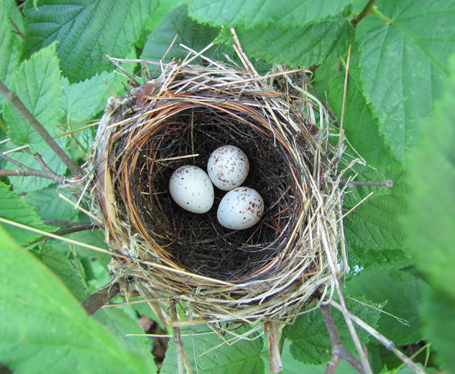
CSWA nest with eggs

The Chestnut-sided Warbler (CSWA) is a fairly common breeder here in Frontenac County and across much of the southern half of Ontario. This species was a North American rarity in the early 19th century before much of the forests were cleared and the young successional habitats became widespread. Populations of Chestnut-sides exploded and now occupy scrubby margins of woodland and overgrown fields from central Saskatchewan to Nova Scotia and south to Georgia along the Appalachian Mountains. In our region they are typically associated with woodland borders of small farms, roadsides, bogs and rock barrens.

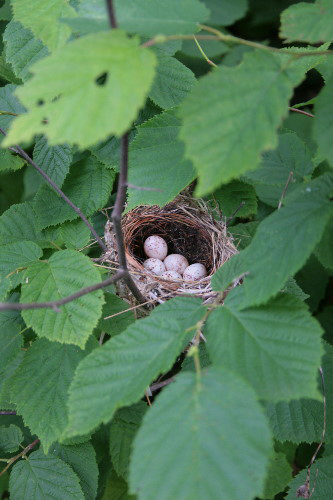
This nest was discovered by the observation and tracking of a female carrying nest material on May 28, 2010 at our Blue Lakes MAPS station near Sharbot lake, ON. There are about ten pairs in the immediate area of the station that are occupying scrubby shoreline edges of lakes and ponds. At least part of the site was burned over at some point within the last century or so, which has slowed regeneration and created appropriate conditions for the species. The nest pictured above was less than half complete on May 28 and was finished by June 4 when three eggs were photographed.

Full clutch (Seabrooke Leckie)

A clutch of five eggs is unusual for this species. This picture was taken on June 8 during our first visit to Blue Lakes. We captured and banded two males and the female responsible for this clutch on that date. The males have an interesting song repertoire and vocal development biology. Two song classes are evident; an Accented Ending (AE) class and an Unaccented Ending (UE) class. The AE song (Please, please, pleased to meetcha) is given on arrival and is primarily used to attract females. The UE song is given later on in the breeding season and seems to be mostly employed for territorial defense and intraspecific aggression. Lab studies have indicated that AE songs are developed with little social interaction while UE songs are learned through direct observation of “tutor” males (Byers and Kroodsma 1992).

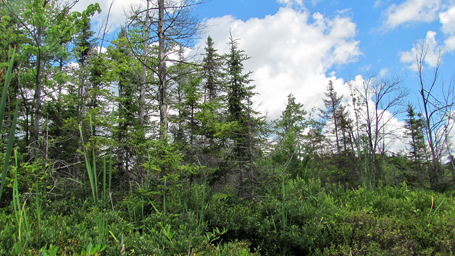
Chestnut-sided Warbler nest site

Here is a photograph of the nest site context along the shore of a small unnamed lake. The Chestnut-sided Warblers are nesting in this low, dense shrub layer beneath scattered clumps of young-mid successional oak and maple. Gray Catbird, Warbling Vireo, Yellow Warbler and Indigo Bunting also occupy this habitat type, although the latter is mysteriously absent from the site. We have about five more weeks of fieldwork in 2010 and a lot yet to learn about the “Chestnuts” at Blue Lakes. We are suspecting that the forthcoming post-breeding dispersal will consist of a large dose of young Chestnut-sided Warblers.

Young CSWA at MABO in 2009 (S.Leckie)

.

MAPS Visit 2 – Blue Lakes & Maplewood

Yellow-bellied Sapsucker

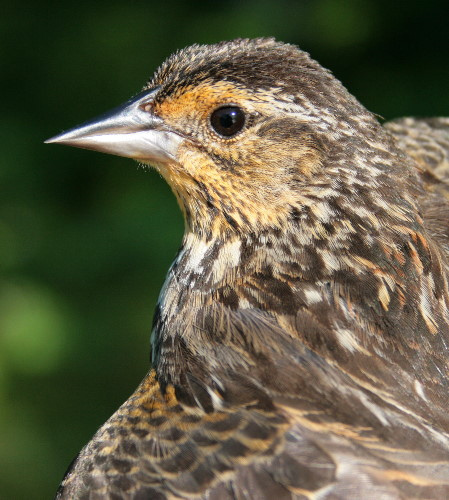
I’ve decided to summarize recent outings to BLAK and MABO in a single post because I’ve fallen behind on a large backlog of other material to touch on soon. Last week we visited the Blue Lakes MAPS site for the second time and had a very good morning. The weather was a highlight in that it wasn’t cloudy or threatening with rain – novel of late. We also captured a nice selection of birds including another Black-throated Blue Warbler (female with brood patch) and five Rose-breasted Grosbeaks, among others. A female Red-winged Blackbird was banded during the morning, which was a first for the FBS MAPS network!

Finally, while driving out at the end of the day we were stopped by the police, who had been lying in wait for us at the end of the road. Apparently, there was some concern that we may have been marijuana growers! That’s another first for FBS….

We will be returning to Blue Lakes by June 29, 2010. Full stats for visit 2 are summarized below the agelaius.

Female Red-winged Blackbird

.

Blue Lakes – Visit 2 of 7

New birds banded (15 of 8 species)

Black-throated Blue Warbler – 1
Ovenbird – 1
Veery – 1
Rose-breasted Grosbeak – 5
Yellow-bellied Sapsucker – 1
Red-winged Blackbird – 1
American Robin – 4
Common Grackle – 1

Recaptures (4 of 2 species)

Black-throated Blue Warbler – 1
Veery – 3

.

Northern Waterthrush (Seabrooke Leckie)

Our first visit to Maplewood Bog in 2010 was a little bit unpleasant due to the wet and ominous weather we endured. We were pleased to give MABO a proper go for visit 2 with clear, warm and dry conditions. The birds were much more active, although Seabrooke and I agree that breeding density seems lower for most species this year. This isn’t too surprising as our 2009 results suggested low productivity for last summer and numbers were way down at most migration monitoring stations this past spring. Visit 2 was all about the Red-eyed Vireo! A total of seven were captured, which included several returns from 2009. We also recaptured two Northern Waterthrushes, which have successfully returned to MABO from their winter haunts in either the Caribbean or Central America.

In all, 28 birds were captured during the six hours of operation. Without question, Maplewood still reigns as the “birdiest” of our MAPS sites….

Full stats for this visit to MABO are provided below Seabrooke’s stunning portrait of a female Eastern Towhee.

Eastern Towhee (Seabrooke Leckie)

.

Maplewood Bog – Visit 2 of 7

New birds banded (17 of 12 species)

Black-capped Chickadee – 1
Ovenbird – 1
Red-eyed Vireo – 2
Song Sparrow – 1
Veery -1
Gray Catbird – 2
Rose-breasted Grosbeak – 1
Wood Thrush – 1
Eastern Towhee – 2
American Robin – 3
Hairy Woodpecker – 1
Blue Jay – 1

Recaptures (11 of 6 species)

Black-capped Chickadee – 1
Red-eyed Vireo – 5
Gray Catbird – 1
Rose-breasted Grosbeak – 1
Blue Jay – 1
Northern Waterthrush – 2