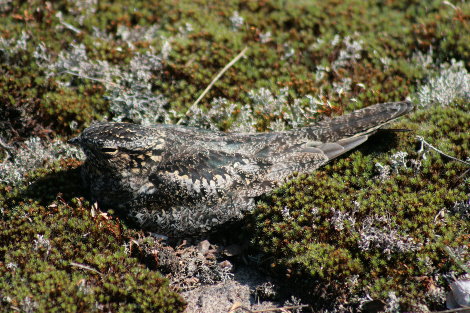
The Common Nighthawk nest first discovered at our Rock Ridge MAPS site is still active. This adult, probably a female, spent the morning of June 16th incubating eggs in the blistering sun and seemed to be catching up on some sleep as well. I called in Seabrooke to sweep by on a net check with her long lens for a photograph and it turned out very nicely as usual. The eggs have been incubated since at least June 2, which means that the chicks should hatch no later than June 21 if they haven’t already. We will be back for our third visit to the site around the middle of next week and will hopefully find two “nighjarlets” at the little rock outcropping. I will also be conducting two point count routes in rock barren habitat next week. Each route will be four kilometres long, which gives me a good opportunity to turn up some more of these fascinating birds.
Whip-poor-wills, waiting for the next full moon to approach, have been quiet of late but we did flush three individuals from Canoe Lake (1 bird) and Perth (2 birds) Rds on our pre-dawn drive to Rock Ridge on the 16th.
Nidiologicals (from Peck and James 1987 and Middleton 1998) Chipping Sparrow (Spizella passerina)
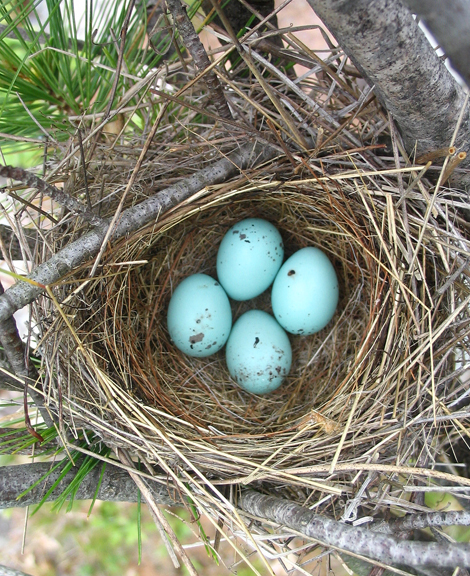
Habitat=open woodlands, parkland and treed fields Spring arrival=April-May Average nest height=0.9-2.4m Nest builder=female Average # of broods/season=2 (rarely 3) Average Egg Date=June 4-June 20 Area sensitive=no Average clutch size=4 Nest building period=~4 days Incubation period=10-11 days Microhabitat=high variable across geographic range; strong preference for conifers. Egg colour=sky blue (rarely white) with irregular streaks, blotches and spots mostly at larger end Incubation=female Parasitized by cowbirds=yes
Nest searching in the FBS study area has been generally productive, although we’ve been forced to reduce the amount of time for dedicated searching due to time constraints in June. I’ve been monitoring about forty nests in the last two weeks and have been pleased with success thus far in finding nests at a good rate when time is available. Yesterday in two hours, I was able to find active nests of Blue Jay, American Robin, Eastern Wood-Pewee, Baltimore Oriole and American Redstart. This post is an in-depth profile of Frontenac nesting species number three (only about 190 to go!).
The Chipping Sparrow is one of North America’s most abundant songbirds, a species that has benefited from the creation of suitable habitat by human settlement and infrastructure from Newfoundland to Alaska through Central America. Unlike most sparrows, the Chipping Sparrow prefers open woodlands and treed edges of waterways and fields. They seem to occur in higher densities in urban settings than undisturbed habitats. I recall my surprise in encountering an abundance of Chipping Sparrows in taiga habitats near the treeline in the Northwest Territories where Chipping Sparrows nested on the ground or slightly elevated in spruce saplings. Here in the Frontenac Arch, “chippers” are abundant in most areas where natural or man-made forest clearings occur. Our point counts are revealing a strong preference for mixed forest sites containing Eastern White Pine and/or juniper.
Chipping Sparrow nest contents (Derbyshire)
This Chipping Sparrow nest was discovered in Frontenac Provincial Park in early June within transitional habitat from young deciduous forest to mixed forest/rock barren. I was alerted to the presence of the nest by alarm calling adults. The nest was easily found at the outer end of a low pine bough, not terribly well hidden. The nest itself is a loosely formed cup consisting of dried grass with a more densely formed inner bowl of animal hair and fine plant fibers. The four eggs are a distinctive sky blue with irregular dark markings, mostly at the larger end. It was recently discovered that male Chipping Sparrows copulate with multiple females in neighboring territories (extra-pair copulations).
These last three shots visually describe the nest position and the habitat. It is unusual for a Chipping Sparrow to select such an exposed location for the nest as this particular one is clearly visible from the sides and especially from below. Not surprisingly, the preference of Chipping Sparrows for wooded edges has exposed them to high rates of brood parasitism by Brown-headed Cowbirds. Interestingly, of the forty nests (all species) I have discovered thus far, I have yet to find a single case of parasitism. This is, in part, due to the habitat where nests have been found, interior forest sites where cowbirds are rare. I have begun nest searching in a forest plot adjacent to open habitats and will be interested to observe any divergence in rates of parasitism.




 Frontenac Bird Studies