Birds at the feeders

Common Grackle (Quiscalus quiscula)

Common Grackles have been second only to Red-winged Blackbird in terms of abundance in the area of late. A dedicated group of about 20-40 individuals have been frequenting the feeders at the FBS “office”. This species has already begun nesting in the region and will be commonly encountered during the Frontenac Breeding Birds program in late spring through summer.

Purple Finch (Carpodacus purpureus)

Purple Finches were scarce during the past winter but have returned to the area en masse in the last month or so. Much like other northern finch species, populations of the Purple Finch are closely tied to seed crops and also outbreaks of budworm catterpillars in the north. Distribution and abundance maps from the Ontario Breeding Bird Atlas mark a strong association of this species to the Southern Shield region where high quantities of suitable habitat can be found (coniferous and open mixed-deciduous forest). Despite its more robust features, interspecific competition with the introduced House Finch (Carpodacus mexicanus) has significantly reduced population size of the Purple Finch.

Our first Rose-breasted Grosbeaks of the spring were recorded this morning and we’ve been fortunate in having two males join the finches and grackles at the feeders this afternoon.

Rose-breasted Grosbeak (Pheucticus ludovicianus)

Migration Update- April 28. 2009

piwa
Pine Warbler, Canoe Lake Road

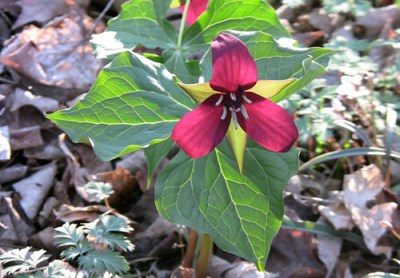
Migrants arrived in high numbers over the weekend! The recent warm front was brief but a “cooker” nonetheless, bringing an excellent variety of insectivorous migrants to southern Ontario. This mornings survey along Canoe Lake Road featured overcast skies, warm temperatures and a sharp increase in budding foliage. Emerging ground cover species including Dutchman’s Breeches, Bloodroot and Large-flowered Trillium have brightened up the forest floor and American Toads are suddenly the most vocal of amphibians in the area.  I also spent the 60 minutes of the survey entertaining an attendant mob of excited Black Flies, which was a less welcome change from recent days!

redtrillium
Large-flowered Trillium (red morph)

Semi-daily surveys of migrant birds along Canoe Lake Road have been very interesting to say the least and some patterns of habitat relation and orientation are beginning to emerge. Other than the usual icterid species (Red-winged Blackbird and Common Grackle), there were no particular species in great supply this morning. A total of fifteen new arrivals were tallied, which included eight newly arrived warbler species. Also new to the scene were singles of Rose-breasted Grosbeak and Eastern Towhee, both common breeders in the region. The next update on spring migration along Canoe Lake Road will be posted on April 30, 2009.

Results (“first of season” species in bold)

Canada Goose    5
Mallard    2
Ruffed Grouse    1
Common Loon    1
Red-shouldered Hawk    1
Mourning Dove    2
Belted Kingfisher    1
Yellow-bellied Sapsucker    4
Downy Woodpecker    1
Northern Flicker    4
Eastern Phoebe    3
Great Crested Flycatcher    2
Warbling Vireo    1

Blue Jay    4
American Crow    7
Black-capped Chickadee    8
Red-breasted Nuthatch    1
House Wren    3
Ruby-crowned Kinglet    3
American Robin    5
Brown Thrasher    2
European Starling    4
Orange-crowned Warbler    1
Yellow Warbler    3
Yellow-rumped Warbler    11
Black-throated Green Warbler    1
Pine Warbler    5
Black-and-white Warbler    2
Ovenbird
2
Common Yellowthroat    1
Eastern Towhee    1
Chipping Sparrow    4
Song Sparrow    3
Dark-eyed Junco    1
White-throated Sparrow    5
Rose-breasted Grosbeak    1
Red-winged Blackbird    26
Eastern Meadowlark    2
Rusty Blackbird    2
Common Grackle    14
Purple Finch    1
Pine Siskin    6
American Goldfinch    3

Spring Species Total=63
Average # Individuals per Census=144.6
Average # Species per Census=30